
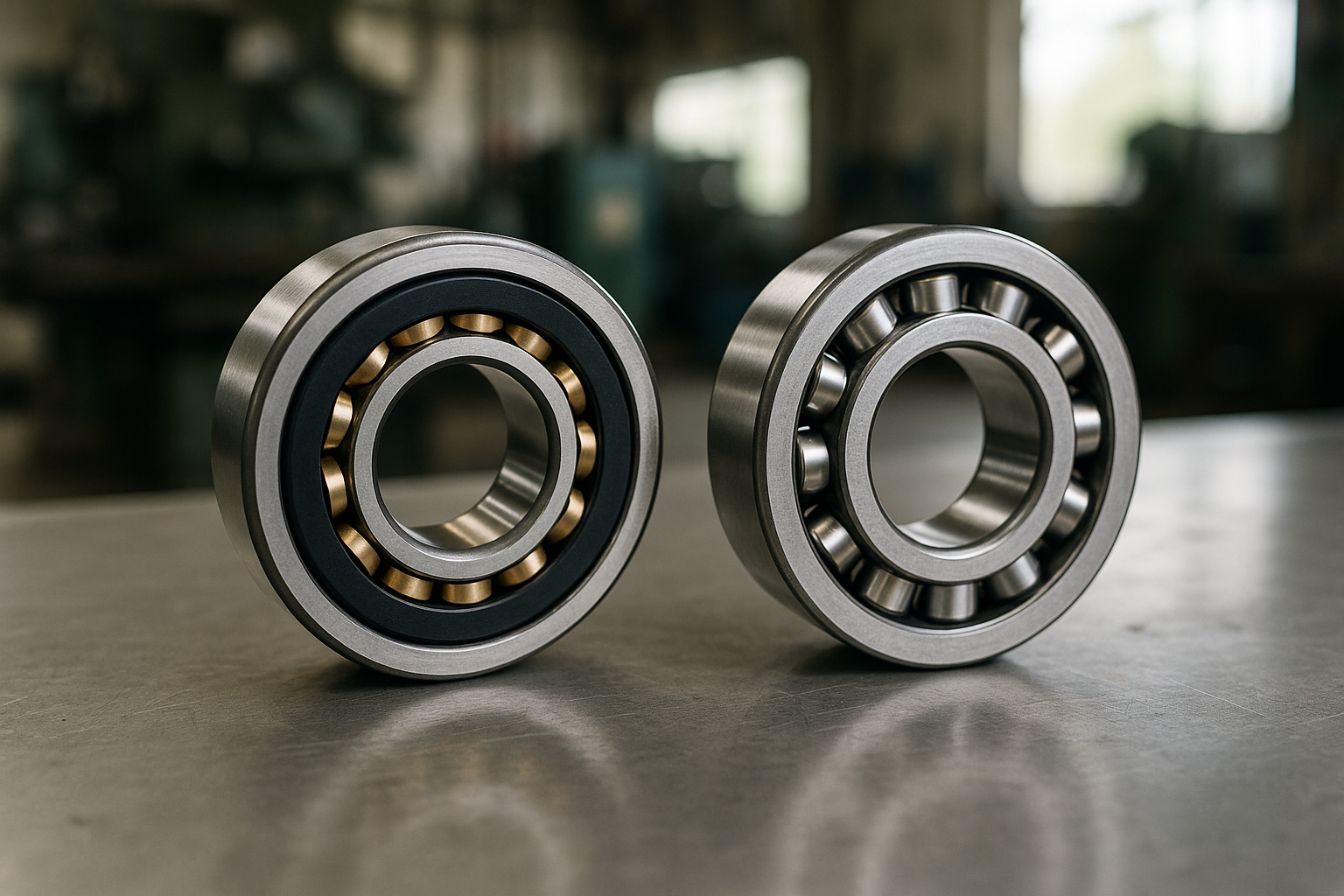
The question arrives at the counter several times a week, usually phrased as a complaint about the price. A customer has been quoted for SKF Explorer versus standard on a replacement they have bought a dozen times, notices the premium sitting somewhere between forty and sixty percent, and wants to know what exactly they are getting for it. The honest answer depends entirely on what the bearing is doing, and a distributor who gives the same answer to every customer — either “always worth it” or “not really” — is wrong roughly half the time.
What the premium actually buys
Explorer is not a marketing tier applied to the same bearing. The steel is cleaner, with fewer of the non-metallic inclusions that initiate subsurface fatigue cracks; the heat treatment produces a more consistent microstructure; the dimensional tolerances and surface finishes are held tighter. The practical results are a thirty to fifty percent longer service life under comparable conditions, fifteen to twenty-five percent more dynamic load capacity at the same envelope, and a higher usable speed before heat generation becomes the limiting factor. These are measurable engineering differences, not claims, which is why the conversation should be about whether your application can convert them into value.
The five situations where the answer is yes
Continuous duty, where service life converts directly into fewer interventions per year. Loading close to the standard rating, where the extra capacity moves the bearing away from its limit rather than merely extending a comfortable margin. Sustained temperatures above roughly a hundred degrees, where the material quality shows. Positions where replacement is expensive or disruptive — awkward access, a crane, a line stop. And anywhere unplanned failure carries a cost that dwarfs the component. If two or more of these apply, the premium pays back on total cost of ownership and the conversation is straightforward.
The situations where recommending it damages your credibility
Intermittent duty, comfortable loading, ambient temperature, easy access, tolerable consequences of failure. On those positions the standard specification will very likely outlast the equipment it is fitted to, and the premium buys nothing the customer will ever experience. Saying so costs a little margin on that line and buys a great deal of trust, which is then available when you tell the same customer that a different position genuinely does need the upgrade. Distributors who recommend the premium tier universally get treated as salespeople; the ones who say “standard is fine here” get treated as advisors, and advisors get asked first.
Running the comparison so the customer can check it
Put the purchase price difference on one side. On the other, put the expected number of replacements avoided over a defined period, multiplied by labour hours, plus the downtime cost per replacement, plus consumables — seals, mounting hardware — that go with each intervention. On a continuously running position with a four-hour stop cost, the arithmetic usually resolves at twenty to forty percent in favour of Explorer. On a two-shift position with easy access it resolves the other way. Showing the customer the working rather than the conclusion is what makes the recommendation credible, and it also means they can rerun it themselves when conditions change.
Cross-brand equivalence keeps everyone honest
FAG Generation C occupies the same tier with comparable performance, and TIMKEN maintains its own premium range. For customers open to multi-brand supply, qualifying equivalents across all three preserves both pricing flexibility and availability when one manufacturer’s lead time stretches. The differences between the Schaeffler-owned brands are worth understanding properly if you are making these substitutions routinely, and we set them out in our comparison of FAG deep groove against INA. Where the customer will not move brand, the pricing structure behind the two biggest names is covered in our note on SKF versus TIMKEN aftermarket pricing.
Stocking it without over-committing
Premium specifications across the thirty to fifty most common industrial designations cover the great majority of genuine upgrade demand, with standard grades carrying the volume beneath them. That two-tier pattern across the deep groove ball bearing and spherical roller categories matches how European aftermarket demand actually distributes, and it avoids tying up capital in premium variants of specifications nobody upgrades. Reading the suffixes correctly matters when customers arrive with an existing part number and want the equivalent, which our suffix cheat sheet covers.
The version to give a customer in thirty seconds
Explorer earns its price where the bearing runs continuously, works near its limit, gets hot, is hard to reach, or stops something expensive when it fails. Elsewhere the standard grade is the right specification and the money is better spent on the positions that need it. Ask four questions about the duty before quoting, and the answer picks itself — which is a more useful conversation than defending a price, and a considerably more durable basis for the account.
Working through premium tier decisions with your customers? Our team supports European distributors on specification strategy and total cost of ownership analysis. Book a free consultation.