
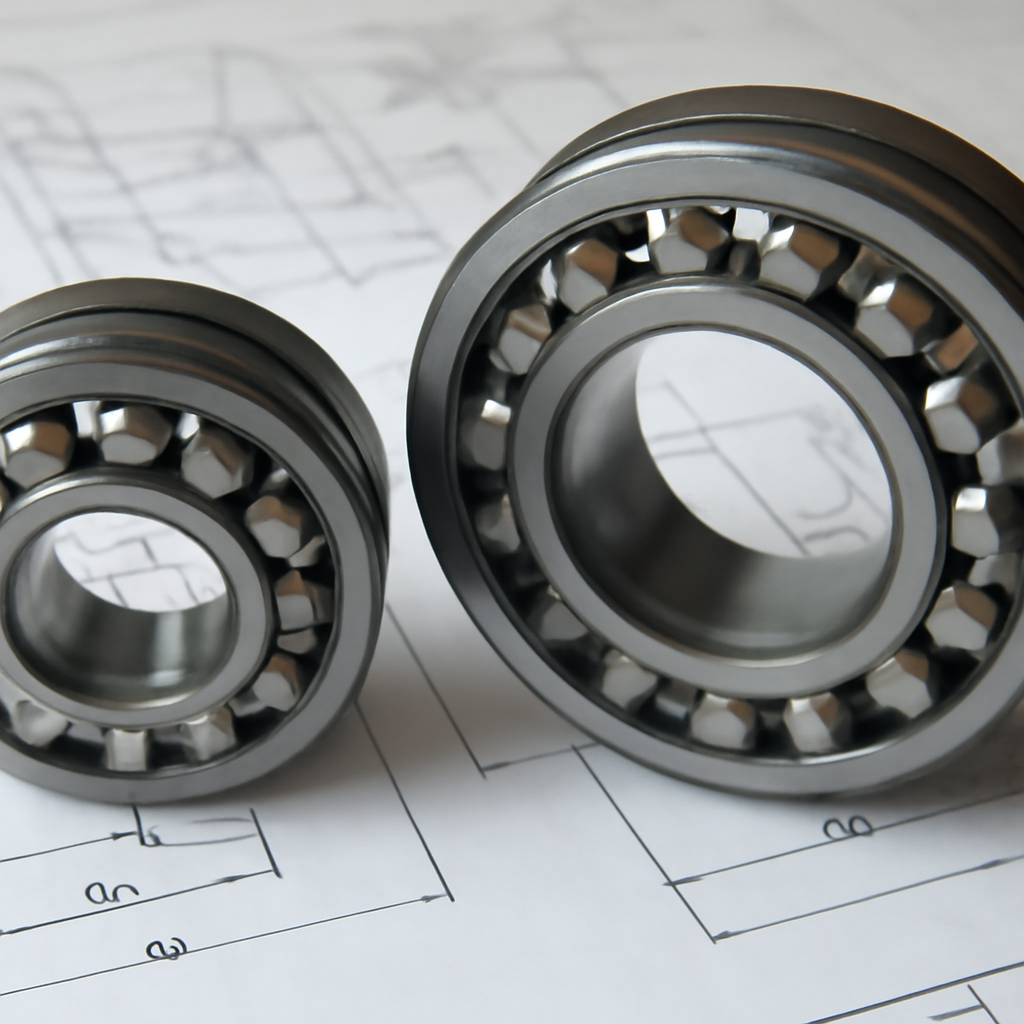
The 22215 versus 22216 spherical roller bearing decision is a variation on a theme that every distributor rep working with cement plants, crushers and mining equipment has run through more times than they can count. Both are workhorse double-row bearings, both tolerate the kind of misalignment that real industrial shafts actually deliver, and both are specified for heavy dynamic loads. The five-millimetre difference in bore looks trivial written on a page. In service it moves the shaft speed limit, the basic dynamic load rating and the cage design options far enough that picking the wrong one shows up as a warranty conversation eighteen months later, usually about a bearing that was never wrong so much as wrongly matched to its duty cycle.
Where the two sit in the range
The dimensional facts come first because everything downstream depends on them. The 22215 runs a 75 millimetre bore, 130 millimetre outside diameter and 31 millimetre width. The 22216 steps up to 80 millimetre bore, 140 millimetre outside diameter and 33 millimetre width. Basic dynamic load rating for the 22216 sits roughly 14 percent above the 22215, which is the number that draws people towards the larger bearing by reflex. Running against it, the permissible shaft speed for the 22215 sits about 7 percent above the 22216, because the roller pitch diameter is smaller and centrifugal loading on the roller set climbs with it. Those two curves cross somewhere in every application, and finding the crossing point is the whole exercise.
Cases where the 22215 quietly outperforms
Vibrating screens turning above 900 RPM with moderate stroke amplitude sit squarely in the 22215 sweet spot, and this is the application where reflexive over-sizing does the most damage. The speed margin matters more here than the extra 14 percent of load capacity, because the screen is not load-limited — it is fatigue-limited by the accelerations it imposes on its own bearings every revolution. Cement mill separator bearings on the smaller shaft diameters land in the same category for the same reason. High-speed centrifugal fans on crushing plant exhaust systems benefit as well, where the marginally lower vibration signature of the smaller roller pitch diameter keeps the assembly further from the resonance band the fan housing was never designed to handle.
Where the 22216 is clearly the right answer
Primary crushers running 400 to 700 RPM with shock loading from oversize rock entering the intake need every bit of the 22216’s additional load capacity, because the design case is not the average load at all — it is the peak that arrives without warning when something the size of a car door goes down the chute. Rolling mill drive shafts turning below 300 RPM under steady heavy load are unambiguously larger-bearing territory, where speed simply is not a constraint worth trading anything for. Large diameter conveyor drive pulleys below 250 RPM sit in the same place, and the extra duty cycle margin of the 22216 is what absorbs the belt tension excursions that occur every time the conveyor is started under a full load of material.
The cage design decision
Both designations ship with a choice of CA pressed and machined steel, MB brass and TN glass-fibre reinforced polyamide cages, and the choice matters more than most specifications acknowledge. For cement, quarry and mining service the CA steel cage is almost always correct, because the ambient temperatures, the contamination load and the shock duty are exactly what it was designed to survive. In textile and food-processing plants where running noise is a genuine constraint on the working environment, the polyamide cage wins clearly and its temperature ceiling is rarely approached. The brass cage sits between the two on both cost and capability, and it earns its place where high temperature and high shock arrive together — which is a narrower set of applications than the number of brass cages actually sold would suggest.
Housing seal compatibility
Both bearings are open by default, which means the sealing arrangement is a separate specification and not a detail the bearing choice takes care of for you. CORTECO and DICHTOMATIK housing seals in the matching sizes cover the SNL and SAF plummer block housings that both designations drop into. Choose the elastomer against the environment rather than against habit: FKM lip seals where elevated temperature or caustic washdown is present, NBR where the exposure is ordinary industrial dust and moisture. Getting this backwards is more common than it should be, and a failed seal will take out a correctly-specified rolling-element bearing just as thoroughly as a wrong bearing choice would have.
The fit is part of the specification
A spherical roller bearing sized correctly and fitted incorrectly will not deliver its rated life, and this is where a surprising share of premature failures on both designations originate. The tapered-bore variants mounted on adapter sleeves are set by drive-up and radial clearance reduction, not by a shaft tolerance, and they demand a feeler-gauge check on the unloaded row before and after mounting. The cylindrical-bore versions live and die by the shaft and housing tolerance grades taken from ISO 286. Under heavy rotating loads the inner ring wants an interference fit, and an inner ring that creeps on its seat will polish the shaft, generate heat and fail in a way that looks exactly like an under-sized bearing — which is how a perfectly adequate 22215 gets blamed and replaced with a 22216 that then fails identically.
Cross-brand equivalency and pricing
Both designations catalogue under identical ISO reference numbers across SKF, TIMKEN, FAG and NSK, which makes the substitution mechanically safe and the negotiation genuinely competitive. European aftermarket pricing typically spreads within 8 to 15 percent across the four, and where a customer has no brand mandate that spread is real money on a stocking order. Above the standard ranges, the SKF Explorer and TIMKEN premium classes deliver somewhere around 30 to 45 percent improvement in calculated L10 life for a 25 to 40 percent price premium — which pays for itself only where the downtime cost of an unplanned change-out is high, and does not where the bearing is accessible and the plant has a spare.
The procurement stocking pattern
The stocking logic follows the failure frequency rather than the catalogue. A mid-size industrial distributor is best served holding the 22215 with a CA steel cage from two brands — typically SKF and FAG, so a customer with a brand preference is still covered — because that is the designation that moves. Matching CORTECO plummer block seals in the 75x100x10 size belong on the same shelf, since a bearing sold without its seal is a callback waiting to happen. The 22216 deserves shelf space too, but in smaller quantity and against the confirmed heavy-load accounts you already know by name, because it is the designation customers plan for rather than the one they need in a hurry.
Three questions before specifying
Ask about the actual shaft speed range, including start-up and run-down, rather than the nameplate figure that everyone quotes. Ask about the peak load during upset conditions — the stone entering the crusher intake, the conveyor started under full load — because that is the load the bearing is really being asked to survive. Ask what the housing misalignment actually measures, not what the drawing assumes it to be, because a spherical roller bearing is being specified precisely because somebody expected misalignment. Three honest answers resolve the 22215 versus 22216 question cleanly, and they resolve it more often in favour of the smaller bearing than most buyers expect.
22215 and 22216 spherical roller bearings available on Eurobearing
The 22215 and 22216 sizes covered in this piece ship from stock in both SKF and FAG variants across common clearance codes and cage designs. Below are the direct product references for the specifications most European aftermarket customers order.
- 22215 SKF variants: 22215 EK/C3 · 22215 E/C3 · 22215 EK/C4 · 22215 E/C4
- 22215 FAG variants: 22215-K-M-C3 · 22215-M-C3 · 22215-C4
- 22216 SKF variants: 22216 EK/C3 · 22216 EK/C4 · 22216 E/C5
- 22216 FAG variants: 22216-K-M-C3 · 22216-M-C3 · 22216-C4
For the CA steel cage variants preferred on cement and quarry applications, filter the SKF EK designations or the FAG K-M designations. For polyamide TN cage variants used on food-processing and textile applications, filter for the TVH suffix on FAG or contact our team for the specific SKU.
Related coverage on Eurobearing
- 22212 vs 22213 Spherical Roller: Field Cases
- Bearing Failure Modes
- The Four Fits Every Designer Re-Derives
- Bearing Installation Mistakes
- CORTECO Seal in a Warped Housing Bore
Need help sizing a 22215 or 22216? Our team supports European engineers with load, speed and fit analysis. Book a free consultation.