
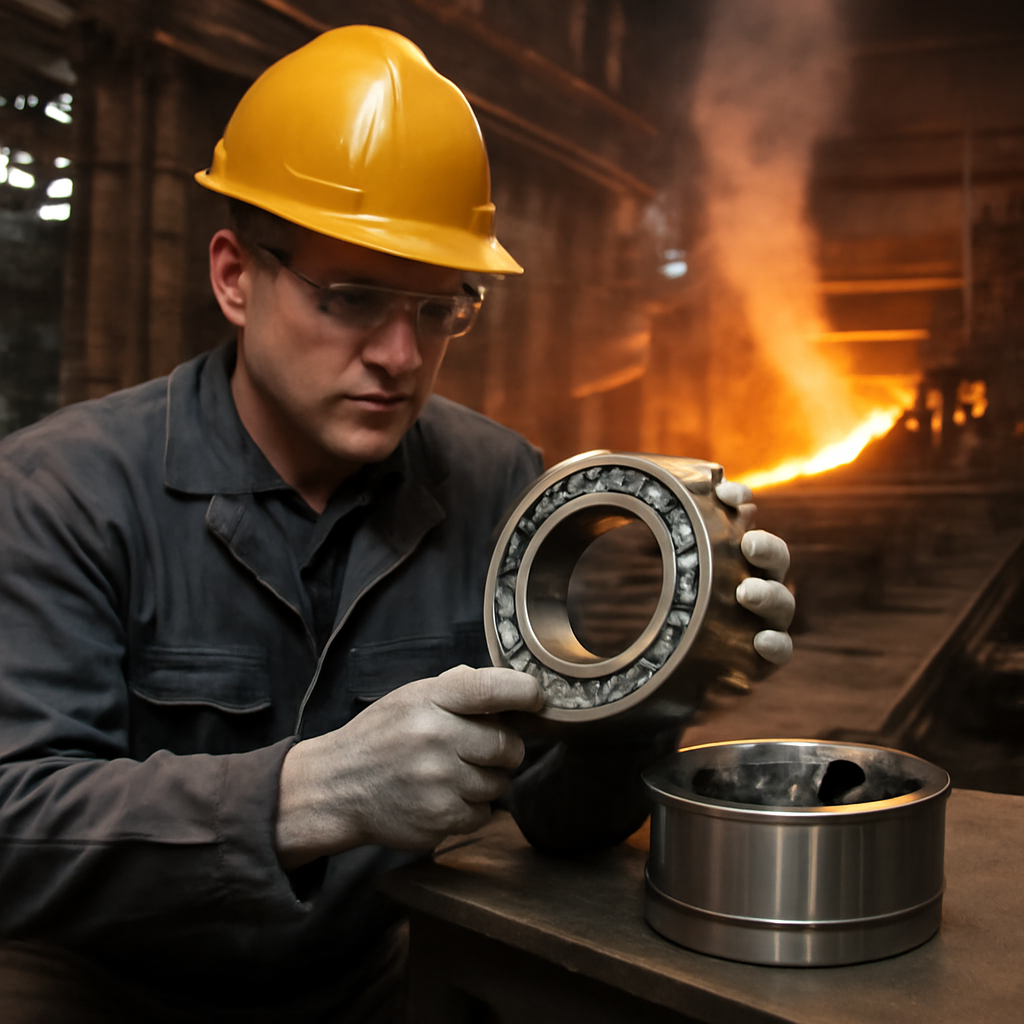
Steel mill bearings face some of the most demanding industrial duty profiles: extreme temperatures, heavy shock loads, water exposure, dust and scale contamination, continuous duty cycles, and replacement costs measured in days of mill downtime. Specifying the right bearing for steel mill applications is a high-stakes engineering decision that combines material science, application engineering, lubrication strategy, and maintenance planning. This guide walks through the practical bearing selection framework for European steel mill operations.
1. The steel mill bearing environment
Steel mill bearings operate in environments characterised by:
- Extreme temperatures: hot strip mill back-up roll bearings face raceway temperatures of 80-150 °C; rolls in close proximity to molten steel face higher.
- Heavy shock loads: rolling forces, bite-in shocks, threading impacts.
- Water exposure: cooling water sprays directly contact bearing housings.
- Scale and dust contamination: continuous airborne particle exposure.
- Continuous duty cycles: 24/7 operation with limited maintenance windows.
- Heavy access constraints: replacement requires significant mill downtime.
2. The major bearing positions in a hot strip mill
2.1 Back-up roll bearings
Four-row tapered roller bearings on the back-up rolls supporting the work rolls. Diameter typically 600-1500 mm. Extreme load capacity required. TIMKEN four-row tapered, SKF spherical roller, FAG tapered are the established options.
2.2 Work roll bearings
Smaller diameter, higher speed than back-up roll bearings. Replaceable during roll changes (relatively short maintenance windows).
2.3 Pinch roll and tension reel bearings
Continuous duty, lower load but high reliability requirement.
2.4 Coiler bearings
Heavy radial load with axial position requirements. Tapered roller or spherical roller standard.
2.5 Mill train auxiliary bearings
Numerous bearings on roller tables, scale breakers, descalers, side guides, etc. Standard industrial heavy-duty configurations.
3. The selection criteria
3.1 Load capacity
Calculate the bearing load from the rolling forces and the bearing arrangement geometry. Apply safety factors for shock loading (typically 1.5-2.0 above static calculations).
3.2 Speed and life
Verify the bearing speed factor against the manufacturer limits. Calculate expected L10 life from the load profile.
3.3 Temperature envelope
Identify the continuous and peak temperatures at the bearing position. Specify clearance class (C3 or C4 standard for hot mill applications) and stabilised heat treatment (S1 or S2).
3.4 Mounting and accessibility
The bearing must be mountable and replaceable within the available access. Adapter sleeve mounting is common for large back-up roll bearings.
3.5 Lubrication system compatibility
Most steel mill applications use circulating oil or automatic grease lubrication systems. The bearing seals and design must accommodate the lubrication strategy.
4. Material specifications
- Standard 100Cr6 (52100): adequate for moderate-temperature applications.
- Stabilised 100Cr6: for continuous operation above 120 °C.
- M50 tool steel: very high temperature, premium pricing.
- Specialty cleanliness grades: enhanced fatigue life for heavy duty applications.
5. Cage selection
Steel mill bearings face shock loading that destroys polyamide cages. Brass cages are the standard choice:
- Solid brass (M, MA designations): heavy industrial duty.
- Steel cages: cost-effective for moderate applications.
- Polyamide cages: NOT recommended for steel mill heavy duty.
6. Sealing strategy
Steel mill bearings typically use specialty heavy-duty seal arrangements:
- Triple-lip contact seals for grease retention and water exclusion.
- Labyrinth seals as outer barrier against water and scale.
- Pressurised housing with positive air pressure (where feasible) to keep contaminants out.
- Standard 2RS contact seals are typically inadequate for severe mill applications.
7. Lubrication strategy
7.1 Grease lubrication
Standard for back-up roll bearings and many auxiliary positions. Calcium sulphonate complex grease with EP additives. Frequent re-lubrication via automatic systems. SKF LGWA 2, Mobil SHC 220 Series, Klüber STABURAGS.
7.2 Oil circulation
Standard for high-speed and high-temperature positions. Mineral or synthetic high-temperature oils. Continuous filtration and cooling.
7.3 Oil mist/oil-air
Specialty for some high-speed applications. Less common in modern mills.
8. The major suppliers for steel mill bearings
- TIMKEN: traditional leader in four-row tapered roller bearings for back-up roll applications.
- SKF: comprehensive steel mill bearing range including specialty spherical roller for heavy duty.
- FAG (Schaeffler): European leader with comprehensive heavy industrial range.
- NSK: Japanese alternative with strong mill bearing portfolio.
- NTN: similar to NSK, with specific strengths in certain bearing types.
9. Cross-reference considerations
Steel mill bearings cross-reference cleanly on dimensional standards but specialty geometry (internal design, cage construction, surface treatment) often differs between manufacturers. For critical positions, verify engineering equivalence with manufacturer application engineering before substitution.
10. Procurement strategy for steel mill operations
- Multi-supplier qualification on critical SKUs for supply resilience.
- Framework agreements with provisions for delivery during mill downtime windows.
- Spare inventory depth on critical bearing positions.
- Engineering relationships with manufacturer application support.
- Condition monitoring deployment on critical positions for predictive replacement timing.
11. The maintenance discipline that pays back
- Detailed asset master data with bearing specifications for each position.
- Vibration monitoring trends on critical bearings.
- Temperature monitoring with alert thresholds.
- Oil/grease sampling and analysis on circulating systems.
- Documented failure investigation feeding reliability improvement.
12. The cost-benefit math for premium specifications
Steel mill bearing failures cost typically €50,000-500,000 per event in unplanned downtime. Premium bearing specifications (TIMKEN SPEXX, SKF Explorer, FAG X-life) cost typically 15-30% above standard equivalents. The cost-benefit math overwhelmingly favours premium specifications on critical mill positions where reliability has direct production cost impact.
13. Smart bearing opportunity
Steel mill bearings are natural candidates for smart bearing technology: high reliability requirements, expensive replacements, continuous duty enabling condition monitoring value. SKF Insight, Schaeffler smart bearing platforms qualify for critical mill positions. Industry adoption is in early commercial deployment with measurable operational benefits.
14. The 2026 strategic context for steel mill procurement
Steel mill bearing procurement in 2026 operates in the broader context of bearing industry consolidation (NSK + NTN), SKF restructuring, Schaeffler capacity expansion, and raw material cost pressure. Multi-supplier qualification, framework agreement renegotiation, smart bearing platform qualification, and master data discipline apply to steel mill operations as much as broader industrial procurement.
Conclusion
Steel mill bearing selection is one of the highest-stakes specification decisions in heavy industrial procurement. The combination of extreme operating conditions, expensive replacements, and direct production cost impact rewards engineering discipline, multi-supplier qualification, and premium specifications on critical positions. European steel mill operations following the disciplined selection framework systematically deliver better operational performance than operations defaulting to lowest-cost specifications.
Related guides on Eurobearing
- TIMKEN Tapered Roller Heavy Industry
- Spherical Roller Bearings
- High-Temperature Bearings Selection
- Bearing Cages Steel Polyamide Brass
- High-Temperature Lubrication Best Practices
Need help with bearing selection? Our team supports you with cross-references and lead-times.