
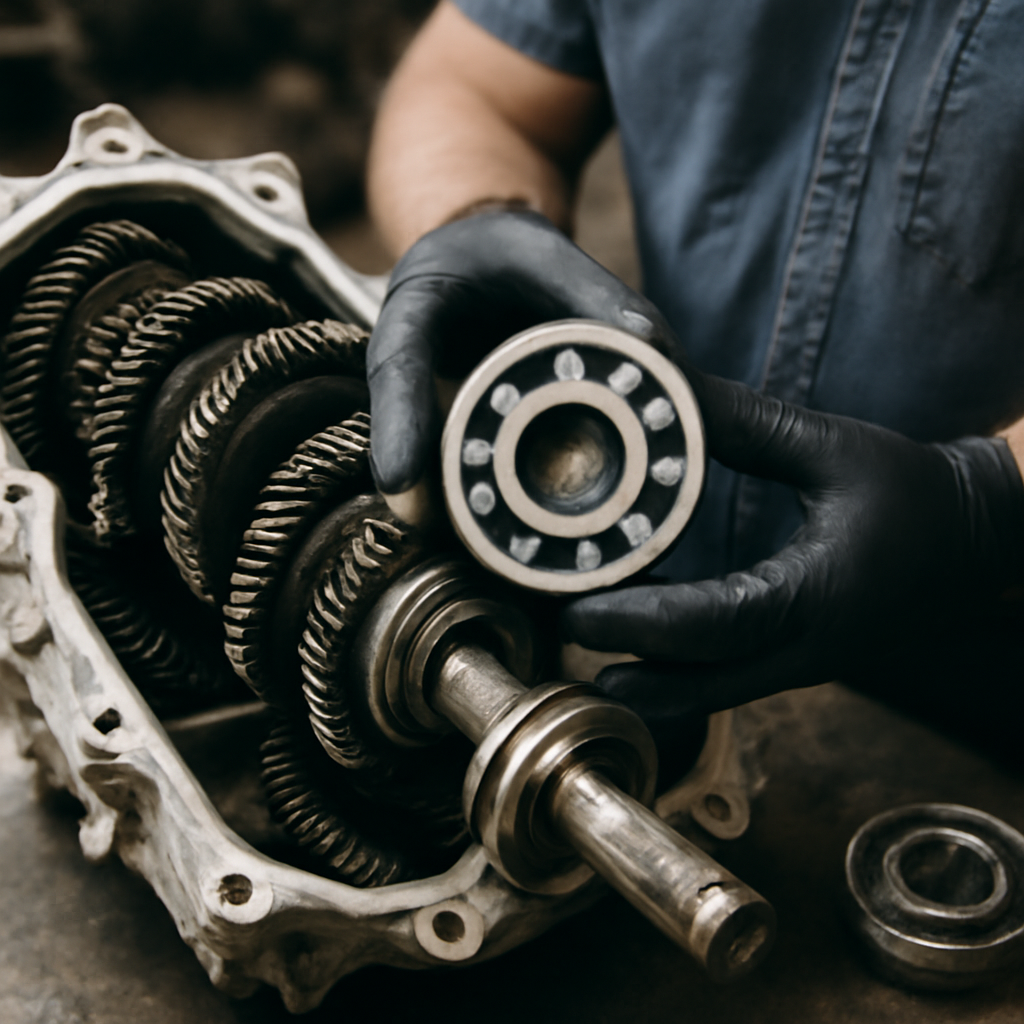
Every gearbox rebuild shop in Europe has a small pile of 6208 bearings sitting on the parts shelf. Not because they are the most sold — the 6205 outsells the 6208 by a factor of three in aftermarket units — but because when a 6208 fails, it usually fails in a specific place with a specific pattern, and the shop wants to be ready. This piece explains why the 6208 shows up so consistently in gearbox teardowns, what the typical failure signature looks like, and how to spec the replacement.
Where the 6208 actually sits in industrial equipment
The 6208 is a 40 millimetre bore, 80 millimetre outside diameter, 18 millimetre width deep groove ball bearing. The dimensions put it at the top end of the 6200 series, and the size matches the input shaft on a large family of European industrial gear reducers — Bonfiglioli, Nord, SEW and dozens of smaller OEMs use 6208 as the standard input shaft bearing on their 2 to 5 kilowatt worm and helical reducer ranges. Because these reducers ship in industrial applications everywhere — food processing, packaging, materials handling, conveyor drives — the 6208 becomes a de facto standard part.
Why the 6208 fails in gearboxes more than expected
The failure rate on 6208 bearings in industrial gearboxes is higher than the geometry would suggest. Three reasons combine. First: the input shaft position sees the driving load path directly, without the load damping that occurs on output shaft bearings. Second: the 6208 sits close to the motor coupling, exposing it to any residual misalignment between motor and reducer. Third: the compact reducer housings often have limited grease reservoir near the 6208 seat, which shortens the interval between lubrication maintenance events. The rolling-element bearing life calculation is theoretically clean but real installations violate the assumptions.
The three failure signatures on a teardown
Teardown data from three European reducer rebuild shops shows three dominant failure patterns on the 6208. First: false brinelling from motor coupling vibration — small oval indentations at ball spacing on the inner race, visible under magnification. Second: grease starvation from inadequate re-lubrication schedule — cage discolouration, dry rolling contact zones, elevated running temperature reports. Third: contamination ingress from failed shaft seals — abrasive wear on the rolling elements, brownish grease. Learning to distinguish these three at a glance saves customer conversation time and helps quote the right root-cause fix.
Spec choices that actually matter for the replacement
For most industrial reducer input shaft applications, the pragmatic 6208 specification is 6208-2RS1/C3 from SKF. The 2RS1 seal handles industrial contamination well, and the C3 clearance code fits the typical gearbox operating temperature range. Do not spec the standard 6208 with the default CN clearance for gearbox use — it runs too tight at operating temperature and shortens L10 life meaningfully. On heavy-duty industrial applications where L10 life is critical, the FAG 6208.2RSR.C3 delivers essentially equivalent performance at slightly better European aftermarket pricing.
The seal-and-grease upgrade path
For reducers running in dusty environments — cement dust, textile fibre, wood processing — the standard 2RS seal is marginal and shortens the maintenance interval. The upgrade is a 6208 with an integrated FKM seal or with an external CORTECO shaft seal in series with the standard 2RS. Grease upgrade to lithium complex with base oil viscosity around 220 cSt at 40°C handles the higher operating temperatures typical of enclosed reducer housings. This combination extends the maintenance interval from 12 months to 24 months in most applications.
Cross-brand equivalency and the aftermarket price gap
The 6208 is essentially interchangeable across major manufacturers. SKF 6208, FAG 6208, TIMKEN 208K, Koyo 6208, NSK 6208 all have identical geometry and functionally equivalent load ratings. Price differentials at European aftermarket list run 5 to 15 percent between brands, with SKF and FAG typically at the top of the range. For most reducer rebuild applications, spec by the customer’s brand preference rather than by absolute price — the annual maintenance cost impact of choosing the second-cheapest brand is negligible against the labour cost of the rebuild itself.
When to upgrade to premium range and when not
For standard industrial reducers running below 60 percent rated torque continuous duty, the standard 6208 is the correct answer. For heavy-duty reducers running above 75 percent continuous, the SKF Explorer 6208 or TIMKEN SPEXX 208K delivers 30 to 40 percent L10 life improvement and pays back the premium quickly. The mistake maintenance procurement teams make is standardising on Explorer for uniformity across all applications — the light-duty reducers do not need it and the extra cost adds up across a fleet of forty or fifty reducers.
What buyers should keep on the shelf
The practical stocking pattern for a mid-size industrial distributor is 6208-2RS1/C3 in both SKF and FAG variants, one shelf of each covering the top two customer brand preferences. Add a small stock of matching CORTECO shaft seals in 40x62x7 and 40x72x7 sizes to serve the seal-plus-bearing combined replacement. Skip the premium ranges from stock — order on customer request rather than tying up working capital. This pattern serves roughly 90 percent of reducer aftermarket demand without holding excess inventory.
6208 bearings available on Eurobearing
Below are the direct product references for the 6208 sizes covered in this article — the sealed and shielded variants that dominate European gearbox aftermarket demand.
- 6208 SKF sealed: 6208 (40x80x18) · E2.6208-2Z/C3 · 6208 TN9/C4
- 6208 FAG variants: S6208 stainless · S6208-2RSR sealed
- 6208 stainless variants: 6208-2RS1 stainless
- 6208 flanged/NR variants: 6208-2RS1NR · 6208 NR
Related coverage on Eurobearing
- Comparing the Top 6 Bearing Brands
- How to Read FAG Bearing Designations
- Bearing Cages: Steel vs Polyamide vs Brass Trade-offs
- Bearing Failure Modes: A Visual Identification Guide
- How to Inspect a Bearing After 24 Months of Service
Need help specifying 6208 replacement for a gearbox rebuild? Our technical team supports European reducer aftermarket with SKU-by-SKU selection and cross-brand equivalency analysis. Book a free consultation.