
The call came in at ten past seven on a Monday: a packaging line near Lyon was stopped, the fitter was holding a failed bearing stamped NSK 6306DDUC3, the stores only stocked SKF, and he wanted the bearing cross-reference logic explained in one sentence so he could decide whether to fit what was on the shelf. The honest answer took longer than one sentence, and that is the point of this article. A cross-reference table, whether printed or generated by software, compares designations, but the decision you are really making is whether two physical parts behave the same in a specific housing, on a specific shaft, at a specific temperature. Most of the time they do, because the industry built a shared dimensional language decades ago. Some of the time they do not, and the differences hide in suffix letters, clearance groups, cage materials and internal geometry that no envelope drawing shows. Knowing which is which separates a five-minute swap from a repeat failure three weeks later.
What ISO 15 actually standardises
The foundation of every interchange is ISO 15, which fixes the boundary dimensions of radial rolling bearings: bore diameter d, outside diameter D, width B and the minimum chamfer dimension r. The standard organises these into diameter series and width series, so that a prefix such as 62 or 63 places a bearing in a defined dimensional family before the bore code is even read. From bore code 04 upward the bore is the code multiplied by five, which is why a 6208 has a 40 mm bore, while codes 00, 01, 02 and 03 stand for 10, 12, 15 and 17 mm. Because SKF, FAG, NSK, Koyo, SNR and RHP all build to this plan, a 6208 from any of them measures 40 by 80 by 18 mm and fits the same shaft seat and housing bore. That is a genuine guarantee, and it answers the most common reason for a cross-reference query. What ISO 15 does not cover is anything inside the envelope: raceway curvature, ball count and diameter, cage design, sealing and heat treatment are left to each manufacturer.
What the base number promises and what it leaves open
The base number, meaning the series digits plus the bore code, is the part of the designation that transfers cleanly between brands. A 6205 is a single-row deep groove ball bearing of 25 by 52 by 15 mm whoever makes it, and a 22216 is a spherical roller bearing of 80 by 140 by 33 mm in every catalogue that lists one. For deep groove ball bearings the base number also implies a broadly similar load rating, but similar is not identical. Dynamic load ratings for the same size can differ by ten per cent or more between brands, and between product generations of the same brand, because ball size, raceway finish and steel cleanliness are not standardised. If the application was sized with little margin, swapping to a lower-rated equivalent quietly shortens calculated life, since life scales with the cube of the load ratio for ball bearings. The base number therefore tells you the part will fit; it does not tell you the part will last as long, and it says nothing about everything written after it.
Seals, shields and a suffix grammar that changes by brand
Closures are where counter staff make the most mistakes, because every manufacturer spells them differently. SKF writes shields on both sides as 2Z and contact seals as 2RS1 or 2RSH, with 2RZ for non-contact seals and 2RSL for low-friction contact seals. FAG uses 2ZR for shields and 2RSR for contact seals, NSK uses ZZ, DDU and VV, and Koyo writes ZZ and 2RS. The trap is that the letters do not map one to one on function. A non-contact seal from one brand and a full contact seal from another may both be sold as the sealed version, yet they differ sharply in frictional torque, temperature rise and resistance to fine dust and water spray. Our fitter’s DDU is a contact seal, so the sensible SKF equivalent is a 2RSH rather than a 2RZ, even though both close the bearing. If you need the full alphabet for a given brand, the SKF suffix cheat sheet and the FAG designation decoder are worth keeping open beside whatever cross-reference tool you use.
Clearance, cage and heat stabilisation: the quiet divergences
Three suffix families change behaviour without changing the outline. Radial internal clearance is grouped under ISO 5753-1 as C2, CN, C3, C4 and C5, and it is the closest thing to a universal suffix, but the notation still varies: SKF writes /C3, FAG appends C3 after a hyphen or a dot, NSK adds C3 directly to the end, and CN is normally not printed at all. Dropping the C3 during a swap is the most common way to turn a healthy electric motor into a hot one. Cages are less standardised. SKF uses J for pressed steel, M for machined brass and TN9 for glass-fibre reinforced polyamide, FAG uses TVH or TVP for polyamide and M or MB for brass, and the default cage for a given size can differ between brands. A polyamide cage substituted into a hot application, or one with aggressive lubricant additives, ages faster than the brass it replaced. Heat stabilisation, marked S0, S1 and S2 for roughly 150, 200 and 250 degrees Celsius, matters in kilns, dryers and ovens, where an unstabilised ring grows and loses its fit.
Precision classes and internal design generations
Tolerance class is a further invisible variable. Standard bearings are made to normal tolerances under ISO 492, and tighter classes are designated P6, P5 and P4 by most European and Japanese makers, sometimes combined with the clearance code so that P63 means class 6 tolerances with C3 clearance. A cross-reference that drops a P5 on a spindle or a printing cylinder will fit perfectly and run noticeably worse. Internal design generations are subtler still. The letter E after a spherical or cylindrical roller bearing denotes a reinforced, higher-capacity design at SKF, while FAG uses E1 and NSK its own EA and CA families, and these carry different roller sets and cage concepts inside an identical boundary. Needle roller bearings, the core of the INA range, follow their own dimensional standards and designations such as HK2016, which encode shaft diameter and width directly. Angular contact bearings are the sharpest case: contact angle and universal matching codes are written differently by each brand, so a matched pair from one maker is not automatically equivalent to another maker’s pair.
Tapered roller bearings: metric series against imperial cups and cones
Tapered roller bearings deserve their own rules because they come apart. Metric single-row sets such as the 30206 or 32208 follow ISO 355 boundary dimensions and are normally bought and fitted as a complete assembly. Mixing a cone from one manufacturer with a cup from another is something workshops sometimes get away with, but roller profile, cup angle tolerance and the stand-out between cone and cup faces are not guaranteed to match, which upsets the endplay you set. Imperial series work differently. The inch system, built around part numbers that Timken established and other makers adopted, identifies the cone and the cup separately, so LM11949 is a cone and LM11910 is its cup, and each half is sold as an individual item. That makes cup and cone combinations deliberate and well documented, which is one reason the LM range has stayed a workshop staple. In both systems, buying from the tapered roller bearing range as a matched cup and cone remains the cleanest route.
A workable interchange routine at the parts counter
In practice a reliable cross-reference follows a fixed order. First confirm the base number and measure the envelope if the marking is worn, because ISO 15 makes the dimensions the safest anchor. Second, translate the closure by function rather than by letters: shield, non-contact seal or contact seal. Third, carry the clearance group across explicitly and write it on the pick ticket, since it is the suffix most often lost. Fourth, check cage material and heat stabilisation against operating temperature and lubricant. Fifth, flag any precision class, matched-pair code or internal design letter and refer those to someone who can read the application rather than the table. Cross-reference software speeds up the first steps and is good at catching the obvious translations, but it cannot know that the motor runs on an inverter, that the gearbox oil is unusually hot, or that the previous bearing was an upgraded design specified after a failure. A thirty-second question to the customer about the duty costs far less than the downtime of getting it wrong.
Back to the fitter near Lyon. The SKF part he fitted was a 6306-2RSH/C3: the same envelope under ISO 15, a contact seal to match the function of the DDU, and the C3 clearance carried across rather than lost. It was the right choice not because a table said so, but because each suffix was translated by what it does. That is the general lesson about interchange between SKF, FAG, INA, NSK and Timken products. The base number is a strong, standardised promise about fit, and for a large share of everyday replacements it is all you need. Everything after the base number is a manufacturer’s dialect describing sealing, clearance, cage, temperature capability, precision and internal design, and those dialects overlap without being identical. Read them as functions, carry the critical ones across deliberately, and escalate the matched, precision and high-temperature cases. Doing that consistently is what turns a cross-reference into something you can sign off on.
Need a second opinion on a bearing equivalent? Our team supports maintenance and purchasing staff in checking interchanges across SKF, FAG, INA, NSK and Timken, suffix by suffix, before the part reaches the machine. Book a free consultation.
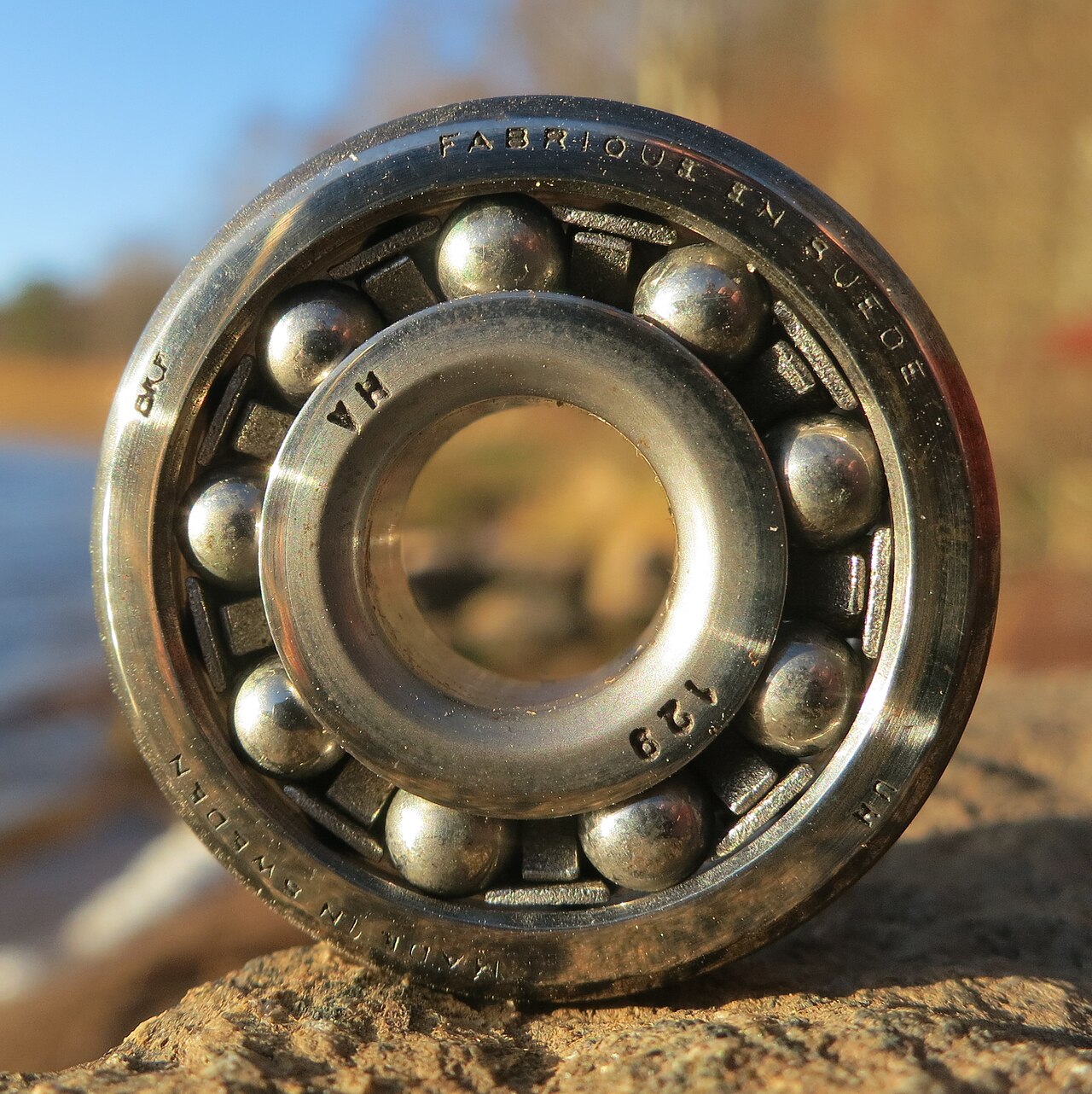
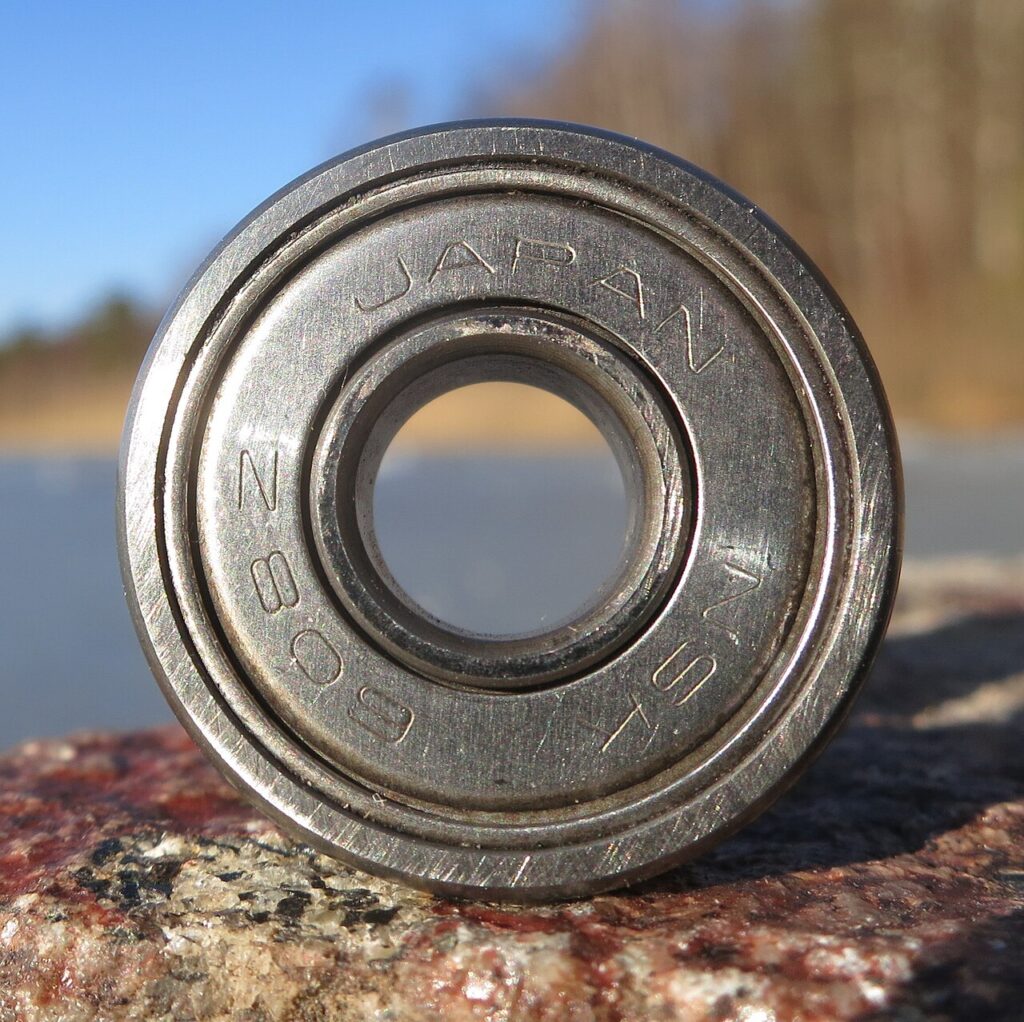
Image credits: “1950s ball bearing 129 HA by Swedish company SKF made in Sweden” by R. Henrik Nilsson (CC BY 4.0); “1990s NSK Nippon Seiko Kabushiki gaisha ball bearing 608Z made in Japan” by R. Henrik Nilsson (CC BY 4.0), via Wikimedia Commons.