
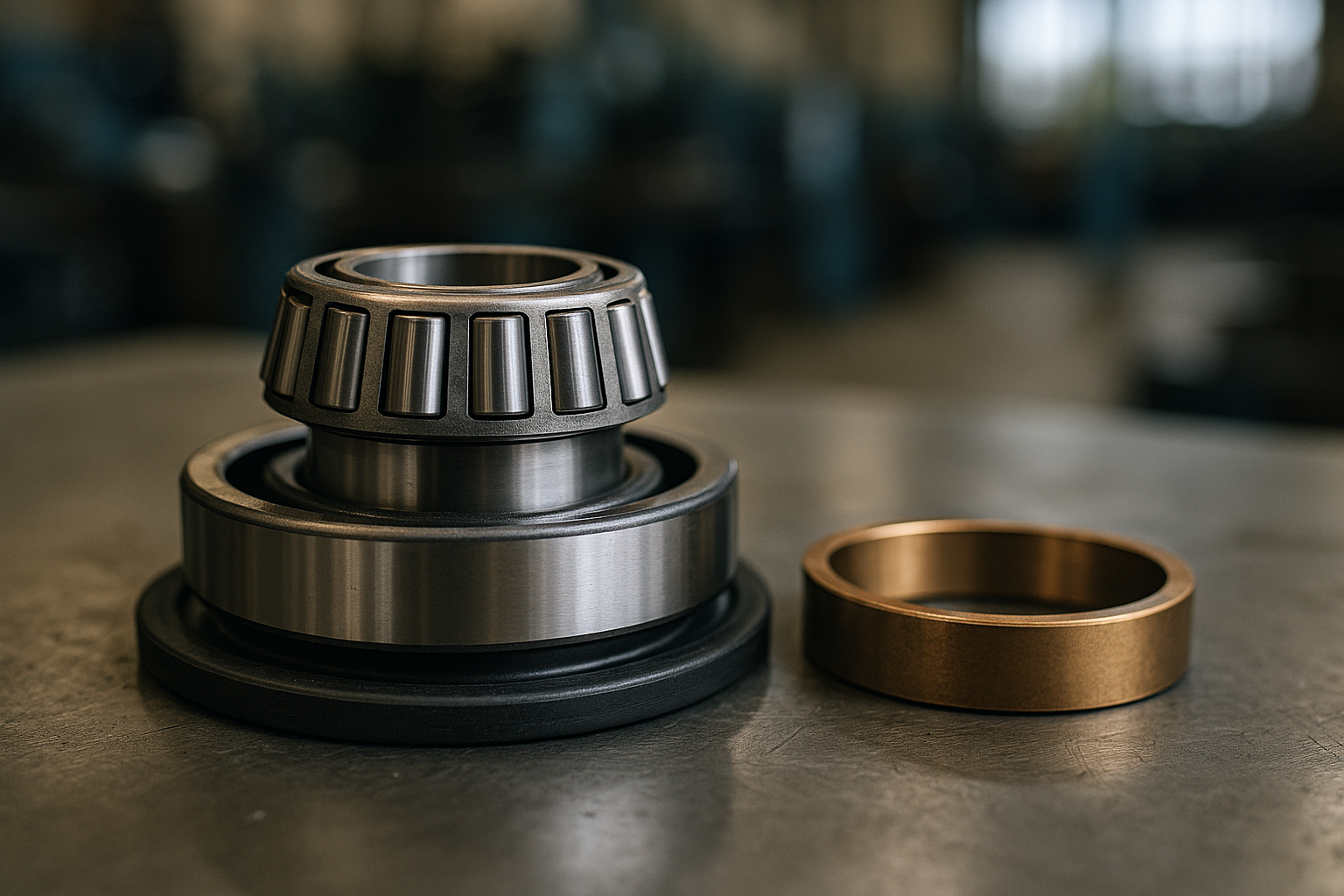
Walk into any bearing distributor in Europe and ask what sits on the fastest-moving shelf in the taper roller section, and the answer will involve the LM series. TIMKEN LM tapered roller bearings have been the default for trailer hubs, agricultural machinery, light industrial gearboxes and wheel ends for long enough that most workshops order them by habit rather than by specification. That habit is mostly justified, but it hides a few things worth knowing — particularly about setting them correctly, which is where most LM-series failures actually originate.
Why this series became the default
The LM range occupies the size band where a great deal of ordinary machinery lives, in the cup-and-cone construction that lets the two halves be handled and replaced separately. Taper roller geometry carries combined radial and axial load in a way ball bearings cannot, which is exactly what a wheel end or a shaft with a helical gear demands. Add decades of availability across every European distributor and a nomenclature that workshops recognise on sight, and the position becomes self-reinforcing: it is specified because it is available, and available because it is specified.
The setting is the whole job
Taper rollers do not have a fixed internal clearance. The clearance is created during assembly by how far the cone is pressed towards the cup, which means the person fitting it determines the bearing’s operating condition. Too loose and the rollers skid rather than roll, generating heat and wearing the raceway unevenly. Too tight and the rollers are preloaded against the races with nowhere for thermal expansion to go, which produces a rapid and comprehensive failure. The correct end-play for most LM applications is a few hundredths of a millimetre, measured rather than judged. A bearing that fails within weeks was almost always set wrong; the component itself rarely deserves the blame it receives.
Cup and cone are a matched pair
The two halves are lapped together during manufacture, and their surfaces carry a wear pattern specific to each other once they have run. Replacing a worn cone against an old cup — tempting, because the cup often looks fine and is awkward to extract from the housing — puts new roller geometry against a raceway that has already worn to a different profile. The contact is wrong from the first revolution and the new component fails early. Always replace both, and resist the argument that the cup looks serviceable, because what matters is not visible.
What actually kills them in the field
Water, mostly. Trailer hubs, agricultural axles and outdoor equipment give tapers a hard life, and the seal is usually what fails first. Once water reaches the rollers, corrosion pits the raceway and the bearing runs rough thereafter regardless of how well it was set. The replacement discipline therefore has to include the seal every time, not just when the seal looks damaged — the shaft seal range covers the sizes that accompany the common LM hubs. Grease specification matters too: the wrong grease in a wheel end that gets hot will not stay where it is needed, and the mixing problem that follows is covered in our piece on grease compatibility failures.
Sourcing and equivalence
The LM designation is an industry-standard dimensional series rather than a proprietary one, so equivalents exist across TIMKEN, SKF, FAG and KOYO, all of them dimensionally interchangeable. Manufacturing quality, surface finish and material consistency do vary, and on high-utilisation or safety-related positions that variation is worth paying for. On a trailer that runs seasonally, it mostly is not. Stock across the taper roller category covers the common sizes in multiple brands, which is worth exploiting when lead times on one manufacturer stretch.
Getting the replacement right the first time
Clean the housing and shaft properly and inspect both for wear before fitting anything. Press the cup square, using a driver that bears on the ring rather than on the raceway. Fit the new seal. Set the end-play to the manufacturer’s figure with a dial indicator rather than by feel, then check it again after the assembly has been torqued. Pack the correct grease in the correct quantity, which is usually less than people assume. Then check the running temperature after the first hour of service, because a setting error shows itself as heat long before it shows itself as damage — and at that point it is still recoverable.
Need help with taper roller specification or setting procedure? Our team supports European workshops and distributors on selection, equivalence and installation practice. Book a free consultation.