
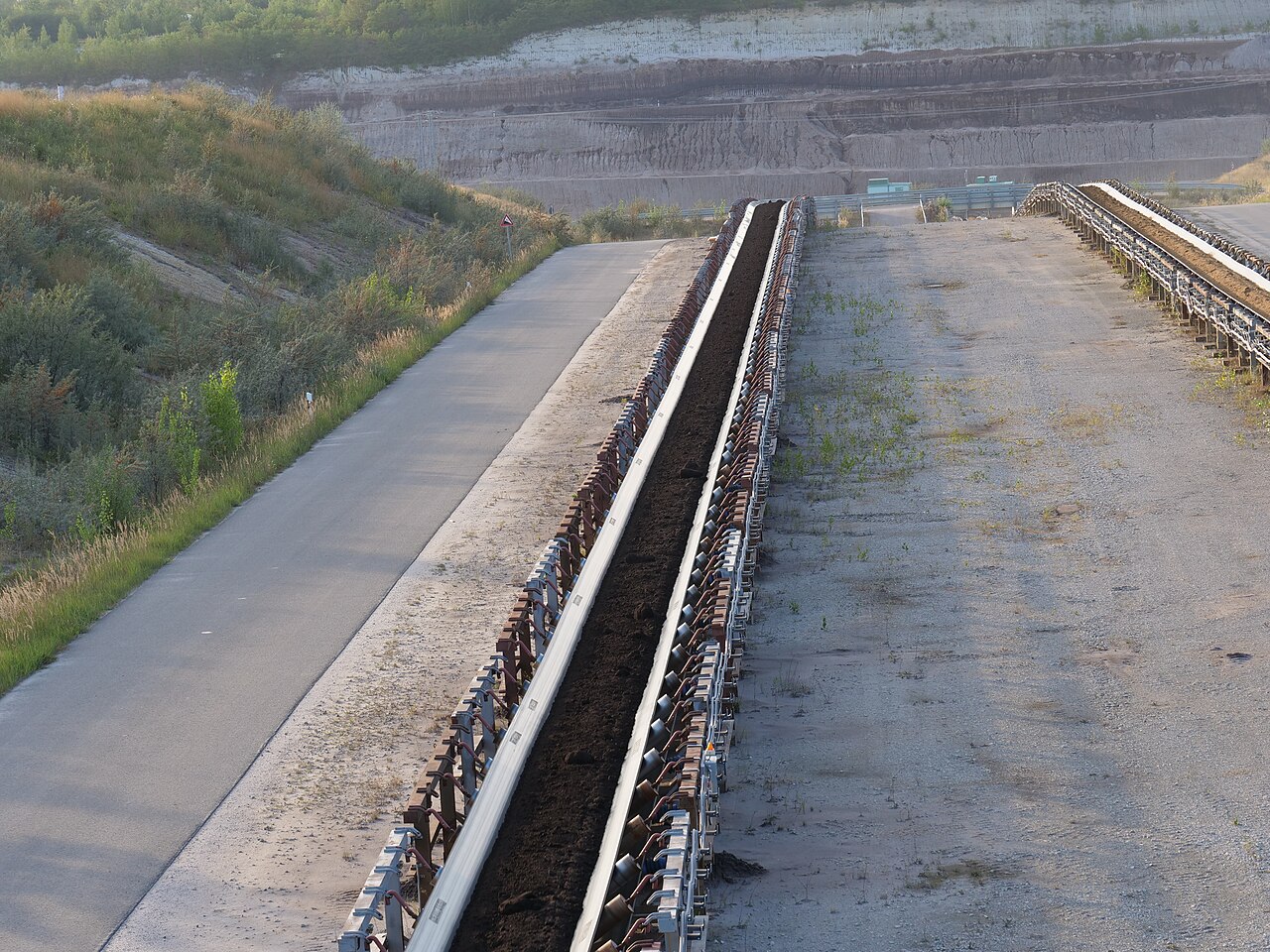
At the end of a dry shift in a limestone quarry, the fine grey dust has settled on everything: the handrails, the motor fins, the housings of the conveyor head pulley and the flywheel guard of the primary crusher. Most of it is harmless on the outside of a machine. A few grams of it inside a bearing, however, will turn smooth raceways into a dull grey surface within weeks, and a single oversized rock in the crusher will deliver a load spike that no catalogue rating was calculated for. Bearings for mining conveyors and crushers live with both threats at once, abrasive contamination and shock loading, and the operations that achieve long bearing life are the ones that treat sealing, lubrication and bearing selection as one decision instead of three separate purchases. This article looks at how that decision plays out on belt conveyors, idlers and crushers, and where maintenance teams most often lose bearing life without noticing.
Two enemies: abrasive dust and impact
Mining and quarry dust is largely silica and other hard minerals, often harder than bearing steel, and it is fine enough to pass through seal gaps that would stop ordinary workshop dirt. Once inside, particles are rolled into the raceways, creating dents and then wear that increases internal clearance and raises vibration. Water from rain, washdown and dust suppression sprays carries particles further and attacks the lubricant. Impact loads come from the process itself: oversized material in a crusher, lumps falling onto a conveyor loading zone, or a belt that stalls and restarts under full load. These loads can exceed the normal operating load many times for a fraction of a second. Bearing rating life calculations assume clean lubricant and steady loads, so in mining applications the effective life is usually limited by contamination and by static overload rather than by classical fatigue. Designing against both is the core of reliable equipment in the pit.
Conveyor pulleys: spherical rollers in sealed plummer blocks
Drive, tail and bend pulleys on mining conveyors are normally supported by spherical roller bearings on adapter sleeves in split plummer block housings. The spherical roller bearing accepts the misalignment that comes from long shafts and frames that move with temperature and load, and its high radial capacity copes with belt tension and impact at the loading zone. The housings are where sealing is decided. Standard double-lip seals are not enough in heavy dust; multi-stage labyrinth seals filled with grease, sometimes combined with an additional contact seal or a V-ring, are the norm on well-run sites. The comparison of maintenance costs in our article on chain or belt conveyor drives shows how strongly bearing and seal life influence the total cost of a conveyor. Housings must also be arranged with one locating and one non-locating position, because long pulley shafts expand noticeably in summer heat.
Crushers: shock loads and static safety
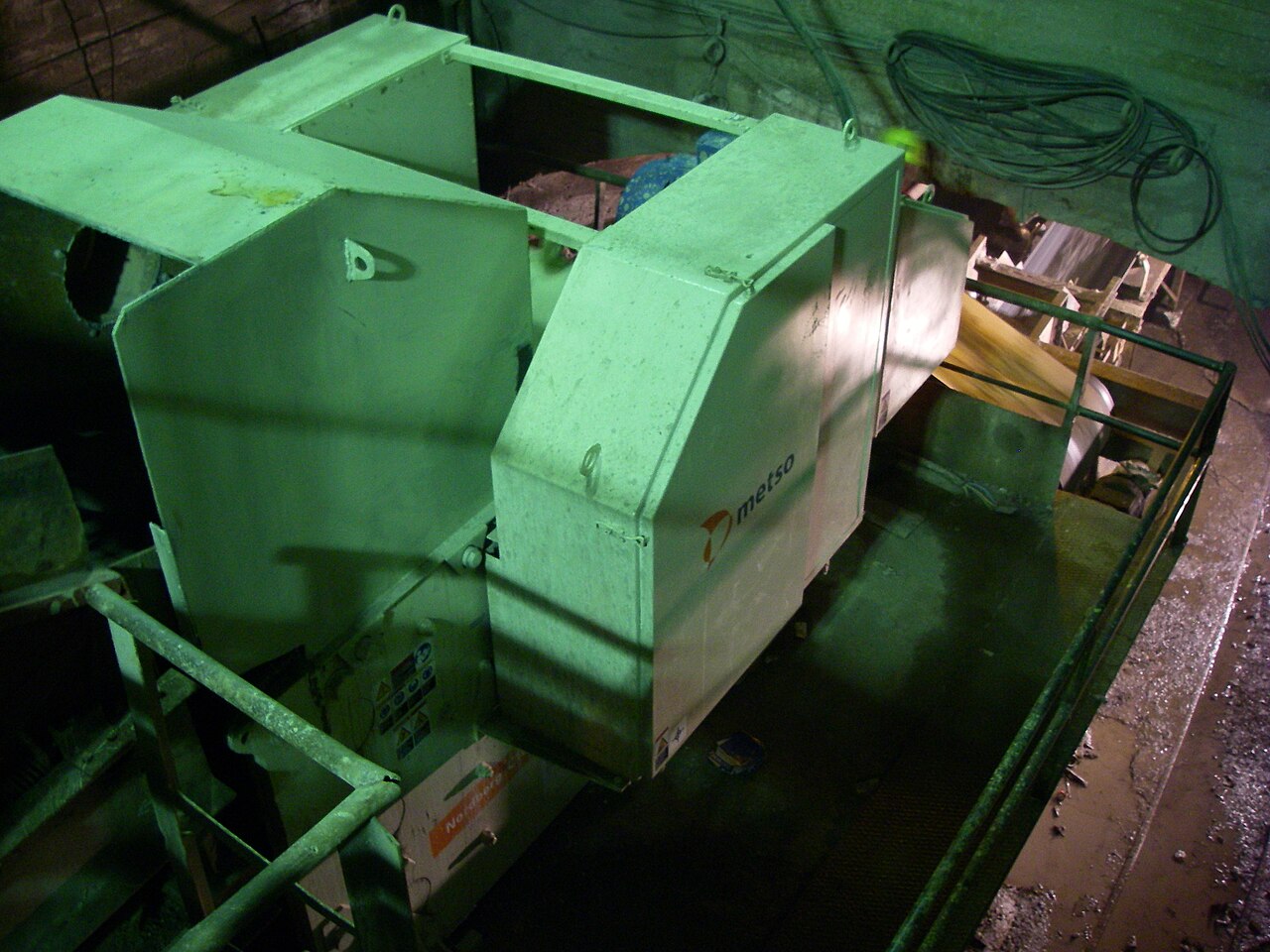
Jaw crushers carry their eccentric shaft and flywheels on large spherical roller bearings, while cone and gyratory crushers use a mix of plain and rolling bearings depending on the design. In every case the governing load is the crushing force, which fluctuates heavily with feed size and hardness and can peak far above the average. For these positions the static load rating and the static safety factor are as important as the dynamic rating, because a single heavy impact can create permanent indentations that then grow into spalls. Our article on sizing spherical roller bearings for shock loads in crushers and mills explains how to set a realistic safety margin. Crusher bearings also run hot under heavy load, so internal clearance is usually larger than normal, often C3 or C4, to keep the bearing from preloading itself at operating temperature.
Idlers: many small bearings, one big cost
A long conveyor may have thousands of idler rollers, each with two small deep groove ball bearings, and their combined failure rate often costs more than the large pulley bearings. Idler bearings are usually sealed for life, protected by a labyrinth in the roller end cap, and they depend entirely on that labyrinth and on their own seals. The trade-off between contact seals and shields, discussed in our article on 6207-2RS versus 6207-2Z in dirty applications, is decisive here: contact seals add a little friction but keep fine dust and water out far better. Seized idlers are not only a bearing problem; a stalled roller wears through its shell, damages the belt and can become a fire risk where coal or combustible dust is present. Choosing better-sealed idlers and replacing failing rollers quickly is one of the most effective reliability measures on any long conveyor.
Lubrication as part of the seal
In dusty environments grease is not only a lubricant; it is a barrier. Labyrinth seals work best when they are full of grease, and regular relubrication pushes a small amount of fresh grease outwards through the labyrinth, carrying contaminants with it. That is why mining sites often use shorter intervals and smaller quantities than the calculated values, or automatic single-point lubricators that deliver grease continuously. The grease should have good water resistance, mechanical stability and extreme pressure performance; formulations based on lithium complex or calcium sulphonate thickeners are widely used, but compatibility with the grease already in the housing must be checked before switching. Intervals should be based on the real duty cycle, as shown in our guide to relubrication intervals for real operating conditions. Over-greasing a slow bearing is rarely a problem here; letting the seal run dry almost always is.
Reading failures from the pit
Bearings removed from mining equipment carry clear evidence of what went wrong, and reading it saves the next bearing. Dull, grey, uniformly worn raceways with increased clearance point to abrasive contamination and to seal or lubrication problems. Many small, sharp-edged dents across the raceways indicate hard particles rolled through the contact. Regularly spaced indentations at roller pitch suggest heavy impact or static overload, typical of crushers and loading zones. Marks at roller pitch with a polished or corroded appearance on equipment that stands still for long periods, such as standby conveyors exposed to vibration from nearby machines, indicate false brinelling rather than impact. Rust and etching point to water. Each pattern leads to a different fix, from better seals and greasing to larger bearings, higher clearance or a change in standby procedures, so failed bearings should be cleaned, photographed and logged rather than thrown into the scrap bin.
Building a reliable bearing package
For new equipment or major overhauls, it pays to specify the bearing, sleeve, housing, seals and grease together for each position, rather than ordering them from separate catalogues. A typical conveyor pulley package combines a spherical roller bearing from a supplier such as SKF or TIMKEN, an adapter sleeve and lock nut, a split housing with a heavy-duty multi-stage seal, locating rings for the fixed side and a grease suited to wet and dusty conditions. Where combined radial and axial loads dominate, such as in some wheel and crusher drive applications, tapered roller bearings may be the better choice. Keeping complete kits for critical positions on site reduces downtime, and recording the specification for each position ensures that every replacement restores the original reliability rather than improvising with whatever is on the shelf.
Bearings in mining conveyors and crushers fail mostly because dust gets in or because impact exceeds what the bearing was sized for. The answer is consistent: choose bearings with enough static safety and suitable clearance, protect them with multi-stage seals that are kept full of grease, relubricate according to the real environment, and read every failure for the evidence it contains. Do that, and the grey dust that coats every surface at the end of the shift stays where it belongs, on the outside of the housings, while the bearings inside keep turning through the seasons. A short audit of the ten most critical positions on site, covering seal type, grease, clearance and the last failure pattern, is usually the fastest way to find where the next bearing will fail and to fix it before it does.
Struggling with bearing life in dusty, high-impact equipment? Send us the application, current bearings and failure photos, and our team will propose a complete bearing, housing and sealing package. Book a free consultation.
Image credits: “Conveyor belt at surface mine Schleenhain 13” by Leonhard Lenz (CC BY-SA 4.0); “UG jaw crusher” by Nuno Madeira Alves (CC BY-SA 4.0), via Wikimedia Commons.