
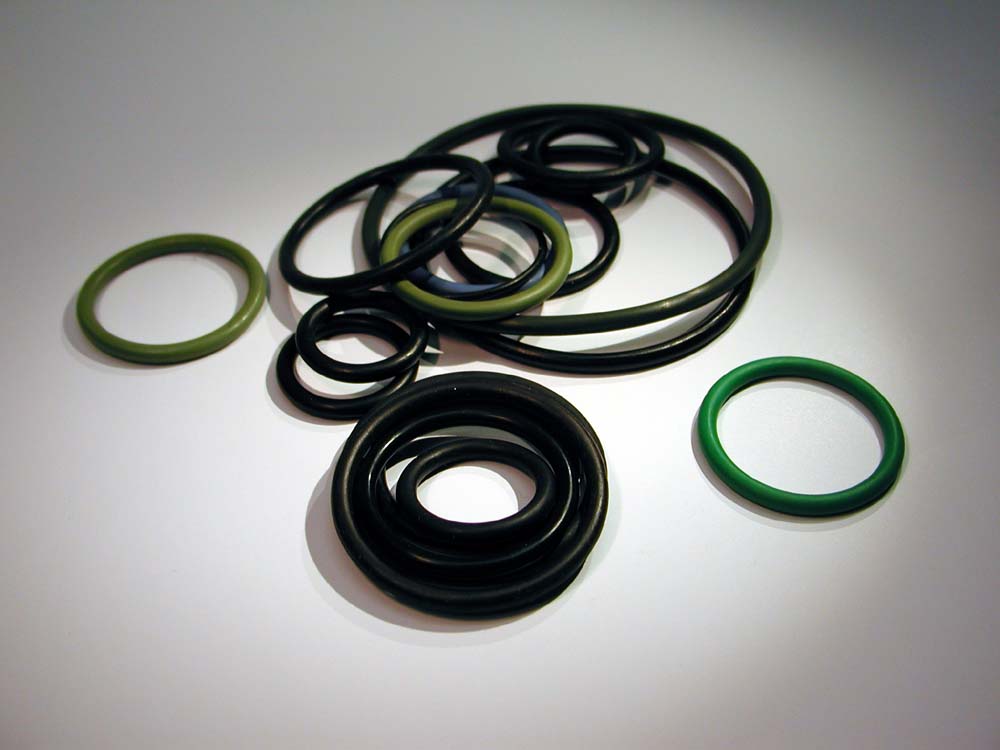
Two seals with identical dimensions sit side by side on the bench: one black, one brown, one costing about a quarter of the other. The gearbox they are meant for runs a synthetic gear oil at 95 degrees in summer, the shaft turns at 1,500 revolutions per minute, and the last black seal lasted eight months before its lip turned hard and cracked. The choice between them is not about colour or price; it is about the lip elastomer and what it has to survive. NBR, HNBR and FKM rotary shaft seals cover most industrial applications between them, and each has a clear operating window defined by temperature, sliding speed and the fluid it seals. Matching those three conditions to the compound is the most reliable way to stop a seal from failing early, and it often explains failures that are blamed on installation, shaft finish or bad luck when the real cause is chemistry and heat at the lip.
Why the lip compound decides seal life
A radial shaft seal works because a thin elastomer lip, pressed onto the shaft by its own interference and a garter spring, rides on a lubricating film only a few microns thick. As long as the lip stays elastic it follows small shaft movements and keeps the film under control. When the elastomer ages, it either hardens and cracks, losing contact, or swells and softens, losing its shape and wearing fast. Both changes are driven by temperature and by chemical attack from the fluid, and both accelerate with time. That is why the operating limits of the compound matter more than the catalogue dimensions. The same logic applies to static seals, as explained in our guide to O-ring compound selection for hydraulics, but rotary lips run hotter than the surrounding fluid because of friction, which makes the choice even more sensitive for shaft seals.
NBR: the workhorse and its limits
Nitrile rubber is the default lip material for most NBR rotary shaft seals because it offers good resistance to mineral oils, greases and many hydraulic fluids at a low price, with a typical continuous range from about minus 40 to plus 100 degrees Celsius and short peaks somewhat higher. It handles moderate speeds well and has good wear resistance. Its weaknesses are clear: above about 100 degrees at the lip it hardens progressively, it ages in ozone and sunlight, and some fluids attack it, including certain synthetic esters, brake fluids and aggressive additive packages in hot gear oils. For standard gearboxes, pumps and electric motors running mineral oil or grease below 80 to 90 degrees in the sump, NBR remains the sensible choice. Double-lip versions, such as our NBR double-lip rotary shaft seals, add dust protection without changing the material limits.
HNBR: more heat and wear resistance in the middle
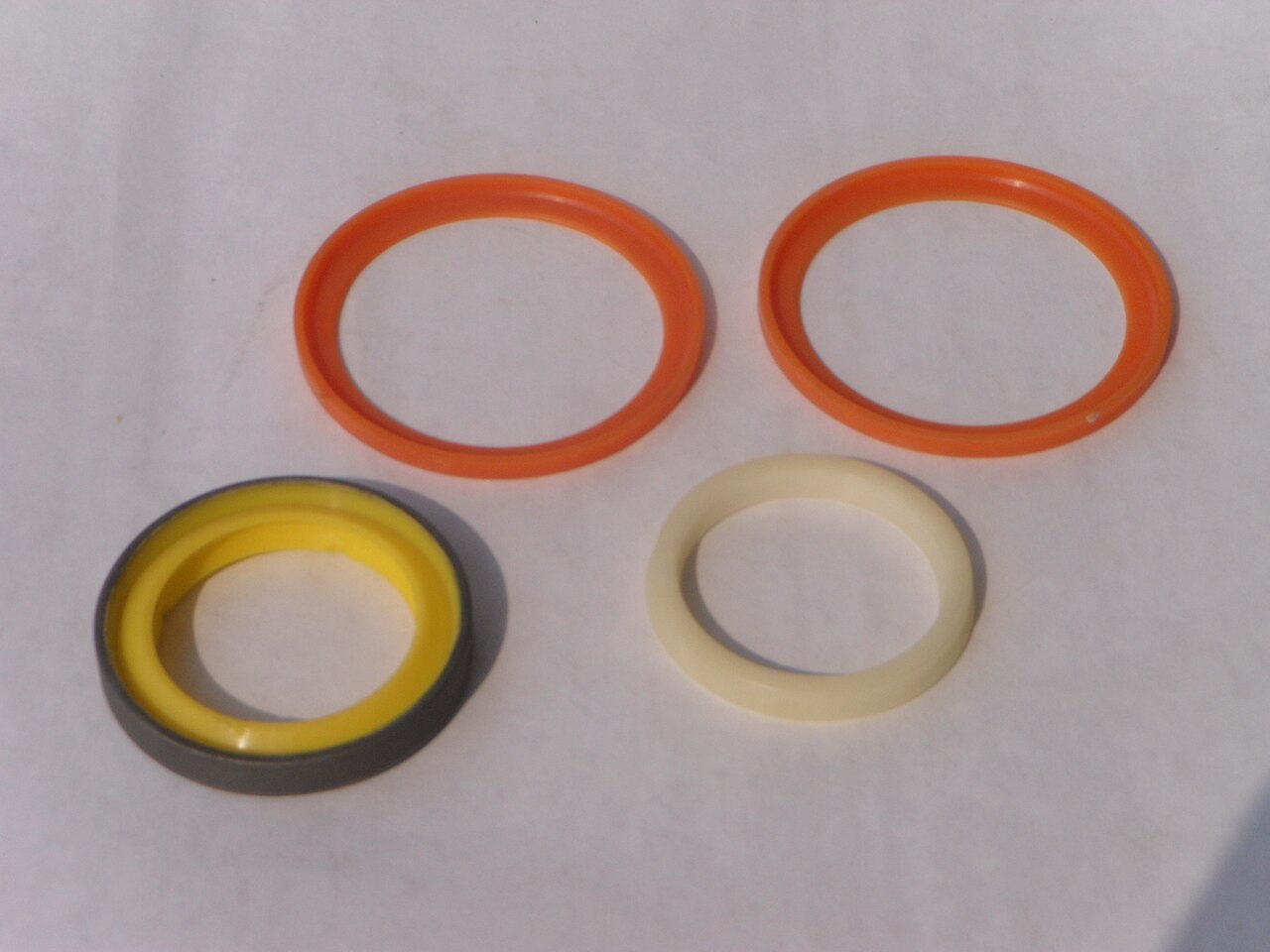
Hydrogenated nitrile rubber is produced by saturating most of the double bonds in NBR, which makes the polymer much more resistant to heat, ozone and oxidation. In practice HNBR lips work continuously up to about 140 to 150 degrees, keep good low-temperature flexibility, and offer excellent abrasion resistance, which makes them attractive for dirty environments and for seals running on shafts that are not perfect. They also tolerate many modern oils with additive packages that would harden standard NBR over time. The trade-offs are higher cost than NBR and more limited availability in uncommon sizes, so HNBR is often specified in OEM equipment and supplied on request rather than stocked in every dimension. It is a strong option for hydraulic and transmission applications where NBR runs at the limit of its temperature range but the full chemical resistance of FKM is not necessary.
FKM: high temperature and chemical resistance
Fluoroelastomer, commonly known as FKM, is the material of choice when sump temperatures are high or the fluid is aggressive. FKM lips work continuously up to around 200 degrees Celsius and resist mineral and synthetic oils, fuels, many solvents and additive packages that attack nitrile. They are standard in high-temperature gearboxes, engines, compressors and chemical pumps. Their limitations are less obvious but important: FKM becomes stiff below about minus 20 degrees in standard grades, it is sensitive to hot water and steam, amines and some glycol-based fluids, and it costs considerably more than NBR. FKM seals are often brown or green, but colour is not a reliable identifier, so the material should always be confirmed by the designation or the supplier. When a seal sits in a warm gearbox running synthetic oil, as in our opening example, FKM is usually the answer.
Sliding speed and the heat it generates
Lip temperature is the sum of the fluid temperature and the frictional heat generated at the contact, and that heat rises with sliding speed. The circumferential speed in metres per second is easy to estimate: multiply the shaft diameter in millimetres by the speed in revolutions per minute and by pi, then divide by 60,000. A 50 millimetre shaft at 3,000 revolutions per minute runs at almost 8 metres per second, which can add 20 to 40 degrees at the lip compared with the oil in the sump. A seal that looks safe on fluid temperature alone may therefore be operating far above its limit. Higher speeds also make dry running more damaging, so oil level and lubrication of the lip matter. Where speeds are high and temperatures marginal, FKM or PTFE lips are often more reliable than NBR, a choice discussed in our article on gearbox output shaft seals with PTFE lips.
Fluid compatibility in practice
Compatibility depends on the base oil and on the additives, so the oil specification sheet is as important as the seal catalogue. Mineral oils and polyalphaolefin synthetics are generally compatible with NBR, HNBR and FKM within their temperature limits. Polyglycol oils can cause problems with some compounds and should be checked with the seal manufacturer. Ester-based oils, biodegradable hydraulic fluids and certain fire-resistant fluids may swell or degrade nitrile. Gear oils with sulphur-phosphorus extreme pressure additives harden NBR quickly at high temperature, while FKM handles them well. Water-glycol coolants and steam favour HNBR or special compounds over FKM. When in doubt, the most practical approach is to ask for the compound recommendation from the seal supplier, as we described for choosing CORTECO seals for hydraulic cylinder rebuilds, and to record the result for future orders.
Specifying and sourcing the right compound
Once the compound is chosen, it must be written into the order, because dimension-only orders default to NBR. A complete specification lists shaft diameter, bore diameter and width, the outer construction, the presence of a dust lip, and the lip material, for example 45 by 62 by 8, rubber-covered with dust lip, FKM. Brands such as CORTECO and Dichtomatik offer the main sizes in both NBR and FKM, while HNBR and special compounds may need longer lead times. For critical machines it is worth keeping a small stock of the upgraded compound, since the price difference is small compared with the cost of a stop. Mark the seal material on the machine or in the maintenance system, so that a future replacement does not silently revert to standard nitrile simply because it was the seal in stock.
Choosing the lip elastomer is a short calculation and a short conversation with the oil data sheet. Estimate the lip temperature from sump temperature and sliding speed, check the fluid against the compound, and choose NBR for standard mineral oil applications, HNBR when heat or abrasion push NBR too far, and FKM when temperatures are high or chemistry is aggressive. Record the choice so the next order repeats it. In the gearbox from the opening paragraph, that means the brown FKM seal, and a lip that should still be elastic long after the cheaper nitrile would have cracked and started weeping oil onto the floor. The extra cost of the better compound is recovered the first time a planned seal change replaces an unplanned one, and on most machines that happens long before the second year of service.
Not sure which lip material your application needs? Send us the shaft size, speed, oil type and temperature, and our team will recommend the right NBR, HNBR or FKM seal. Book a free consultation.
Image credits: “Oring gr” by Ilja (Gert Wrigge) (CC BY-SA 3.0); “Assortment of oil seals 3” by Qingshansealing (CC BY-SA 4.0), via Wikimedia Commons.