
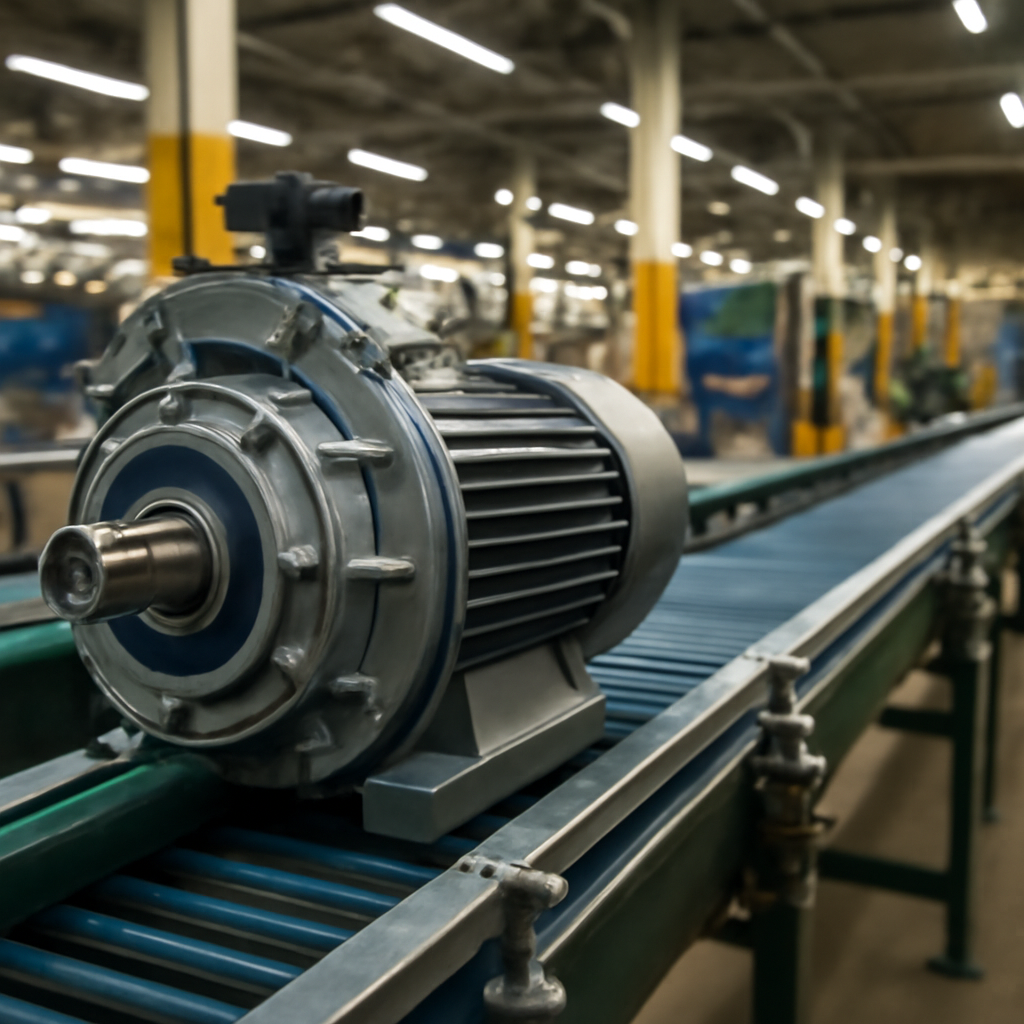
Walk through any Italian conveyor system on a food-processing line, a packaging plant or a warehouse handling automation project, and there is a fair chance a CHIARAVALLI variator is quietly doing the speed-control job somewhere in the mechanical drive train. The brand is not a household name outside Italy, but the Milanese power-transmission specialist has built one of the most quietly reliable mechanical variator ranges in the European market over the past four decades. This piece explains why CHIARAVALLI keeps winning specification against inverter-and-motor alternatives on specific conveyor applications, and where the mechanical variator approach still makes economic sense in 2026.
What a CHIARAVALLI variator actually does
The CHIARAVALLI planetary variator uses friction discs and steel balls in a planetary arrangement to deliver continuously variable speed reduction from a constant-speed input shaft. The output speed adjusts by mechanically shifting the friction contact geometry, giving speed ratios from roughly 1:1 down to 1:5 on the standard range, and extending to 1:8 on the extended ratio version. The mechanical adjustment happens through a hand crank or an electric actuator, and holds the set speed without any electronic control. This is a fundamentally different approach from the modern default of running an AC motor through a variable frequency drive.
Why the mechanical variator still competes with inverter drives
Three reasons keep the CHIARAVALLI variator in the competitive mix despite the ubiquity of inverter drives. First: on conveyor applications with continuous stable-speed requirement, the mechanical variator has no ongoing electrical losses at the setpoint. An inverter drive dissipates 2 to 4 percent of shaft power continuously as switching and modulation losses. A mechanical variator dissipates roughly 5 percent as friction, but only when the friction disc is loaded. On light-duty conveyor drives the mechanical solution can actually run more efficiently. Second: the mechanical variator is fully isolated from grid disturbances, harmonics and inverter-induced motor bearing damage. Third: the mechanical variator holds calibrated speed setpoint mechanically, which some food-safety and pharmaceutical audit protocols prefer over software-defined setpoints on inverters.
Where CHIARAVALLI dominates in Italian industrial installations
The concentration of CHIARAVALLI specification in Italian food-processing plants is not accidental. The brand has been the incumbent on Italian OEM conveyor and packaging equipment for decades. Barilla, Ferrero, Lavazza and dozens of smaller food processors specify CHIARAVALLI variators as the reference solution when the OEM proposes a mechanical variator alternative to an inverter drive. The reasons are practical: local service network, local spare parts availability, technical documentation in Italian, and forty years of accumulated failure data. When an Italian maintenance team asks their mechanical distributor for a variator, the default answer is a CHIARAVALLI part number. This creates a strong incumbent effect that makes it hard for other mechanical variator brands to gain share in Italy.
The technical specification decisions that matter
CHIARAVALLI publishes four main variator families. The continuously variable transmission series K covers standard general-purpose applications from 0.18 to 7.5 kilowatt input. The T series adds a torque limiter for shock-load applications. The BS series integrates a gearbox on the output for higher torque with lower speed. The C series is the compact version for space-constrained installations. The choice between the four depends on input power, output torque, and installation envelope. Wrong series selection typically shows up as premature friction disc wear when a K series is deployed on an application that actually needs the T series torque limiter, or as installation problems when a standard series does not fit in the space the compact C series would have handled.
Lubrication and maintenance realities
CHIARAVALLI variators use a specific mineral oil formulation designed to work with the friction disc surfaces. Using a generic industrial gear oil is a common maintenance mistake — the wrong additive package prevents the friction contact from working correctly and dramatically shortens the life of the friction discs. The correct lubricant is CHIARAVALLI’s own formulation or an equivalent from Shell or Mobil approved specifically for planetary variator use. Oil change interval is 2,000 to 3,000 operating hours depending on load. This is meaningfully more frequent than an equivalent gearbox oil change interval, and it is one of the ongoing operating costs to factor into the mechanical variator specification decision.
Where the CHIARAVALLI variator loses to inverter drives
High-cycle speed variation applications — those that adjust setpoint dozens of times per hour — are not the right fit for the mechanical variator. The friction disc wear accelerates with cycling. Applications requiring integrated control feedback loops with plant automation systems favour the inverter drive because the interface is native. Applications with widely variable load spectrum favour the inverter drive because the mechanical variator’s efficiency drops off at part-load conditions. And applications where the initial capital cost differential matters heavily for a large fleet of small drives favour the inverter drive because inverter prices have dropped substantially over the last decade while mechanical variator prices have been relatively stable.
The 2026 market position and outlook
CHIARAVALLI’s competitive position in 2026 remains strong in Italy and in Southern European export markets that draw on Italian OEM equipment. In Northern Europe the brand is less known and typically loses specification to Bonfiglioli or Nord Gear on new equipment. The company has been quietly expanding its export sales function and building direct distribution relationships in France, Germany and Spain over the past three years. Whether this translates into meaningful market share gains in those markets depends on the OEM specification cycle, which turns over slowly on capital equipment. The technical case for the mechanical variator on specific applications remains sound, but the sales momentum still favours inverter drives on new installations.
What buyers should keep on the specification checklist
For Italian food-processing and packaging line specifications, CHIARAVALLI is often the pragmatic choice: local service, local spares, local documentation, incumbent status with the OEM. For European conveyor and light-load automation applications with stable setpoint and long service intervals, the mechanical variator remains competitive against the inverter alternative on total cost of operation. For high-cycle speed variation, integrated control requirements or capital cost sensitivity, the inverter drive wins. And for any specification that touches food-safety audit protocols, CHIARAVALLI’s history in the Italian food industry gives it an advantage that is hard to replicate.
Related coverage on Eurobearing
- SEDIS Industrial Chains: Selection and Maintenance
- OPTIBELT V-Belts: A Complete Selection Guide for Industrial Drives
- Strategies to Extend the Lifespan of Power Transmission Belts
- Optibelt RBK and TruckPower Belts
- How AI Is Revolutionising Mechanical Transmission Monitoring
Need help selecting a CHIARAVALLI variator for a conveyor application? Our technical team supports European engineers with variator series selection and inverter-versus-mechanical trade-off analysis. Book a free consultation.