
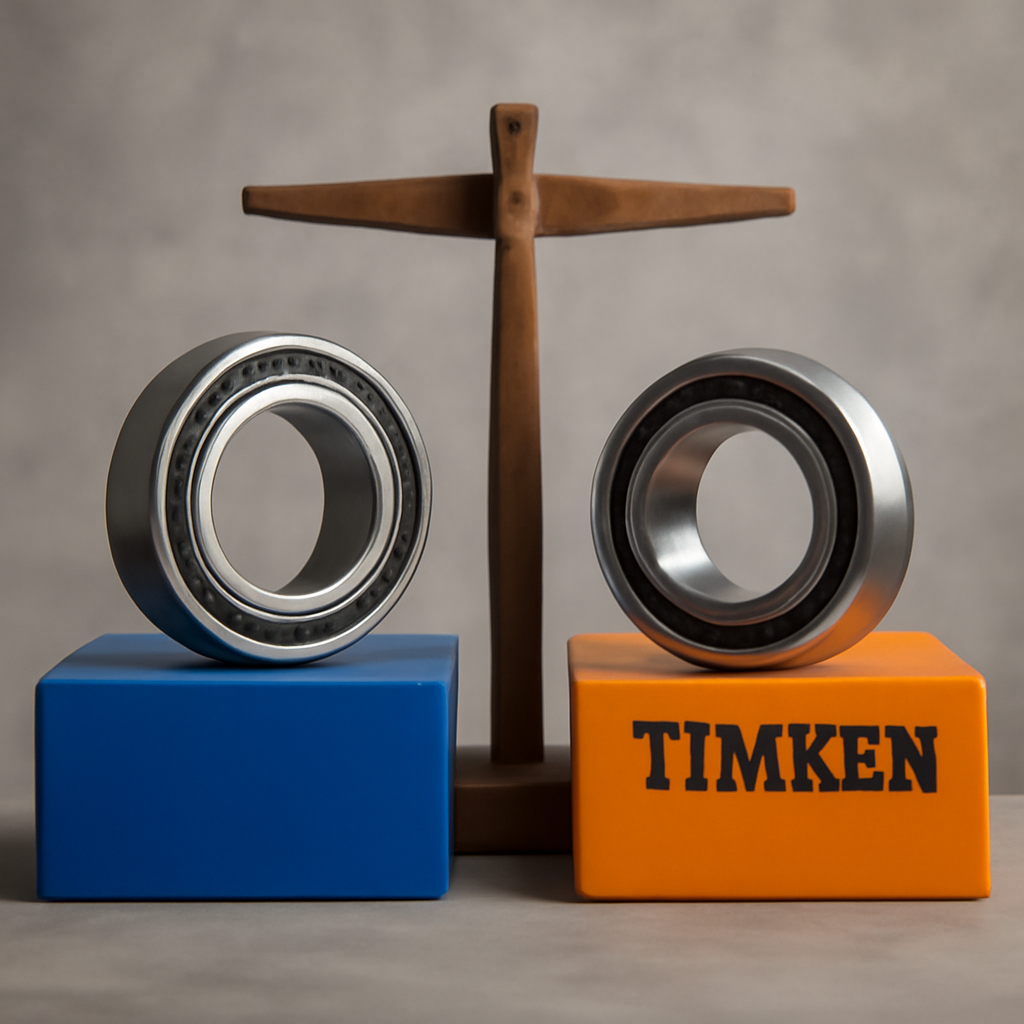
The SKF versus TIMKEN pricing comparison in the European aftermarket is a conversation that happens every day at distributor counters, but the honest answer is more complicated than most technical publications admit. On paper both premium ranges sit in a similar price band. In practice the differential varies by product family, by country, by whether the buyer is OEM or aftermarket, and by the exact contract terms the distributor holds with each manufacturer. This piece pulls together twelve months of European aftermarket transaction data to show where each brand actually holds the price advantage and why.
The two ranges are not the same product
Start with the obvious: SKF and TIMKEN target different core markets. SKF built its franchise on general industrial applications with strong European automotive OEM penetration. TIMKEN built its franchise on tapered roller bearings with strong North American heavy industry penetration. The overlap is real but not complete. For deep groove ball bearings SKF holds the reference position in Europe. For tapered rollers TIMKEN holds it in North America. The European aftermarket sees both brands competing across the range, but the underlying manufacturing footprint and channel strategy differ significantly, and pricing follows.
Where SKF prices below TIMKEN in Europe
The clearest price gap sits in deep groove ball bearings for European electric motor rebuild applications. On a 6205-2RSH/C3 sold through an Italian or German industrial distributor, SKF list price runs 5 to 12 percent below the TIMKEN equivalent. The reason is straightforward: SKF has manufacturing scale in Europe that TIMKEN lacks, and the aftermarket volume for European motor bearings favours the brand with local production. The gap widens on 6200-series sizes and narrows on 6300-series and larger deep groove bearings where TIMKEN’s US-based production is competitive.
Where TIMKEN prices below SKF in Europe
The tapered roller aftermarket favours TIMKEN on price. A 32208 or 32210 tapered roller for a European trailer axle or gearbox application typically comes in 3 to 8 percent below the SKF equivalent through European distributors. TIMKEN’s US taper roller production scale, combined with a well-developed European distribution channel that emphasises taper rollers specifically, gives them the volume base to price competitively. The larger the taper roller — 32300 series and above — the wider the TIMKEN advantage becomes. On spherical rollers the gap narrows again, and SKF sometimes leads slightly on standard 22200 and 22300 series sizes.
The premium range comparison that matters
SKF Explorer versus TIMKEN SPEXX is where the interesting comparison lives. Both premium ranges promise longer L10 life through cleaner steel and better cage precision. Both cost 25 to 45 percent above the standard range from the same manufacturer. The field data shows Explorer holds a slight advantage on high-cycle applications like electric motor bearings and general industrial pumps. SPEXX holds a slight advantage on heavy shock-load applications like mining crushers and rolling mills. Neither range is a universal winner. The pricing is nearly identical at list — within 3 percent — so the choice comes down to application fit rather than price.
How the distributor contract terms shift the comparison
List prices are only half the story. Distributor discount structures with SKF and TIMKEN differ significantly by country and by annual volume commitment. A large German distributor with a €5-million-plus annual SKF commitment gets discount tiers that materially close the gap versus TIMKEN. A specialist tapered roller distributor with strong TIMKEN volume gets discounts that make TIMKEN competitive against SKF Explorer on standard bearings. The end customer sees different landed prices at different distributors for what looks like the same part. This is why comparison shopping across European distributors on premium bearing SKUs sometimes turns up gaps of 15 to 20 percent for identical parts.
The aftermarket versus OEM price split
OEM contract pricing runs 30 to 50 percent below aftermarket list on both SKF and TIMKEN premium ranges. Distributors with dual OEM-and-aftermarket business use the OEM contract terms to feed the aftermarket at prices that specialist aftermarket distributors cannot match. This creates persistent price gaps at the end-customer level that have little to do with which brand is cheaper and everything to do with which distributor holds which contracts. Buyers who navigate this pattern well can save 10 to 20 percent on their annual bearing spend without changing bearing specifications.
Post-restructuring pricing dynamics in 2026
SKF’s automotive spin-off completed in Q4 2025 has changed the pricing dynamics for automotive-adjacent industrial bearings. The industrial parent business, now more focused on core industrial applications, has slightly firmed pricing on Explorer range bearings targeted at industrial customers. TIMKEN, meanwhile, has held pricing stable through the Q2 earnings cycle. The net effect is a modest widening of the price gap in favour of TIMKEN for premium industrial bearings, most visible on tapered rollers and large deep groove sizes. Whether this pattern holds through H2 2026 depends on how each company responds to the German mechanical engineering PMI trend.
The NSK-NTN merger effect on the SKF-TIMKEN pricing dynamic
The ongoing NSK-NTN antitrust review changes the competitive frame. If the merger closes and the combined entity gains negotiating power against European distributors, SKF and TIMKEN both benefit from having a smaller field of premium-bearing competitors. Neither has publicly signalled pricing changes tied to the merger timeline, but distributors are already reporting that both brands have been slower to negotiate discount tier improvements in 2026 than in prior years. This is consistent with a market anticipating reduced competition and preserving pricing power. Aftermarket buyers should not assume the pricing dynamic will improve during 2026 or 2027.
What buyers should specify by application
The pragmatic 2026 procurement pattern: SKF Explorer on European industrial electric motors and general pumps because the pricing is competitive and the technical fit is well-established. TIMKEN SPEXX on tapered roller applications, particularly for European trailer, gearbox and heavy-industry customers, because the pricing is meaningfully better. Standard SKF on general industrial deep groove where premium is not justified. Standard TIMKEN on aftermarket taper rollers for automotive applications. Avoid over-standardising on one brand across all bearing families because the pricing landscape rewards intelligent sourcing across both.
The takeaway for procurement teams
The SKF-TIMKEN price comparison is not a single number. It varies by product family, by country, by distributor relationship and by the specific range being compared. Procurement teams that treat the two brands as interchangeable premium options miss real savings. Those that map the pricing dynamic by product family and negotiate discounts by category typically save 5 to 12 percent on their annual premium bearing spend. That is meaningful money on a mid-sized industrial buyer’s bill, and it is available without any bearing specification changes.
Related coverage on Eurobearing
- Comparing the Top 6 Bearing Brands
- Timken Tapered Bearings vs SKF: Side-by-Side Selection
- SKF Bearings 2026: The New Structure After the Automotive Spin-off
- TIMKEN Tapered Roller Bearings: Heavy Industry Applications
- Bearing Market H2 2026: Three Scenarios for Distributors
Need help mapping SKF and TIMKEN pricing across your bearing families? Our team supports European procurement teams with SKU-by-SKU landed cost analysis. Book a free consultation.