
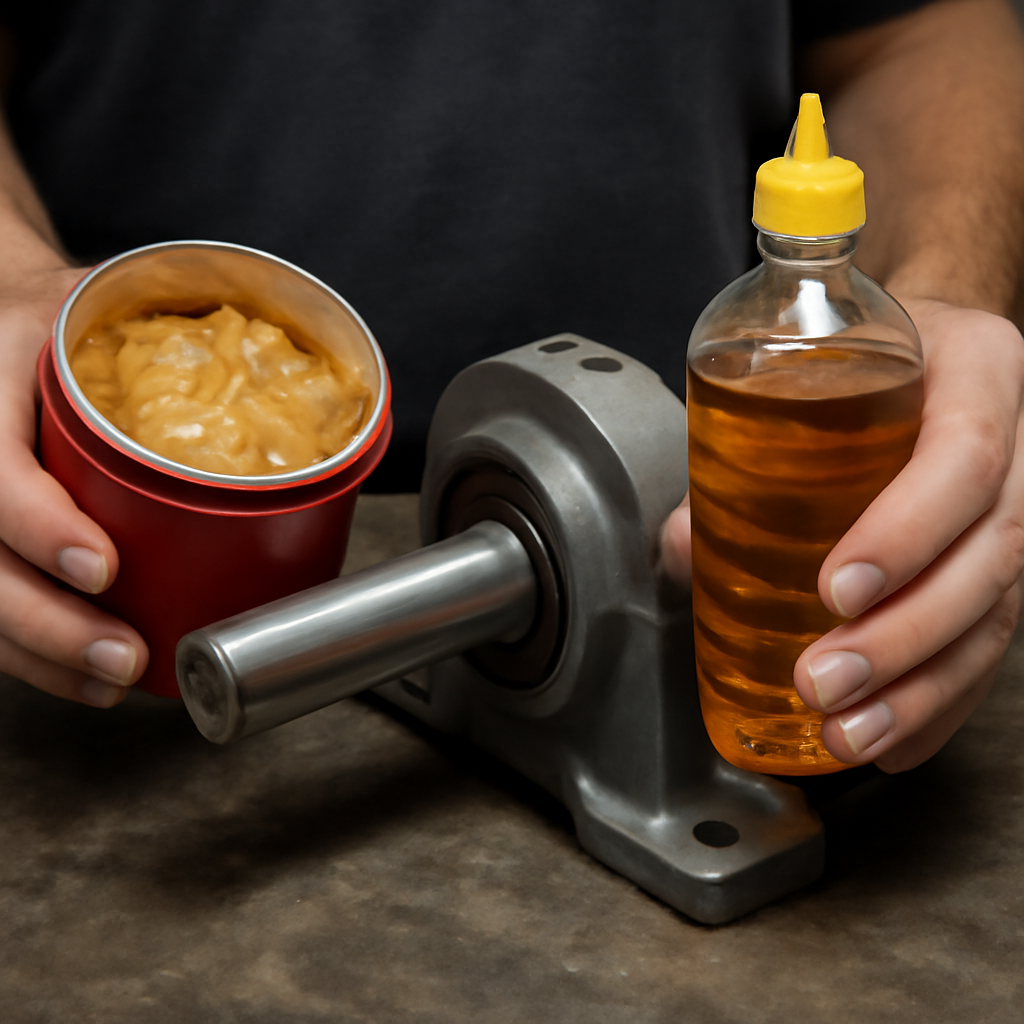
The grease versus oil lubrication choice on a mid-speed industrial shaft is one of the most common specification decisions that affects bearing service life and maintenance schedule. Mid-speed applications — those running between roughly 1,500 and 5,000 RPM on typical industrial bearing sizes — fall in the range where either lubrication approach works, with specific trade-offs that favour one or the other depending on application characteristics.
What mid-speed actually means
Mid-speed applications include general industrial pumps, fans, gearbox input shafts, and machine tool auxiliaries. The specific speed range where grease-versus-oil decisions matter depends on bearing size — 5,000 RPM matters more on a 6305 than on a 6203. The SKF catalog specifies speed limits for each bearing designation in both grease and oil lubrication conditions.
Where grease wins
Grease delivers meaningful advantages on applications where lubrication maintenance access is limited. Sealed bearings with grease pre-fill require no ongoing maintenance for typical service life. Applications with intermittent operation benefit from grease because oil migrates away from bearing contact zones during shutdown periods while grease stays in position. Vertical shaft applications favour grease because gravity does not assist oil circulation as it does on horizontal shafts.
Where oil wins
Oil lubrication delivers advantages on applications where heat removal matters. Bearings running above 80 to 100 degrees C above ambient benefit from oil’s superior heat transfer capacity. Applications with continuous operation and accessible lubrication maintenance benefit from oil’s superior long-term protection when properly maintained. High-load applications where the elastohydrodynamic film thickness matters typically favour oil for the fresh lubricant continuously circulated to contact zones.
The maintenance discipline consideration
Oil lubrication requires disciplined maintenance including oil level monitoring, periodic sampling, and scheduled changes. Applications where maintenance discipline is uncertain — remote installations, applications operated by non-specialist maintenance teams — often benefit from grease despite technical preference for oil. Match the lubrication choice to the actual maintenance capability rather than to the theoretically optimal specification.
The temperature consideration
Grease temperature limits depend on the specific thickener and base oil combination. Standard lithium grease serves acceptably to 100 degrees C above ambient. Lithium complex extends to 130 degrees C. Specialty greases with polyurea or calcium sulfonate thickeners extend to 150 to 180 degrees C. Above these limits, oil becomes the practical answer regardless of other application characteristics.
The lubrication viscosity selection
Grease base oil viscosity should match the operating speed and temperature. Standard ISO VG 100 to VG 220 grease base oil handles most mid-speed applications. Higher speed applications benefit from lower viscosity — VG 68 or VG 32. Higher temperature applications benefit from higher viscosity — VG 320 or VG 460. Oil applications follow similar viscosity selection logic.
The sealing implications
Grease-lubricated bearings often use sealed 2RS variants that trap grease and prevent contamination. Oil-lubricated bearings typically use open designs relying on housing seals for contamination protection. The sealing approach affects both bearing specification and system design. Applications transitioning between grease and oil lubrication typically require sealing changes rather than just lubricant changes.
The economic consideration
Grease application costs less than oil circulation systems in initial investment but may cost more in long-term maintenance if replacement frequency is high. Oil circulation systems have higher initial cost but lower long-term maintenance cost on applications where the system runs continuously. The break-even analysis depends on operating hours and maintenance labor cost assumptions.
The pragmatic default choice
For mid-speed industrial applications with standard operating conditions and typical maintenance capability, grease is often the pragmatic default. Applications with accessible maintenance, continuous operation, or elevated temperature requirements shift the decision toward oil. Very high speed applications above the grease speed limit require oil regardless of other characteristics.
The takeaway for procurement teams
Match the lubrication choice to the specific application characteristics rather than defaulting to one approach across all installations. Grease for accessibility and maintenance simplicity. Oil for heat removal and continuous operation. Verify the choice matches maintenance capability rather than theoretical optimization. Distributors carrying both grease and oil supply lines can serve both procurement paths.
Related coverage on Eurobearing
- Choosing Grease Marine
- Bearing Lubrication Intervals
- Lubricant Selection Tree
- High-Temperature Lubrication
- Oil Seal Materials
Need help with grease vs oil selection on specific applications? Our team supports European procurement teams with lubrication analysis. Book a free consultation.