
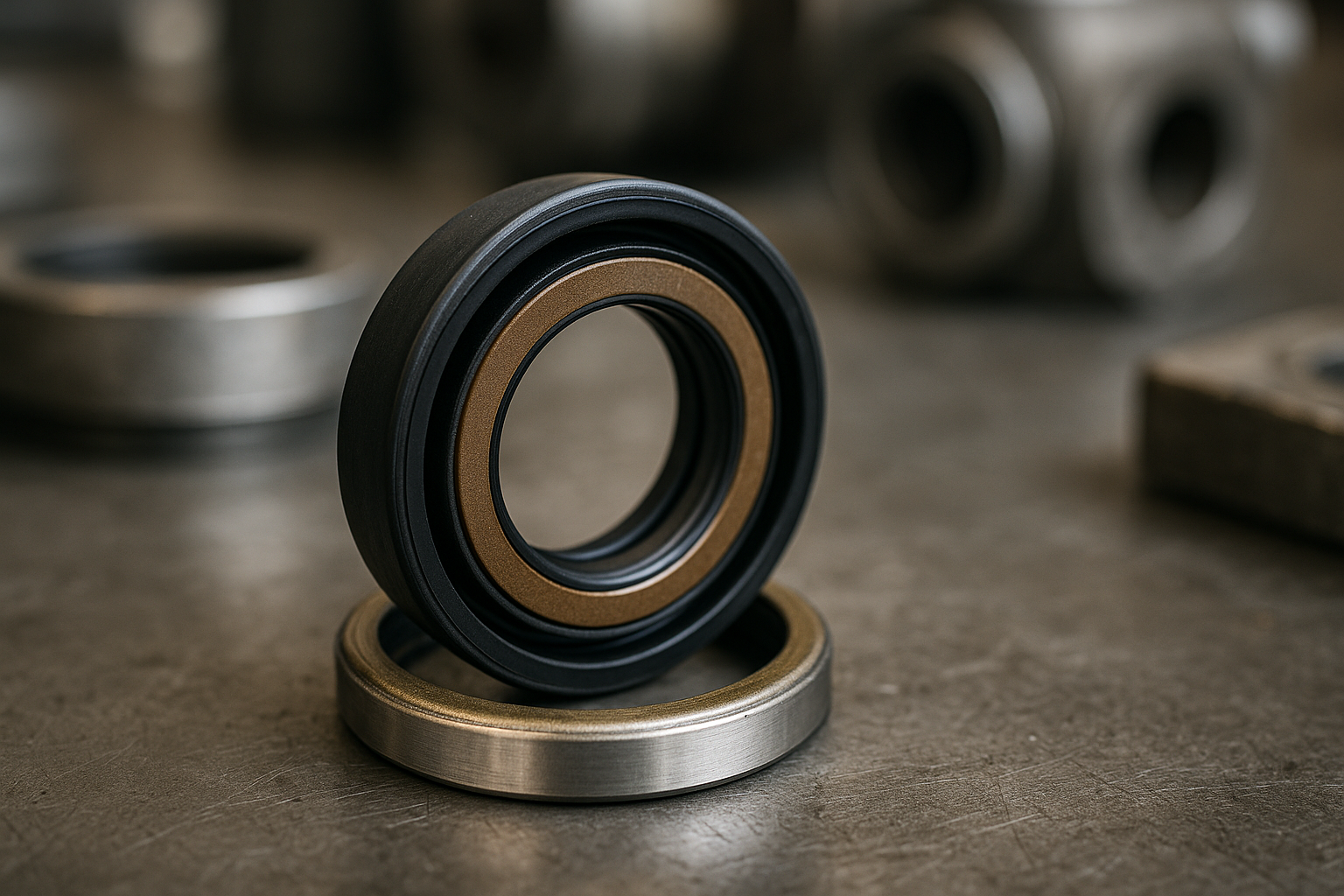
A customer puts a worn seal on the counter with a part number rubbed half away and asks for another one. This is the ordinary condition of the seal trade, and the counter staff who handle it quickly are the ones who read the seal rather than chase the number. CORTECO oil seal codes follow a convention that becomes second nature with a little practice, and understanding it turns a catalogue search into a thirty-second identification that also works when the customer has no number at all.
The three things every code tells you
A seal designation carries a profile type, a dimensional triplet and a material or feature suffix. The profile tells you whether it is single lip, double lip, whether there is a dust lip, whether it is spring-loaded. The dimensions give shaft diameter, housing bore and width in that order, always in millimetres. The suffix covers material and any special execution. Once you can separate those three components in your head, the rest of the catalogue stops being intimidating — and more usefully, you can construct the correct specification from a physical seal even when every marking on it has worn off.
Reading the dimensions off the part in front of you
Shaft diameter first, then bore, then width. A seal marked 35x50x8 fits a 35mm shaft into a 50mm housing and is 8mm wide. Measure the old seal rather than trusting the number when the number is unclear, and measure the shaft too, because a worn shaft has a groove where the lip rode and the diameter there is no longer what it was. This is the single most common error at the counter: a correctly specified seal fitted to a grooved shaft leaks within weeks and comes back as a warranty complaint. Where the groove exists, a wear sleeve is the correct answer.
Profile designations and why substituting them fails
The type prefix distinguishes single lip from double lip and identifies whether a dust lip is present. Customers routinely order a single lip because that is what the catalogue offered first, when the application had a dust lip for a reason — usually because the environment throws grit at it. The replacement then admits contamination, the main lip wears, and the seal fails early. Getting the profile right matters as much as the dimensions, and unlike the dimensions it is not self-evident from a worn part. Ask what the application is if there is any doubt.
Material suffixes are where money and failure both live
NBR is the unmarked default, good to around a hundred degrees in mineral oil. FKM appears as a V or FKM suffix and handles higher temperatures and aggressive chemistry at two to three times the cost. HNBR sits between them. EPDM serves specific chemical exposures and will not survive mineral oil, which is a trap worth remembering. Selling NBR into an application that needed FKM produces a seal that hardens and leaks within weeks; selling FKM where NBR was adequate produces an unnecessary bill. Neither is a good outcome. The material landscape is set out more fully in our overview of oil seal materials in current use.
Cross-referencing to other brands
Once you have profile, dimensions and material, the equivalent from any manufacturer follows directly, because the dimensional standards are shared. DICHTOMATIK and other European ranges cross-reference cleanly for general industrial work. The caveat is automotive rebuilds under warranty, where matching the original brand may be a contractual requirement rather than a technical one. For everything else, availability should decide. The full CORTECO seal range sits alongside the broader shaft oil seal category, and the comparison between the two main brands is covered in our piece on how DICHTOMATIK compares to CORTECO on the shelf.
What to stock and what to order
The twenty most common dimensional combinations in NBR, plus the same sizes in FKM where local industry demands it, covers the substantial majority of counter traffic. Everything beyond that is better ordered than stocked, because seal sizes have a long tail and the slow movers accumulate quickly. Reviewing which sizes actually turn, rather than which ones somebody once thought would, is worth doing annually — seal ranges are among the easiest places to accumulate dead stock precisely because individual items are cheap enough that nobody notices.
The thirty-second counter routine
Measure shaft, bore and width. Identify the profile from the old part, checking specifically for a dust lip. Ask about temperature and what fluid it runs in. Then specify. Those three steps take half a minute, prevent almost every return in the category, and mark the difference between a counter that supplies seals and one that solves sealing problems — which is what brings the customer back rather than sending them to whoever is cheapest that week.
Training counter staff on seal identification or reviewing your stocked range? Our team supports European distributors on sealing specification and inventory strategy. Book a free consultation.