
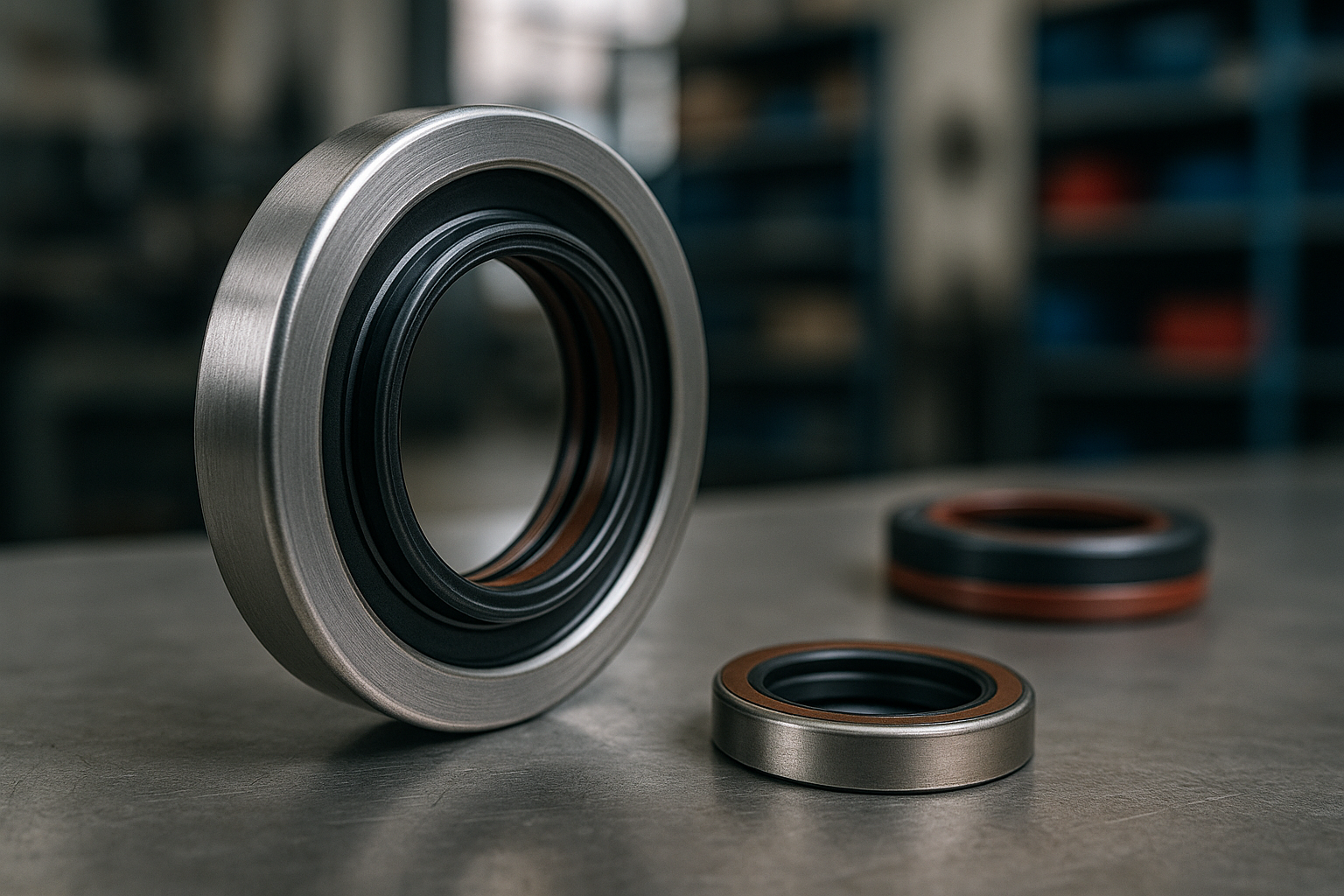
Two brands, one shelf, and a parts counter that has to decide which one to reach for. DICHTOMATIK rotary shaft seals and CORTECO cover much of the same dimensional ground in the European aftermarket, which makes them look like alternatives until you look at where each one came from. One grew out of German automotive OEM supply; the other out of broad European vehicle aftermarket coverage. That origin still shapes which applications each handles best, and it is more useful for a stocking decision than any feature comparison.
Where the two ranges came from and why it still matters
DICHTOMATIK, part of the Freudenberg group, carries the tolerance conventions and material specifications of German automotive OEM practice. CORTECO built its position on aftermarket coverage depth across European vehicle parcs, including the French and Italian applications that German-centric ranges cover less completely. Neither is better in the abstract. On a German transmission rebuild where the original was a Freudenberg-family seal, DICHTOMATIK is the closer match. On an older Fiat or Renault application, CORTECO is far more likely to have the exact size and profile on the shelf.
The dimensional part is genuinely interchangeable
Shaft diameter, housing bore and width define the fit, and a 35x50x8 from either brand will install in the same housing. For general industrial applications where no OEM specification governs the choice, cross-brand substitution works without drama and the decision comes down to availability and price. Where it stops being straightforward is on warranty-sensitive automotive rebuilds and on applications where the lip profile — not just the dimensions — was chosen for a reason. A single-lip seal fitted where a double-lip with dust lip was removed will pass oil eventually, and the dimensions will have been correct the whole time.
Material is the specification that gets missed
NBR is the default and covers most applications up to around a hundred degrees in mineral oil. FKM handles higher temperatures and aggressive chemistry at two to three times the price. HNBR sits between them; EPDM suits specific chemical exposures and is incompatible with mineral oil, which catches people out. Both brands cover the common materials, with DICHTOMATIK carrying particular depth in FKM reflecting its automotive high-temperature heritage. The practical failure here is defaulting to NBR because it was not specified — the seal works for a few weeks and then hardens, and the diagnosis blames the brand. Our overview of oil seal materials in current use covers the selection properly.
Decoding what the customer brings to the counter
Customers arrive with a seal in one hand and a part number that may or may not still exist. Reading the type designation, dimensions and material suffix off the old seal is faster and more reliable than chasing a superseded number through a catalogue, and it works across both brands. The CORTECO numbering convention in particular repays a few minutes of learning, and we set it out in our piece on decoding CORTECO oil seal codes. Getting this right at the counter prevents the majority of returns, which in the seal category are almost always specification errors rather than defects.
How to split the stock between them
For a distributor serving mixed European automotive and industrial demand, CORTECO works as the volume range because its aftermarket coverage is broader, with DICHTOMATIK carried in depth on German OEM applications and on the FKM sizes where its range is stronger. That split covers most demand without duplicating slow-moving sizes across two brands, which is the most common stocking error in this category. The broader shaft oil seal range and the double lip NBR category carry the executions that cover the bulk of counter demand.
The part nobody asks about until it leaks
A correctly specified seal fitted badly fails as reliably as a wrong one. The lip must not be inverted during installation, the shaft must be clean and free of the wear groove left by the previous seal, and the seal must be pressed square using a driver on the outer case rather than tapped in on one side. Where the shaft carries a groove, a wear sleeve is the proper answer rather than a slightly offset seal position. These are counter conversations worth having, because a seal returned as faulty is usually a seal that met a shaft nobody inspected.
Working out the right brand split for your seal stock? Our team supports European distributors on sealing specification, cross-reference and inventory strategy. Book a free consultation.