
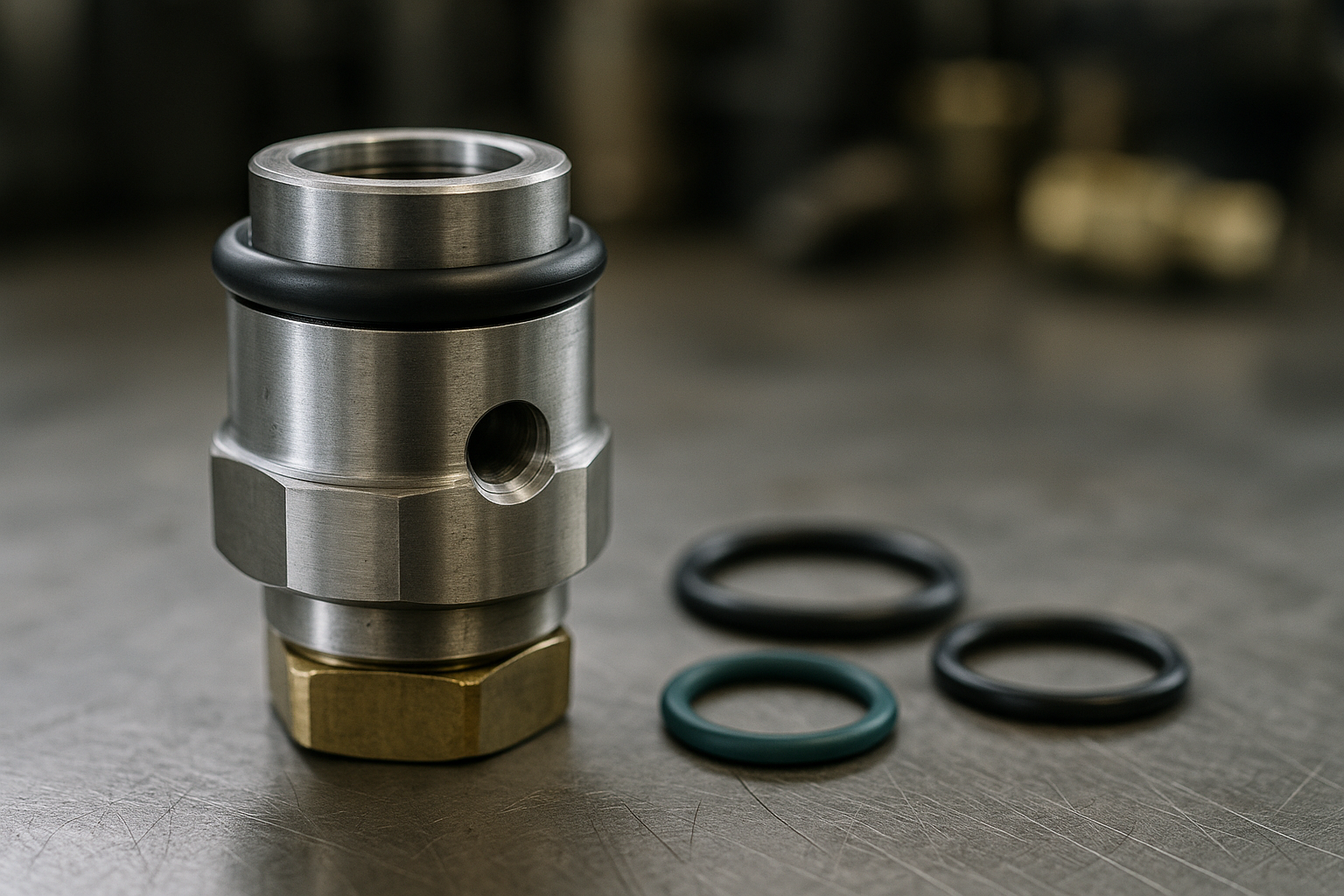
A hydraulic power pack is rebuilt over a weekend and put back into service on Monday. By Thursday the return line union is weeping, and the O-ring that comes out is swollen to the point where it will no longer fit back into its own groove. The dimensions were right. The part was new. What was wrong was the compound, because the system had been converted to a phosphate ester fluid four years earlier and nobody had updated the spares list. O-ring material selection fails this way constantly, and the reason is structural rather than technical: an O-ring is specified by two dimensions and a hardness number, all of which are printed on the packet, while the compatibility question that actually determines whether it works is not. Getting it right means asking about the fluid before asking about the size, every time.
The fluid decides the compound, and almost nothing else does
Every other consideration in O-ring selection — hardness, groove fill, surface finish, back-up rings — refines the performance of a seal that is already chemically compatible. None of them can rescue one that is not. Incompatibility shows up in two directions and both are destructive. Swelling occurs when the fluid is absorbed into the elastomer, and a compound that swells more than about fifteen percent by volume loses its mechanical properties, extrudes from the groove and can no longer be reassembled. Shrinkage occurs when the fluid extracts plasticiser from the compound, and it is arguably worse because the seal leaves the sealing surfaces entirely and often hardens and cracks at the same time. Both processes take weeks to months, which is exactly long enough for the rebuild to be signed off and the connection to the wrong part to be lost. The discipline that prevents it is to record the fluid on the machine, not just in a file, and to specify the compound on the spares list rather than accepting whatever an O-ring kit contains.
NBR and where its ceiling really sits
Nitrile rubber covers the overwhelming majority of industrial hydraulic and pneumatic work, and deservedly so: it handles mineral hydraulic oils, most greases, water below about eighty degrees, and compressed air, at a price nothing else approaches. The published temperature range of roughly minus thirty to plus one hundred degrees is where the trouble starts, because it is a peak rating rather than a service life rating. A nitrile O-ring at one hundred degrees continuous will harden and lose elasticity in months; the same ring at seventy degrees will run for years. If a system’s oil temperature reaches ninety degrees on a hot afternoon in August, nitrile is being asked for something it will deliver only briefly. The other common trap is low temperature, since standard nitrile stiffens enough around minus twenty to lose sealing contact on a cold start, which produces the classic symptom of a machine that weeps for the first twenty minutes each winter morning and then stops. Low-temperature nitrile grades exist and cost little more.
FKM: excellent almost everywhere, catastrophic in two places
Fluoroelastomer is the natural upgrade: continuous service to around two hundred degrees, outstanding resistance to mineral oils, fuels, and most process chemicals, excellent ageing and ozone resistance, and very low compression set. Where temperature, chemical aggression or a long maintenance interval is the driver, it is the right answer and worth its price several times over. It has two blind spots that matter in real plants. It is attacked by hot water and steam, which makes it the wrong choice for steam service and for hot washdown applications where people often specify it precisely because it looks like the premium option. And it is destroyed by amines, ammonia and by some of the additive packages in certain synthetic lubricants and refrigerants. A fluoroelastomer ring in the wrong service does not weep gradually; it degrades into a soft or crumbling mass. Where both high temperature and hot water are present, the compound has to be chosen against the specific combination rather than against the temperature alone. The same additive-compatibility thinking that applies to grease applies here, as our notes on grease compatibility failures illustrate.
EPDM and the brake fluid trap
Ethylene propylene handles hot water, steam, brake fluid, many acids and bases, and outdoor exposure better than anything in its price class, and it is standard in water systems, hot washdown and glycol service. Its incompatibility is absolute and in the opposite direction: EPDM is destroyed by mineral oil and by petroleum products of essentially every kind, swelling dramatically within days. This produces the single most common cross-contamination error in mixed plants, where an EPDM ring from a water system finds its way into a hydraulic joint because the dimensions matched and the colour looked close enough. The corollary is equally important in the other direction — a nitrile ring in a brake or hydraulic system using glycol-based fluid will fail — which is why any plant running both mineral and synthetic fluid systems needs its O-ring storage physically segregated and labelled by compound rather than by size alone. Colour coding helps but should never be trusted alone, since colour conventions vary by supplier and black covers several compounds.
Hardness, gland fill and extrusion
Once the compound is settled, hardness becomes the next decision, and it is a trade-off between conformity and extrusion resistance. A 70 Shore A ring is the general-purpose standard, conforming well to ordinary surface finishes and sealing reliably at moderate pressure. A 90 Shore A ring resists extrusion into the clearance gap at high pressure but needs a better surface finish and a more accurate groove to seal at all. As a rough guide, pressures above roughly 100 bar with a standard clearance call for either a harder compound or a back-up ring, and above 200 bar a back-up ring is effectively mandatory regardless of hardness. Groove design matters just as much: the ring should be compressed by around 15 to 30 percent of its cross-section for a static seal, and the groove volume must exceed the ring volume so that thermal expansion has somewhere to go. Over-filling a groove is a surprisingly common cause of failure on rebuilt equipment, particularly when a metric ring is fitted into an imperial groove or vice versa, and the resulting damage looks like extrusion without the pressure to explain it.
Compression set, storage and why an old O-ring leaks
Compression set is the permanent deformation an elastomer retains after being held compressed, and it is the mechanism by which a seal that has never seen an incompatible fluid or an excessive temperature eventually stops sealing. The ring flattens into an oval cross-section and loses the stored elastic energy that pressed it against the surfaces. Heat accelerates it enormously, which is another reason that running nitrile at its temperature ceiling shortens life so sharply. Storage matters for the same underlying reason: elastomers age in the box, and ozone, ultraviolet light and heat all attack them while they sit on a shelf. Rings should be kept in sealed bags, in the dark, below twenty-five degrees, away from electric motors and fluorescent fittings that generate ozone, and not stretched over hooks or pegs. Most compounds carry a practical shelf life measured in years rather than decades, and a drawer of loose unlabelled rings of unknown age is worth discarding rather than fitting. The principle is the same one that governs bearing storage in a distribution warehouse.
Reading a failed O-ring
The failed part usually diagnoses itself if you look before discarding it. A ring that is swollen, soft and oversized indicates chemical incompatibility with the fluid. A ring that is shrunken, hard and cracked indicates plasticiser extraction or thermal ageing. A flattened ring with a permanently oval section and no other damage is straightforward compression set at end of life. A ring with a nibbled, feathered edge on the low-pressure side has extruded into the clearance gap and needs either a harder compound, a back-up ring or a tighter gap. Spiral cuts or a twisted appearance point to installation damage or to a dynamic application where the ring rolled rather than sliding. Radial cuts and nicks mean the ring was dragged over a sharp edge or thread during assembly, which a lead-in chamfer and a smear of the system fluid prevents. Recording that observation on the job card takes ten seconds and is the difference between a rebuild that lasts and one that recurs. The same inspection logic applied to lip seals is set out in our piece on diagnosing a weeping gearbox shaft seal.
The workable rule for a stores operation is to stop thinking of O-rings as a commodity kit and start treating them the way bearings are treated, with a compound designation as part of the part number and segregated storage by compound. Record the fluid on every machine that has one, and when a fluid is changed, change the spares list in the same work order rather than in a later one that never happens. For rebuild work on hydraulic cylinders the compound question extends beyond the O-rings to rod seals, wipers and guide rings, and getting one right while getting another wrong produces exactly the same leak. A quality range from an established supplier such as CORTECO or DICHTOMATIK gives you documented compound data rather than an unmarked black ring, which is what makes the record keeping possible at all.
Rebuilt it and it still weeps? Our team supports European plants and hydraulic repairers with compound-specified sealing elements, cross-references and fluid compatibility checks before the rebuild, not after. Book a free consultation.