
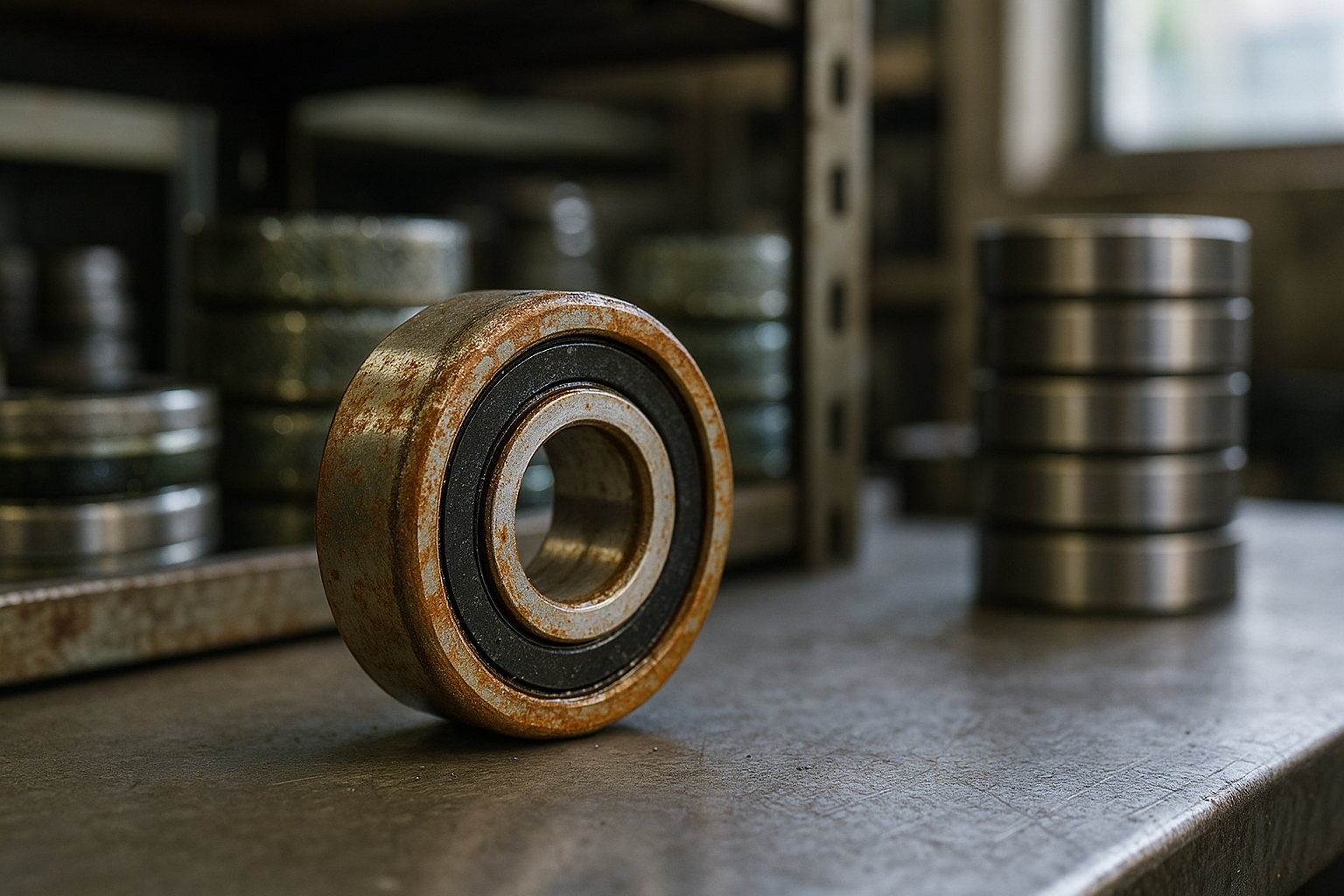
A pallet of bearings arrives on a Friday afternoon, the racking is full, and the boxes end up stacked against the outside wall of the warehouse near the loading door because that is the only free floor space. Eighteen months later somebody opens one and finds a faint brown bloom on the outer ring bore. That is bearing storage doing its quiet damage, and it is one of the few reliability problems that costs money before a component has ever turned under load. Nothing dramatic happens in a stockroom, which is precisely why the losses go unnoticed until a customer rejects a delivery or a fitter finds rust on a part with a perfectly valid batch code. The rules that prevent it are not complicated, but almost every one of them is routinely broken in real distribution warehouses, usually by people acting on entirely sensible short-term instincts.
The packaging is a component, not a wrapper
Bearing manufacturers do not use greaseproof paper and polyethylene sleeves for presentation. The inner wrap carries a vapour phase corrosion inhibitor that evaporates slowly inside the sealed envelope and plates the exposed steel surfaces with a molecular film. Once that envelope is opened, the inhibitor is gone within days, and the clock on the part starts running at a completely different rate. This is why the habit of slitting a box open to check the reference, then taping it shut again, is far more expensive than it looks: the part is now protected by a paper wrapper and nothing else. If you need to verify a reference, read the outer carton label or check the batch photograph, and if you genuinely must open the inner pack, mark the box with the date and move that item to the front of the picking sequence. Treat an opened bearing as a short-life item rather than a warehouse resident, and the problem largely disappears.
Humidity is the variable that decides everything else
Steel rings will tolerate a surprisingly wide temperature range without complaint, but relative humidity above roughly 60 percent starts pushing condensation onto any surface that drops below dew point, and a bearing sitting against an uninsulated exterior wall does exactly that every time the outside temperature falls overnight. The damage mechanism is not dramatic corrosion; it is microscopic pitting on raceway surfaces that later becomes a noise complaint or a premature spall once the part is in service. A stable environment beats a cold dry one: a warehouse held at 18 degrees with humidity between 40 and 50 percent will preserve stock better than a colder store that swings twenty degrees across a winter day. The practical intervention is cheap. Move rolling stock off exterior walls and away from roller shutter doors, keep pallets clear of concrete floors on racking rather than dunnage, and put a logging hygrometer in the worst corner of the building rather than the office. The data it produces will settle most internal arguments within one season.
Horizontal storage and why large bores behave differently
Small deep groove ball bearings are effectively indifferent to orientation, because the ring sections are stiff relative to their own weight and the internal clearance is large compared with any elastic deflection. That stops being true as bore diameter climbs. A large spherical or cylindrical roller bearing stored standing on edge for a long period rests its full mass on two or three rollers at the bottom of the complement, and the ring sections are thin enough that the geometry deforms elastically and, over long periods with vibration present, permanently. Anything above roughly 100 mm bore should be stored lying flat, fully supported on its side face, which also stops the rolling elements from settling into one contact position. The rule matters most for slow-moving large items, since those are exactly the parts that sit untouched for years. A spherical roller bearing held upright in a rack for three seasons can arrive at the fitter with false brinelling marks that no inspection at goods-in would have caught.
Shelf life is a grease question, not a steel question
Open bearings supplied without grease have, for practical purposes, an indefinite shelf life provided the preservative and the packaging remain intact. Sealed and shielded units are different, because they leave the factory already charged with grease, and grease ages whether or not the bearing turns. Base oil bleeds slowly out of the thickener structure, the additive package oxidises, and in extreme cases the grease separates into a stiff soap residue and a pool of oil that migrates to the seal lip. Most manufacturers put a practical ceiling somewhere around three to five years for a greased unit held in good conditions, and considerably less where storage temperatures run high. The failure mode is nasty precisely because it is invisible: the bearing looks perfect, fits perfectly, and then runs hot within weeks because the lubricant no longer behaves like lubricant. If you have ever had to explain a grease-related warranty argument to a customer, the dynamics will be familiar from our notes on grease compatibility failures.
Stacking, shelving and the damage nobody logs
Physical handling damage in a warehouse almost never gets recorded, because nobody sees it happen and the part carries no external mark. Cartons stacked high enough that the bottom layer crushes will press the inner packaging against ring faces; a pallet dropped six inches by a forklift transmits a shock through every part on it; a box slid off a shelf onto a concrete floor delivers an impact that can indent a raceway even inside its packaging. None of this shows up until commissioning. The controls are procedural rather than technical: cap stack heights by carton size rather than by available height, store heavy large-bore items at waist level so nobody lifts them overhead, and treat any dropped carton as a quarantine item requiring inspection instead of returning it to stock. A small quarantine shelf with an honest no-blame policy will catch more real defects than any inspection regime, because it relies on the person who dropped the box rather than on somebody finding the damage later. The same three-minute discipline applies at goods-in that we described for checking a returned pump bearing.
Rotating stock without touching every box
First in, first out is easy to say and hard to run when the same reference arrives in five deliveries a year and the picking face is at the front of the rack. The pragmatic version is to enforce rotation only where it actually matters. Sealed and shielded units, anything with a rubber component, and belts and seals all need genuine date-based rotation, because their ageing clock runs independently of use. Open bearings, housings and metal accessories do not, and forcing strict rotation on them wastes labour for no reliability gain. Split the warehouse accordingly, mark the date-critical bins physically rather than only in the system, and audit those bins quarterly rather than auditing everything annually. Most distributors discover that the date-critical population is under a fifth of the SKU count, which turns an impossible task into a two-hour job. This kind of segmentation pairs naturally with the inventory work described in our SKU rationalisation piece.
What to check before a bearing leaves the building
A thirty-second outbound check catches most of what storage does to stock. Confirm the inner wrap is intact and unopened, because that single observation validates everything else. Look at the outer carton for crush marks, water staining along the bottom edge, or a label that has been overwritten. For sealed units, check the manufacture date code against your own shelf-life threshold and flag anything approaching it rather than shipping it and hoping. For large items, confirm the part was stored flat and note it on the paperwork, because that is the first question a manufacturer’s technical department asks when a false brinelling claim lands. Where a customer is buying a premium reference such as an SKF sealed unit for a critical drive, tell them the batch date proactively: it costs nothing, and it converts a potential future dispute into a reason they trust the supplier. A 6205-2RS1/C3 that has sat sealed and dated for eight months is an entirely different proposition from one nobody can date at all.
None of this requires capital expenditure, which is why it tends not to happen: there is no project to approve and no supplier pitching a solution. What it requires is a decision that the stockroom is part of the reliability chain rather than a neutral holding area between purchase and sale. The warehouses that get this right tend to share three habits. They know their humidity range because they measure it, they can tell you the age of any sealed item on the shelf, and they have somewhere to put a suspect part other than back in the bin. Everything else follows from those three. The alternative is to keep discovering the cost at the customer’s end, where a rusted ring or a dried-out grease charge stops being a stock write-down and becomes a warranty argument with a maintenance manager who has a line down.
Unsure whether a batch is still good? Our team supports European distributors and maintenance teams with batch traceability, clearance advice and replacement references when stock has aged out. Book a free consultation.