
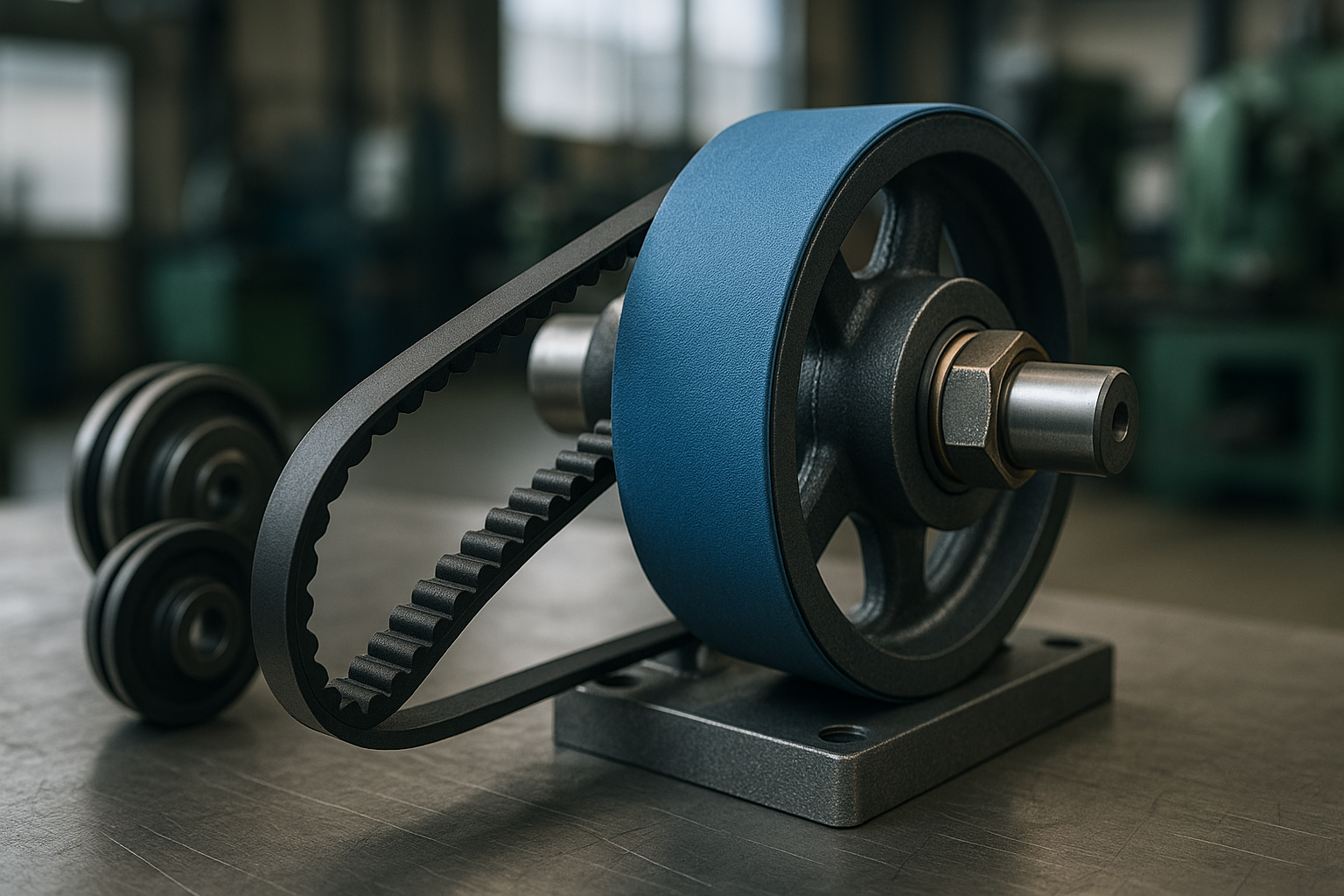
Belt drives are the part of a plant nobody thinks about until one lets go, and the specification decision usually gets made on price because the differences are invisible in the box. OPTIBELT Blue Power sits at the top of the range against the classic wrapped construction that has served European industry for decades, at a premium of thirty to sixty percent. Whether that premium returns anything depends almost entirely on how many hours a year the drive actually turns.
What the premium construction changes
Blue Power belts use different compound formulations and tighter manufacturing tolerances than the classic range, which produces three measurable effects. Flexure losses are lower, so less of the transmitted power becomes heat in the belt. Fatigue and heat-aging resistance are better, so the belt holds its length and its grip longer. And the power capacity at a given cross-section is higher, which means a given drive can transmit more without going up a section. None of these is visible at the point of purchase, which is precisely why the decision so often defaults to price.
Energy is where the numbers get interesting
A few percentage points of transmission efficiency sounds like nothing until you multiply it by a motor running continuously. On a substantial drive operating around the clock, the electricity saved over a belt’s service life can exceed the purchase price difference several times over — and that calculation has become considerably more compelling at current European energy prices than it was five years ago. On a drive that runs two hours a day, the same efficiency difference is arithmetically real and financially irrelevant. Utilisation is the variable that decides, and it decides decisively in both directions.
Service life and what replacement actually costs
Blue Power belts typically deliver thirty to fifty percent longer service life than classic construction under comparable conditions, which matters most where replacement is expensive rather than where belts are cheap. A drive at the top of a silo, inside a guarded enclosure, or on a line that has to stop for access carries a replacement cost dominated by labour and downtime rather than by the belt. Halving the frequency of that intervention is worth real money. On an accessible drive that takes ten minutes to change during a scheduled stop, it is worth very little. The broader set of practices that extend belt life regardless of tier is covered in our piece on extending transmission belt lifespan.
Where the classic range remains the right answer
Intermittent duty, moderate power, accessible drives, tolerable failure consequences. That describes a large share of industrial belt positions, and on all of them classic construction from the classic V-belt range does the job at the right price. Specifying premium across an entire plant is a common and expensive habit, and it takes budget away from the handful of drives where the upgrade genuinely returns something. Segment by running hours first and the answer usually becomes obvious without needing a spreadsheet.
The retrofit nobody thinks to do
An existing drive running classic belts can move to Blue Power at the next scheduled replacement with no modification to pulleys, guards or anything else — same section, same length, same fitting job. The incremental cost is only the belt price difference, since the labour was going to be spent regardless. On high-utilisation drives this is close to free money and it is routinely overlooked, because belt replacement is a task that gets done rather than reviewed. Auditing your continuously running drives for this once is worth an afternoon.
The belt is only half the drive
Fitting premium belts onto worn pulleys wastes them. A pulley groove that has worn out of profile grips the belt on its flanks rather than its sides, generating heat and shortening the life of whatever is fitted — and the resulting disappointment is usually blamed on the belt. Check groove profile with a gauge before specifying an upgrade, and replace pulleys from the pulley range where they have gone. Alignment matters just as much, and our notes on proper belt drive alignment cover the part that most installations get approximately right and therefore wrong.
Tension is the discipline that determines whether any of this works
An under-tensioned belt slips, heats and glazes; an over-tensioned one loads the shaft bearings and shortens their life rather than the belt’s. Premium construction does not rescue either error, which means a plant without a tensioning routine will get roughly classic-range service life from premium-range belts and conclude that the upgrade does not work. Fit properly, tension to specification with a gauge rather than by thumb, and re-check after the first running hours when the initial seating has taken place. The full V-belt range from OPTIBELT covers both tiers across the common sections, and the selection framework between them sits in our guide to OPTIBELT V-belt selection for industrial drives.
Working out which drives justify the premium tier? Our team supports European plants on belt drive specification, retrofit assessment and tensioning practice. Book a free consultation.