
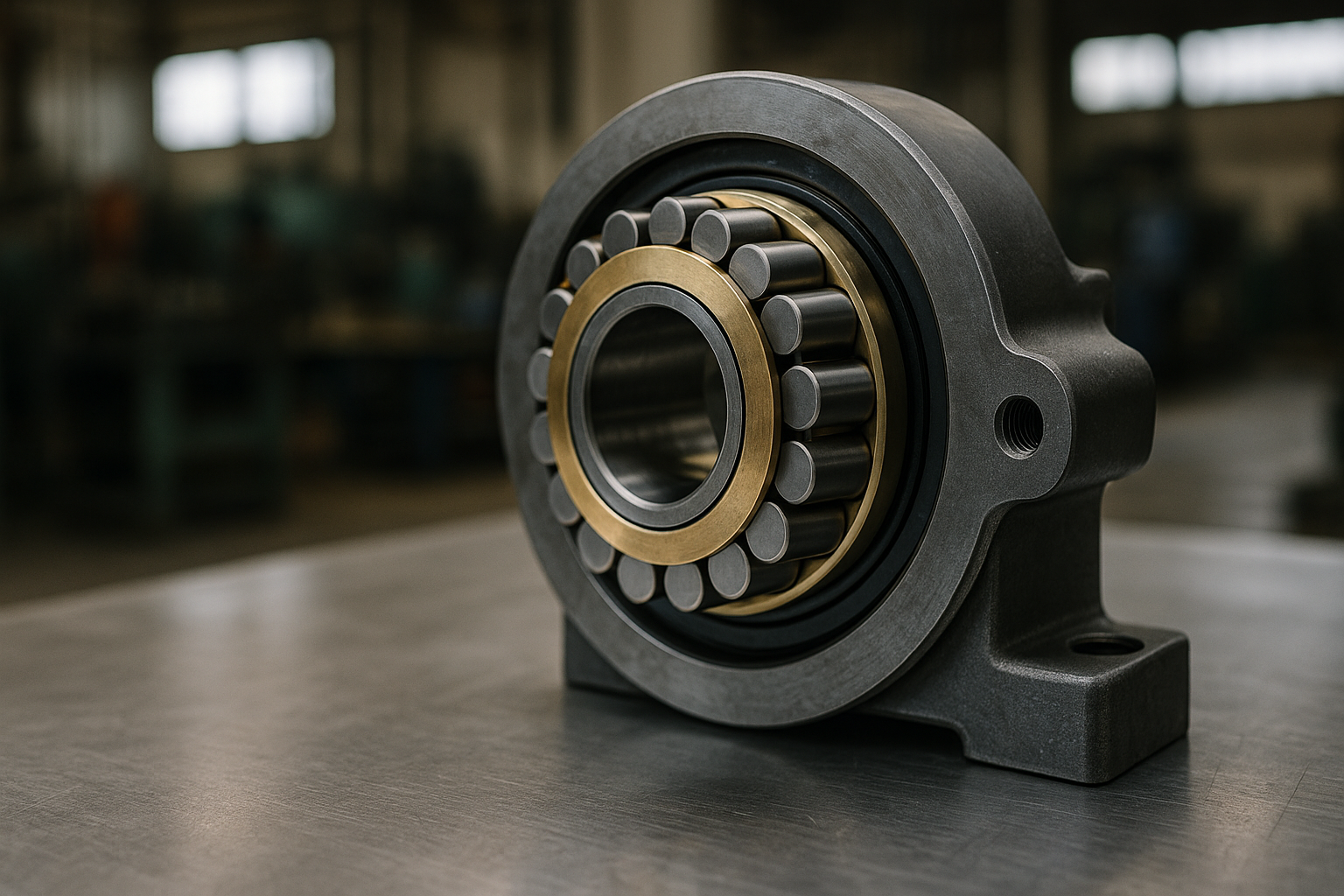
Three European steel plants, three different reliability problems, three programmes that eventually worked — and one conclusion that all three arrived at independently. Rolling mill bearing reliability is rarely improved by changing the bearing. It is improved by finding out what the bearing was actually being subjected to, which in every case below turned out to be something other than what the specification assumed.
The hot strip mill that kept losing work roll bearings
A German hot strip mill was replacing work roll chock bearings at roughly half their expected life, consistently, across several stands. The bearings were correctly specified for the calculated load and came from a major manufacturer, so attention turned to the supplier. Teardown analysis told a different story: the failure signature was water etching and corrosion, not fatigue. Descaling spray was finding its way past the chock seals during roll changes, when the assemblies sat open on the shop floor. The fix was procedural rather than technical — covering chocks during changes, revising the seal specification, and adding a purge step before reassembly. Bearing life roughly doubled without changing the bearing.
The cold mill with a vibration problem nobody could locate
An Italian cold rolling operation had intermittent bearing failures on the backup rolls with no consistent pattern — some assemblies lasted years, others months, same specification, same duty. Vibration monitoring eventually showed the failing positions had a characteristic signature appearing weeks before failure, and tracing it back pointed to chock bore wear allowing the outer ring to creep under load. The bearings were being destroyed by a housing problem, and every replacement bearing inherited the same condition. Once the chocks were measured and reconditioned on a schedule, the failures stopped. The monitoring route that found it is the kind described in our piece on setting up a vibration monitoring route, which is considerably less elaborate than most plants assume.
The section mill with a lubrication assumption that had drifted
A Spanish long products mill found bearing life falling gradually over several years with no single change to point at. The lubrication schedule had been set when the mill ran two shifts; production had since moved to near-continuous operation and nobody had revisited the interval. The bearings were receiving the same quantity of grease across substantially more operating hours, which meant the film was marginal for a growing fraction of the time. Recalculating the interval against actual running hours — the method is set out in our note on practical lubrication interval calculation — restored the expected life. The plant had been buying premium bearings to compensate for a maintenance schedule that no longer matched the duty.
What the three have in common
In every case the initial hypothesis was that the bearings were inadequate, and in every case the bearings were fine. The actual causes were a contamination path opened by a procedure, a housing condition that transferred damage to each new bearing, and a lubrication regime that had silently fallen behind a change in operating pattern. None of the three would have been found by upgrading the specification, and all three would have continued indefinitely while the plant spent progressively more on components. The instinct to treat repeat failures as a purchasing problem is strong and usually wrong.
What a rolling mill programme should actually contain
Teardown analysis of every failed bearing with the failure mode recorded rather than guessed, so that patterns become visible across time. Housing and chock dimensional checks on a schedule, because a worn seat destroys good bearings indefinitely. Lubrication intervals tied to running hours rather than to the calendar. Condition monitoring on the positions where failure is expensive enough to justify it. And a log that makes the accumulated evidence usable, which is the part most plants skip — the design that survives contact with a busy maintenance department is described in our piece on the failure master log.
Where specification genuinely does matter
None of this argues against premium bearings in mill applications. Work roll and backup roll positions carry very high loads in contaminated, hot, wet conditions, and the material quality in premium ranges from SKF, FAG and TIMKEN delivers real service life advantage once the root causes above are addressed. Sealed executions across the spherical roller and cylindrical roller ranges are the right answer for contaminated positions. The sequence matters though: fix the cause first, then the upgraded specification delivers what it promises instead of being consumed by the same underlying problem.
The conclusion all three plants reached
Repeat failures are information, not bad luck. A position that eats bearings is telling you something about its condition, its environment or its maintenance regime, and the bearing is the messenger rather than the culprit. Plants that investigate rather than reorder find the cause within a few cycles and stop paying for it; plants that treat it as a supply problem keep buying the same failure at increasing cost. The difference between the two is not budget or sophistication — it is whether anybody opens the failed bearing and looks at it properly.
Working on a reliability programme for mill positions? Our team supports European steel operations on failure analysis, specification and lubrication strategy. Book a free consultation.