
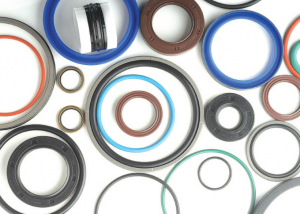
Sealing rings and oil seals are available in various standard and specialized materials for the sealing lip (the elastomer component), the metal insert, and the spring. Usually, the material used for the sealing lip is specified. The description of elastomer materials follows the nomenclature used in DIN ISO 1629 and ASTM D 1418. The raw material for the elastomer element is synthetic rubber produced by the chemical industry. Elastomers differ based on the base polymer from which they are made.
The finished material used to produce the elastomer for the oil seal is obtained by combining the raw material, rubber, with numerous additives, such as fillers, pigments, plasticizers, processing aids, antioxidants, vulcanizing agents, curing accelerators, retarders, and more. This process provides the specific characteristics required for the material.
Sealing rings are available on the market in both standard materials suitable for a wide range of applications and specialized materials for applications requiring very high performance. The sealing ring achieves its final shape through a vulcanization process, during which the metal insert is securely bonded to the rubber. Following a chemical-physical transformation, the rubber transitions from a predominantly plastic state to an elastic state, acquiring its sealing properties. This is achieved either through a cutting operation afterward or directly during the molding process. The spring is inserted at the end of the process.
Let’s take a closer look at the various standard and specialized materials available for the sealing lip:
Nitrile Rubber (NBR)
NBR oil seals are made using a copolymer elastomer of butadiene and acrylonitrile, and they are used for most conventional fluid sealing applications. The acrylonitrile content determines the classification into low, medium, or high nitrile. The higher the content, the greater the resistance to oils and petroleum-derived hydrocarbons. However, this also decreases flexibility at low temperatures. For this reason, the standard NBR compound used offers the best compromise between oil and hydrocarbon resistance, flexibility, and mechanical strength.
- Operating temperature: -30°C to 100°C (120°C for high-nitrile classification)
- Color: Black
Advantages:
- Good resistance to mineral oils and greases
- Good resistance to water and radiator fluids
- Good tear and abrasion resistance
- Good flexibility
Limitations:
- Poor resistance to ozone, weather, and direct sunlight
- Not resistant to glycol-based fluids
- Poor resistance to polar fluids (ketones, ethers, esters), chlorinated hydrocarbons, and aromatic solvents
Fluorinated Rubber (FPM)
Better known as Viton® (a trademark of DuPont), its primary advantage lies in its resistance to high temperatures. Viton oil seals are usually brown in color.
- Operating temperature: -30°C to 200°C
- Color: Brown
Advantages:
- Excellent resistance to mineral oils and greases, including most additives, and hydrocarbons
- Resistant to most chemicals, except ketones, ethers, and esters
- Excellent resistance to aging, ozone, and weather
Limitations:
- Hardens at low temperatures
- Lower abrasion resistance compared to NBR compounds
Silicone Rubber (SIL)
Also known as MVQ or VMQ, its main advantage is its relative stability across a wide temperature range. Silicone oil seals and sealing rings are available upon request.
- Operating temperature: -60°C to 200°C
- Color: Red
Advantages:
- Stability across temperature variations
- Good resistance to mineral oils and greases
- Excellent resistance to aging, ozone, and weather
- Good chemical resistance to alkalis
Limitations:
- Not recommended for use with hydrocarbons containing benzene or paraffin and light mineral oils
- Poor resistance to water, acids, and non-mineral brake fluids
- Low tensile strength and abrasion resistance
Ethylene Propylene Rubber (EPDM)
Characterized by high resistance to abrasion, aging, and weather, this compound is specifically used where moderate operating temperature ranges are required.
- Operating temperature: -50°C to 150°C
- Color: Black
Advantages:
- Resistant to non-mineral oils, brake fluids
- Resistant to polar fluids, aging, and water
Limitations:
- Poor resistance to mineral oils and greases
Polyurethane
This elastomer is distinguished by exceptional abrasion resistance—better than all other rubbers—as well as high strength and tear resistance while maintaining excellent flexibility at low temperatures.
- Operating temperature: -40°C to 100°C
Advantages:
- High mechanical strength
- Good flexibility
- Excellent abrasion resistance
- Good resistance to petroleum and derivatives, weather, and ozone
Limitations:
- Poor resistance to aqueous, acidic, or alkaline solutions, hot water, glycol, steam, and ketones
- Rapid degradation at high temperatures
Related Reading
- Bearing Lubrication Intervals: A Practical Calculation Method
- How to Choose the Right Grease for Marine Bearings
- Sealing Rings and Oil Seals: Materials Used in 2026
- Grease vs Oil Lubrication for Bearings: A Decision Framework
- Sealing Solutions: Oil Seals vs Gaskets Compared
Need help with bearing selection?
Our Euro Bearing technical team helps engineers and maintenance managers choose the right bearing, seal or linear component for each application — from automotive transmissions to agricultural machinery and industrial robotics. Tell us your operating conditions (load, speed, temperature, environment) and we will recommend the optimal solution from our catalogue of premium European bearings.
Contact our technical office → or browse the full product range.
Nitrile (NBR): The Default General-Purpose Compound
Nitrile rubber, designated NBR or sometimes Buna-N, is the most widely specified elastomer for oil seals in general industrial applications. Its operating window of roughly −30 °C to +100 °C covers the great majority of conveyor drives, gearboxes, hydraulic cylinders and electric-motor housings. It resists mineral oils, vegetable oils, most hydraulic fluids and water, and it is comparatively inexpensive. The compromises are an upper temperature ceiling that fails under prolonged contact with hot oils above 100 °C, poor resistance to ozone and weathering that limits outdoor use without shielding, and incompatibility with brake fluids, ketones and strong oxidisers. Where these limits are not crossed, NBR remains the rational default.
Fluoroelastomers (FKM/Viton®): When Temperature or Chemistry Push NBR Past Its Limit
Fluoroelastomer — sold under the Viton® brand by Chemours and as FKM by other producers — is the workhorse for elevated-temperature and aggressive-chemistry applications. The continuous operating range stretches from −20 °C to +200 °C, with intermittent excursions to +250 °C tolerated. FKM resists synthetic oils, high-temperature mineral oils, fuels, and a wide spectrum of solvents and acids that destroy NBR within hours. The price difference can be three to five times higher than NBR, which means selection should be deliberate rather than reflexive, but for transmission cases, transfer pumps for hot fluids, automotive engine and gearbox seals, and any environment with chemical exposure, FKM pays for itself in extended service intervals.
EPDM, PTFE and Composite Constructions
EPDM (ethylene-propylene-diene) is the seal material of choice for water, steam, polar solvents and brake fluids — applications where NBR and FKM both fail. It does not tolerate mineral oils, so it is rarely used on bearing housings, but it is universal on cooling-system seals and on outdoor enclosures because of its excellent ozone and UV resistance. PTFE (polytetrafluoroethylene) is at the opposite end of the spectrum: a fluoropolymer that resists almost everything and operates from cryogenic temperatures to over 250 °C, but with negligible elasticity. This is why PTFE almost always appears as a sealing lip on a metal carrier, sometimes spring-energised, rather than as a standalone moulded ring. Composite seals combining a PTFE lip with an elastomer back-up are the gold standard for difficult applications.
A Pragmatic Selection Sequence
A workable selection sequence starts with the four extreme values of the application: maximum continuous temperature, minimum starting temperature, fluid in contact with the lip, and shaft surface speed at the sealing diameter. If maximum temperature stays below 100 °C and the fluid is a mineral oil or grease, NBR is the answer. If temperature exceeds 100 °C but stays below 200 °C, or if the fluid is synthetic or aggressive, move to FKM. If the fluid is water-based or includes brake fluid, EPDM is the answer. If surface speed exceeds roughly 15 m/s, or if dry-running episodes are possible during start-up, the carrier should host a PTFE lip rather than an elastomer one. After material selection, verify the dynamic profile — single-lip, double-lip with dust shield, spring-loaded — against the shaft eccentricity and the contamination level. This four-step sequence resolves the great majority of selection questions in less than five minutes.
Related Resources from Eurobearing
For technicians who want to go deeper into oil seal materials, our editorial team has produced dedicated guides on adjacent topics. Each of the following articles complements the framework above with concrete examples, photographs, and selection tables built around real distribution scenarios:
- Viton Oil Seal: A Top-Quality Component for Lubricant Products
- Sealing Solutions: Oil Seals vs Gaskets Compared
- Lubricant Selection: A Decision Tree for 12 Industrial Scenarios
- Guide to Choosing Lubricants for Bearings: Greases vs Industrial Oils
Need help with bearing selection?
Eurobearing is a European bearing and power-transmission distributor based in Northern Italy serving OEMs, MRO buyers, and industrial resellers across more than 40 countries. Our technical desk can help you cross-reference legacy part numbers, identify the correct dynamic load rating, choose the right cage material or seal type, and align lubricant intervals to your duty cycle. If you are evaluating oil seal materials for a specific machine — whether it is a continuous-process line, a packaging station, an agricultural drivetrain, or a marine winch — we are happy to review specs and propose qualified options from brands like SKF, FAG, INA, NSK, NTN, NMB, and Schaeffler. Contact the Eurobearing technical team for a free consultation, share the application photograph and the failed reference, and we will return a recommendation within one business day.