
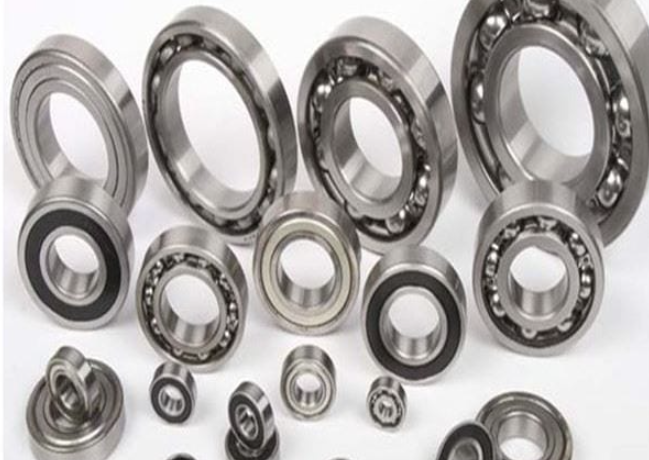
But what are the main types of bearings? And what are their characteristics?
Deep Groove Ball Bearings
Let’s start with a quick look at deep groove ball bearings, which are characterized by a very simple structure and can consist of one or two rows of balls. They can support a radial load (i.e., they can support a force directed perpendicular to the axis) and a light axial load (i.e., they can support a light force directed axially), and can operate under versatile conditions, including at fairly high speeds.
This particular category of ball bearings is usually non-separable and has various shielding schemes to prevent the ingress of dirt and debris, either sealed (with no radial clearance) or unsealed (with radial clearance).
Self-Aligning Ball Bearings
Another category of ball bearings is represented by self-aligning ball bearings, characterized by the presence of two rows of balls and mainly used in scenarios requiring a high degree of rotation between the rings. Their structure is quite different from those in the previous category: they have an inner ring with two raceways and an outer ring with a single spherical raceway. Lubrication holes ensure proper movement: they are non-separable and can be made either sealed or unsealed.
Angular Contact Ball Bearings
Another category of ball bearings is angular contact ball bearings, which consist of particular inner and outer ring raceways, offset from each other in the direction of the bearing axis: the contact between the balls and the raceways occurs along an oblique axis relative to the bearing axis. Typically, these bearings are used in situations where combined loads need to be supported, i.e., when radial loads (those generating force perpendicular to the axis) and axial loads (those generating force in the axial direction) act simultaneously. The axial load capacity will increase as the angle between the line connecting the contact points between the ball and the raceways and the perpendicular to the bearing axis increases. These bearings are separable and can be made with a single row of balls, which must always be mounted in opposing pairs, or with two rows of balls.
Related Reading
- How to Inspect a Bearing After 24 Months of Service
- Strategies to Extend the Lifespan of Power Transmission Belts in 2026
- AB-TOOLS Hand Tools for the Maintenance Technician
- Spherical Roller Bearings: Heavy-Load Applications Explained
- Angular Contact Bearings: When and Why to Use Them in 2026
Need help with bearing selection?
Our Euro Bearing technical team helps engineers and maintenance managers choose the right bearing, seal or linear component for each application — from automotive transmissions to agricultural machinery and industrial robotics. Tell us your operating conditions (load, speed, temperature, environment) and we will recommend the optimal solution from our catalogue of premium European bearings.
Contact our technical office → or browse the full product range.
Deep-Groove Ball Bearings: The Industrial Workhorse
Deep-groove ball bearings are the single most produced type of rolling-element bearing in the world, and for good reason. The geometry — a deep raceway in both inner and outer ring with a single row of balls — supports moderate radial loads, modest axial loads in both directions, and a wide range of speeds from a few revolutions per minute up to tens of thousands. They are tolerant of mounting imperfections within reason, available in dozens of sealed and shielded variants, and produced in millions of size combinations from a few millimetres bore up to over a metre. When an engineer reaches for a bearing without prior reason to specify something else, this is the type they pick, and it is correct in roughly seventy percent of general-purpose applications.
Angular-Contact Ball Bearings: Pairing for Stiffness
Angular-contact ball bearings shift the contact line between balls and raceway off the radial plane, giving them genuine thrust-load capacity in one direction. They are almost always installed in pairs — back-to-back, face-to-face, or in tandem — and the chosen arrangement determines whether the pair behaves as a stiff rigid system, a self-correcting compliant system, or a high-thrust system. Machine-tool spindles, automotive wheel hubs, screw-drive end supports and high-performance pump shafts all use angular-contact pairs because they combine high radial stiffness with controlled axial preload. Selection requires careful attention to contact angle (15, 25, or 40 degrees are common), preload class, and the matched-pair specification stamped on the rings.
Self-Aligning, Thrust, and Miniature Variants
When a shaft is long, flexes under load, or runs in a housing that cannot guarantee precise alignment, a self-aligning ball bearing solves the geometry problem at the bearing level. The outer raceway is spherical, so the inner assembly can pivot a few degrees without restraint, removing the parasitic loads that destroy fixed-axis bearings in agricultural drives, textile machinery, and pulley shafts. Pure thrust ball bearings, by contrast, accept axial load only and are found on vertical shafts where radial loads are negligible — gear pumps and rotating tables, for example. Miniature ball bearings, finally, occupy a different world: bore sizes from a single millimetre, found in dental handpieces, micro-pumps, surgical drills and high-end small fans, where the loads are tiny but the speeds and cleanliness requirements are extreme.
Choosing Between Types: A Decision Sketch
The selection logic begins with the load picture. If radial load dominates and axial load is incidental, deep-groove is the starting point; if axial load is significant or stiffness matters, move to angular-contact pairs; if angular misalignment is a real possibility, choose self-aligning. From there, narrow by speed: deep-groove and miniature variants handle very high speeds with appropriate cage materials; thrust bearings have lower speed ceilings; self-aligning roller types replace ball variants when loads grow heavier. Next, narrow by environment: contaminated environments push you toward sealed deep-groove or solid-housed units; high temperatures push you toward C3/C4 clearance and high-temperature grease; corrosive environments shift you toward stainless steel rings and balls. Eurobearing maintains stock across all of these categories from major manufacturers, which means selection is rarely constrained by availability.
Related Resources from Eurobearing
For technicians who want to go deeper into ball bearing types, our editorial team has produced dedicated guides on adjacent topics. Each of the following articles complements the framework above with concrete examples, photographs, and selection tables built around real distribution scenarios:
Sealing, Lubrication, and Cage Variants Within Each Type
Once the bearing type is chosen, three further selections remain that strongly affect operating life. The seal variant — open, shielded (Z, 2Z), contact-sealed (RS, 2RS), or low-friction (RSL) — trades contamination protection against drag and heat. The lubricant fill — standard grease, low-temperature grease, food-grade, or high-temperature — must match the operating window. The cage — stamped steel, machined brass, polymer (TN, TVH) — affects mass, speed limit, and resilience to shock and chemical exposure. These three sub-selections collectively define what the catalogue calls the bearing’s suffix code, and getting any one of them wrong produces a bearing that fits geometrically but fails functionally.
In high-volume OEM applications, the suffix code is often a negotiated specification rather than a catalogue pick — manufacturers offer variants that are not in the standard listings. In MRO contexts, picking the right standard suffix the first time saves repeat orders.
A short worked example: a packaging conveyor running at 28 °C ambient with weekly washdown will typically be specified deep-groove 6206-2RS C3 with food-grade NSF H1 grease and a glass-fibre-reinforced polyamide cage. Every element of that suffix maps directly to an operating constraint. Substitute even one element — 2Z instead of 2RS, for instance — and washdown ingress will halve the service life.
Eurobearing maintains technical documentation, cross-references and supply for the full catalogue of major bearing brands — SKF, FAG, INA, NSK, NTN, NMB, Schaeffler and dozens of secondary suppliers. If you need a second opinion on a ball bearing types question your team is wrestling with, our engineering desk is reachable by email and replies typically within one business day.
Need help with bearing selection?
Eurobearing is a European bearing and power-transmission distributor based in Northern Italy serving OEMs, MRO buyers, and industrial resellers across more than 40 countries. Our technical desk can help you cross-reference legacy part numbers, identify the correct dynamic load rating, choose the right cage material or seal type, and align lubricant intervals to your duty cycle. If you are evaluating ball bearing types for a specific machine — whether it is a continuous-process line, a packaging station, an agricultural drivetrain, or a marine winch — we are happy to review specs and propose qualified options from brands like SKF, FAG, INA, NSK, NTN, NMB, and Schaeffler. Contact the Eurobearing technical team for a free consultation, share the application photograph and the failed reference, and we will return a recommendation within one business day.