
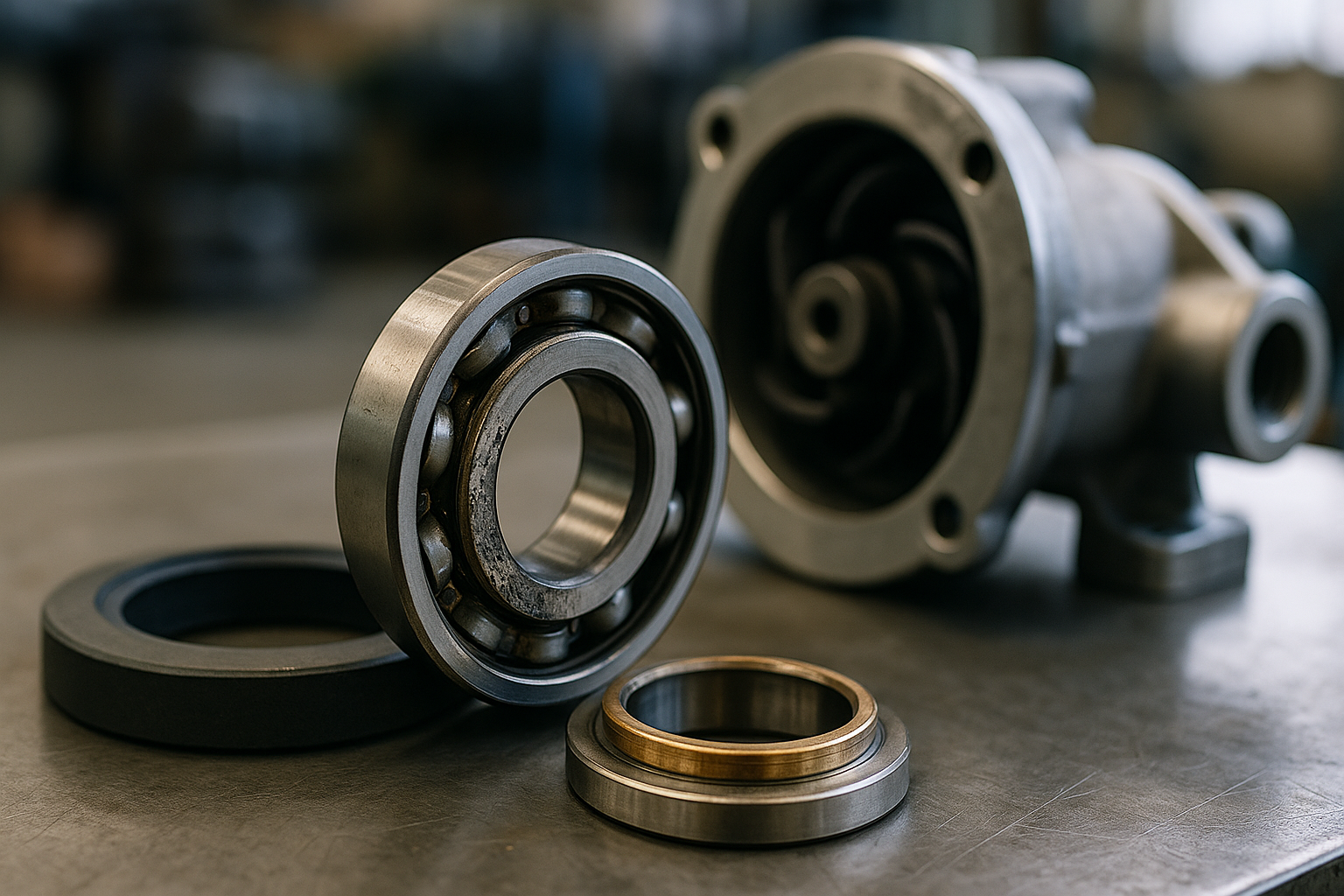
A pump arrives back at the workshop on a pallet with a note that says “noisy, leaking”. That is the entirety of the diagnostic information the customer has supplied, and it is fairly typical. The three-minute bearing damage check is what an experienced technician does before the unit goes anywhere near a bench, and it exists because knowing within three minutes whether you are looking at a bearing failure, a seal failure or something the pump did to itself changes which queue the job goes into and what you tell the customer this afternoon rather than next week.
What you are trying to establish before you open anything
The question is not what failed in detail — that comes later with the unit apart. The question is which failure family you are in, because the four answers lead to four different amounts of work and four different conversations about cost. Bearings fine and the problem is elsewhere; bearings tired and worth changing while you are in there anyway; bearings are the primary failure; or the bearings have destroyed enough around them that the economics of repair need checking before anyone spends more time. Sorting into those four buckets at intake is worth doing well, and it takes three minutes.
Thirty seconds looking, ninety seconds turning, sixty seconds writing it down
Start with the outside. Where has oil come from — the bearing housing or the shaft seal? Is there corrosion streaking, impact damage, evidence of the pump having run somewhere it was not specified for? Then turn the shaft by hand, slowly, through several full revolutions, and pay attention to what you feel and what you hear. Then photograph what you found and write down what you observed while it is still in your hands, because the technician who strips it in three days will not remember the conversation. Documentation habits at this stage save arguments later, and the wider case for keeping this data is made in our piece on the failure log a maintenance team actually uses.
What the hand tells you
Smooth and silent through a full rotation means the bearings are probably healthy and the fault is elsewhere — check the seal and the impeller. A faint regular roughness means wear has started and the bearings should be replaced during whatever work happens anyway. Pronounced roughness, catching, or a rotation that varies in resistance means bearing damage that is very likely the reason the pump came back. Anything that will not turn at all means catastrophic failure, and the assumption from that point should be that the shaft and housing need measuring too, not just the bearings.
What the ear adds
Continuous grinding through the rotation points to raceway damage — spalling or abrasive wear from contamination. A regular click once per revolution suggests a damaged rolling element or a failing cage. A dry squeal means lubrication has gone, either lost through a breached seal or degraded by heat. Metallic knocking means something is loose inside and the unit needs opening carefully, because parts may fall out of it. Each of these sounds maps to a failure family, and building that vocabulary is the part of the check that takes a technician longest to learn; the visual counterparts are collected in our visual guide to bearing failure modes.
Where the oil came from matters more than how much
Oil tracking from the bearing housing indicates the housing seal has gone, and on a pump that has been running that usually means the bearing was already generating heat or vibration that finished the seal off. Oil at the shaft seal with a dry bearing housing is a different fault entirely and often unrelated to bearing condition. Both wet means either a long-running neglect or a single event that took out more than one thing. Reading the leak path correctly at intake is what stops a job being quoted as a seal replacement and then coming back as a rebuild, which is the conversation nobody enjoys having twice. In chemical service the corrosion history complicates all of this, and we covered that environment separately in our notes on pump bearings under corrosive vapour.
What to do with the result
Route the unit to the appropriate queue and tell the customer today what you found and what it probably means, with the caveat that teardown may change it. Customers value the early call disproportionately, partly because it lets them decide about repair versus replacement while the decision is still theirs to make calmly. Over time the intake observations also accumulate into something useful: patterns by pump model, by site, by duty. When the same model keeps arriving with the same failure signature, that is a specification conversation worth having with your bearing supplier — brands with application engineering support behind the distribution, such as SKF or FAG, can work from that evidence, and replacements across the deep groove and angular contact ranges can be specified deliberately rather than like-for-like.
Teaching it to someone who has not done it
The check is mostly calibrated judgement, which means a new technician needs to feel a dozen known-good shafts and a dozen known-bad ones before their hand means anything. Pair them with someone experienced at intake for a few weeks, and keep a small shelf of failed bearings with known histories to hand for reference. It is a modest training investment against a check that improves throughput, sharpens the customer conversation and builds the evidence base for supplier discussions. Most workshops that adopt it formally wonder afterwards why they spent years opening pumps to find out things they could have known on the pallet.
Setting up intake diagnostics or reviewing recurring pump failures? Our team supports European service workshops on bearing specification and failure analysis. Book a free consultation.