
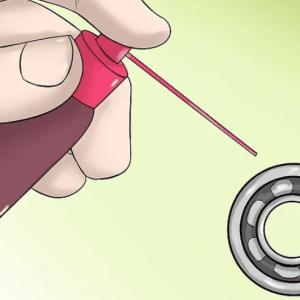
We recently discussed grease lubrication for bearings, emphasizing the importance of preventive maintenance, evaluating the need for refills, and monitoring for operational anomalies.
Now, it’s time to focus on the other main type of bearing lubrication: oil lubrication.
Oil Lubrication
For an oil-bath lubrication system, it is advisable to have an integrated system with an oil level indicator to ensure proper oil maintenance when the bearing is not in use. This reduces the risk of errors caused by estimations regarding whether or not a refill is needed.
If the amount of oil present is below the recommended level, a top-up is necessary. Conversely, if the system operates correctly and there are no hydraulic leaks, the need for frequent lubrication intervention decreases.
When Is Re-Lubrication Necessary?
The need to replace or replenish the oil in a bearing lubrication system primarily depends on the operating conditions.
- If the bearing operates at a low temperature in a favorable environment, free from contamination by dust or other impurities, re-lubrication requirements will be minimal and infrequent. In this case, following the manufacturer’s recommendations is sufficient.
- If the bearing works at high operating temperatures, is exposed to external heat sources, or frequently comes into contact with dust and other contaminants, oil replacement will be needed more frequently.
As for the amount of oil to be added, it depends on the specific operating conditions, making it difficult to provide a generic estimate. It is always best to refer to manufacturer guidelines or a professional mechanical consultant for precise recommendations.
Cuscinetti & Componenti: The Best Selection for You!
At Cuscinetti & Componenti, we offer over 50,000 industrial items, bearings, and components, ensuring that you can find everything needed to optimize your system’s performance. If you cannot find the exact component you need, our team of consultants is available to explore customized solutions for you.
We also offer fast delivery throughout Italy, secure payments via credit card, PayPal, or bank transfer, and highly reliable pre- and post-sales technical support to ensure customer satisfaction!
Related Reading
- Bearing Lubrication Intervals: A Practical Calculation Method
- How to Choose the Right Grease for Marine Bearings
- Sealing Rings and Oil Seals: Materials Used in 2026
- Grease vs Oil Lubrication for Bearings: A Decision Framework
- Sealing Solutions: Oil Seals vs Gaskets Compared
Need help with bearing selection?
Our Euro Bearing technical team helps engineers and maintenance managers choose the right bearing, seal or linear component for each application — from automotive transmissions to agricultural machinery and industrial robotics. Tell us your operating conditions (load, speed, temperature, environment) and we will recommend the optimal solution from our catalogue of premium European bearings.
Contact our technical office → or browse the full product range.
The Physics: How an Oil Film Actually Separates Steel from Steel
The whole purpose of lubricating a rolling bearing is to keep the rolling elements from touching the raceways. Inside the contact zone the pressure reaches values in the order of one to three gigapascals — high enough that the oil temporarily behaves almost like a solid and the steel surfaces themselves deform elastically. This regime is called elastohydrodynamic lubrication (EHL), and the film it produces is astonishingly thin: typically 0.1 to 1 micrometre, thinner than the roughness of many machined surfaces.
Whether that film is thick enough is expressed by the lambda ratio (λ), the film thickness divided by the combined surface roughness of the two contacting bodies. Above λ = 3 the surfaces are fully separated and fatigue life approaches the theoretical maximum. Between 1 and 3 there is occasional asperity contact — the mixed regime where most industrial bearings actually live. Below λ = 1 the bearing is in boundary lubrication, the additive package is doing the work instead of the oil film, and life falls quickly. Every practical lubrication decision — viscosity, temperature, speed, cleanliness — is ultimately a decision about lambda.
Choosing the Viscosity: The Only Calculation That Really Matters
Viscosity selection follows a simple logic. First, calculate the required viscosity (ν1) from the bearing’s mean diameter and its rotational speed: the larger and faster the bearing, the lower the required viscosity. Second, find the actual viscosity (ν) of your candidate oil at the bearing’s real operating temperature — not at 40 °C, which is only a reference. The ratio κ = ν / ν1 should be at least 1, and ideally between 1 and 4.
A κ below 1 means the film is too thin: increase viscosity, lower the temperature, or accept a shorter life. A κ far above 4 is also a mistake — an over-viscous oil generates churning losses, raises the operating temperature and can end up producing a thinner film than a correctly chosen oil. Two practical corollaries follow. Operating temperature must be measured, not assumed, because viscosity roughly halves for every 10–15 °C. And the viscosity index (VI) matters: a high-VI oil holds its viscosity across a wider temperature range, which is why synthetic base oils are the default choice for machines that see large thermal swings.
Oil Lubrication Methods, from Simplest to Most Demanding
Oil bath. The bearing dips into a static reservoir; the rolling elements carry oil into the contact. Simple, cheap and self-contained, but limited to low and moderate speeds — the oil level must reach roughly the centre of the lowest rolling element, and no higher, or churning losses and heat will rise sharply.
Oil circulation. A pump moves oil through the bearing and back through a cooler and a filter. This is the workhorse of medium and high-speed industrial machinery, because it does two jobs the bath cannot: it removes heat, and it removes particles. Where the bearing is a significant heat source, circulation is not optional.
Oil jet. One or more nozzles fire oil directly into the bearing at high velocity, penetrating the air barrier that surrounds a fast-rotating bearing. This is the standard for machine-tool spindles, turbines and gearboxes running at high speed factors.
Oil-air and oil-mist. Minute, precisely metered quantities of oil are carried into the bearing by a compressed-air stream. Because the quantity is tiny, churning is eliminated and the air itself cools the bearing — which is why oil-air is the method of choice for the highest-speed spindles. It demands clean, dry compressed air and careful engineering, including extraction of the exhaust.
Oil or Grease? Choosing Between the Two
Grease is chosen for roughly nine out of ten industrial bearings, and for good reason: it is simple, it helps seal the bearing, and it needs no circuit. Oil earns its complexity in four situations — high speed, where grease would churn and overheat; high temperature, where oil can carry heat away; heavy load combined with the need for a robust film; and shared lubrication, where the bearing sits in a gearbox that is already oil-lubricated. If your application is none of these, our guide to grease lubrication for bearings is probably the more relevant read.
Keeping the Oil Clean: The Cheapest Life Extension Available
Cleanliness is the most under-rated variable in bearing life. Solid particles larger than the oil film — remember, well under a micrometre — are rolled into the raceway and produce indentations that become the initiation points for spalling. Reducing the ISO cleanliness code by even two or three steps can extend calculated bearing life several times over, at the cost of a better filter. Water is equally destructive: as little as a few hundred parts per million promotes corrosion and strips the additive package.
The practical checklist is short. Filter the oil to the ISO code the bearing manufacturer specifies. Keep the reservoir sealed and use desiccant breathers. Sample the oil periodically for viscosity, water, oxidation and particle count. And take the seals seriously: they are the boundary between a clean system and a contaminated one, and our overview of oil seal materials explains how to match the seal to the fluid and the temperature.
What Goes Wrong, and What It Looks Like
A starved bearing runs hot and its raceways discolour. An over-filled bath churns and also runs hot — the symptom is identical, the cure is opposite, which is why diagnosis must precede intervention. An oil that is too thin produces a matt, burnished raceway and early micro-pitting. A contaminated oil produces dull indentations with sharp edges. If your bearing is running hotter than it should, our article on bearing overheating sets out the diagnostic sequence, and the preventive inspection programme is what catches these conditions before they become failures. For a manufacturer-specific reference, see also our complete guide to SKF bearing maintenance and lubrication.
Key Takeaways
- Oil lubrication works by forming a sub-micrometre elastohydrodynamic film; the lambda ratio decides bearing life.
- Select viscosity from the κ ratio at the real operating temperature — aim for κ between 1 and 4.
- Match the method to the speed: bath, circulation, jet, or oil-air.
- Choose oil over grease for high speed, high temperature, heavy load or shared gearbox lubrication.
- Filtration and water control are the cheapest bearing-life extension you can buy.
Need help with bearing selection? Our team supports you with cross-references and lead-times. Contact our specialists →