
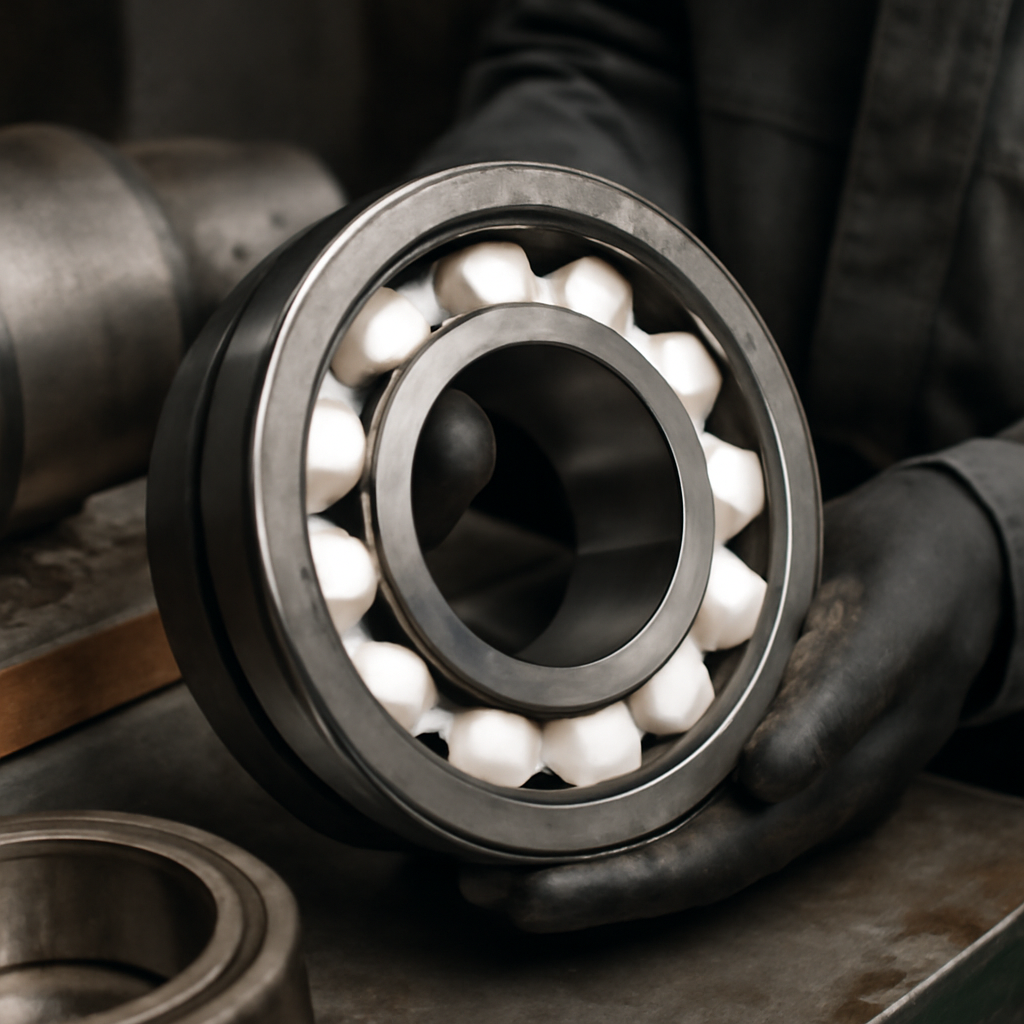
The vendor marketing on ceramic hybrid bearings promises dramatic improvements in service life, running temperature and reliability. The technical reality is more nuanced. Ceramic bearings deliver real advantages in specific application categories and marginal or no advantages in most general industrial applications. This deep-dive walks through where ceramic hybrids actually pay back the price premium, where they do not, and what the 2026 market realistically expects from the technology through the end of the decade.
What ceramic hybrid means technically
A ceramic hybrid bearing has steel inner and outer rings with silicon nitride (Si3N4) ceramic rolling elements — balls in ball bearing designs, rollers in roller bearing designs. The full ceramic bearing with ceramic rings and elements exists but represents a small specialty segment. Most industrial ceramic bearing installations are hybrids, not full ceramic. The silicon nitride rolling elements deliver three specific technical advantages: lower density than steel (roughly 60 percent), higher hardness, and electrical insulation.
Where the lower density matters
The 40 percent lower ceramic ball mass reduces centrifugal loading at high speed. For applications running above 12,000 to 15,000 RPM on smaller sizes or above 8,000 RPM on larger sizes, this translates to lower running temperature and longer service life. High-speed machine tool spindles, precision aerospace applications and some specialty pump designs benefit meaningfully. Most industrial applications running below 3,000 RPM see no advantage from the reduced ball mass.
Where the higher hardness matters
Silicon nitride rolling elements are approximately 30 percent harder than standard bearing steel. In contaminated environments where fine abrasive particles get into the bearing, the harder rolling elements resist surface damage better than steel. This translates to longer service life in dirty applications. For clean-running industrial applications the hardness advantage does not translate to meaningful life improvement.
Where the electrical insulation matters
Ceramic balls do not conduct electricity between the inner and outer rings. On motor applications where variable frequency drives generate shaft voltage — the phenomenon known as electrical fluting damage — ceramic hybrid bearings prevent the current path that damages standard steel bearings. This is the single most important ceramic application in modern European industrial installations. VFD-driven motor bearings running above 55 kilowatts increasingly specify ceramic hybrids as standard.
Where ceramics do not deliver
General industrial applications — pumps, fans, gearboxes running below 3,000 RPM in clean environments without VFD — see no meaningful advantage from ceramic hybrids. The 4 to 8 times price premium over standard bearings does not pay back in service life extension or in operational reliability. Distributors selling ceramic hybrids into these applications create disappointed customers. The technology does not fix problems these applications do not have.
Cross-brand ceramic hybrid availability
All the major European bearing brands offer ceramic hybrid ranges. SKF Explorer Ceramic, TIMKEN Ceramic Hybrid, FAG HCS7 series. The performance across the brands is essentially equivalent at the top of the range. Pricing across the brands varies more than for standard bearings — 15 to 25 percent apart at European aftermarket list. The choice between brands typically comes down to distributor relationship and technical support depth rather than performance differentiation.
The cost-benefit calculation
For VFD motor applications above 55 kilowatts, ceramic hybrids pay back through avoided electrical fluting damage. The bearing life extension can be 3 to 5 times standard, and the avoided motor rewind cost when fluting damage would have occurred justifies the price easily. For high-speed machine tool spindles, ceramic hybrids pay back through extended maintenance intervals and better vibration signature. For contamination-heavy applications the payback depends on the specific contamination profile.
The 2026 market position and outlook
Ceramic hybrid bearing adoption in European industrial applications has been growing at roughly 12 percent annually since 2022. Adoption concentrates on VFD motor bearing applications where the payback is clearest. Machine tool spindle applications add another meaningful share. General industrial adoption remains low because the payback does not materialise on those applications. This pattern is likely to continue through the end of the decade.
The takeaway for procurement teams
Ceramic hybrid bearings are worth specifying on VFD motor applications above 55 kilowatts, on high-speed machine tool spindles, and on specific contamination-heavy applications. They are not worth the price premium on general industrial applications running below 3,000 RPM in clean environments. Match the technology to the application need rather than to the vendor marketing promise. The right ceramic specification saves meaningful downtime cost. The wrong ceramic specification wastes procurement budget without delivering value.
Related coverage on Eurobearing
- Comparing Top 6 Bearing Brands
- EV Motor Bearings Suppliers
- Bearing Cages Trade-offs
- Bearing Failure Modes
- Digital Twin Bearing Selection
Need help evaluating ceramic hybrid bearings for a specific application? Our team supports European procurement teams with application-specific cost-benefit analysis. Book a free consultation.