
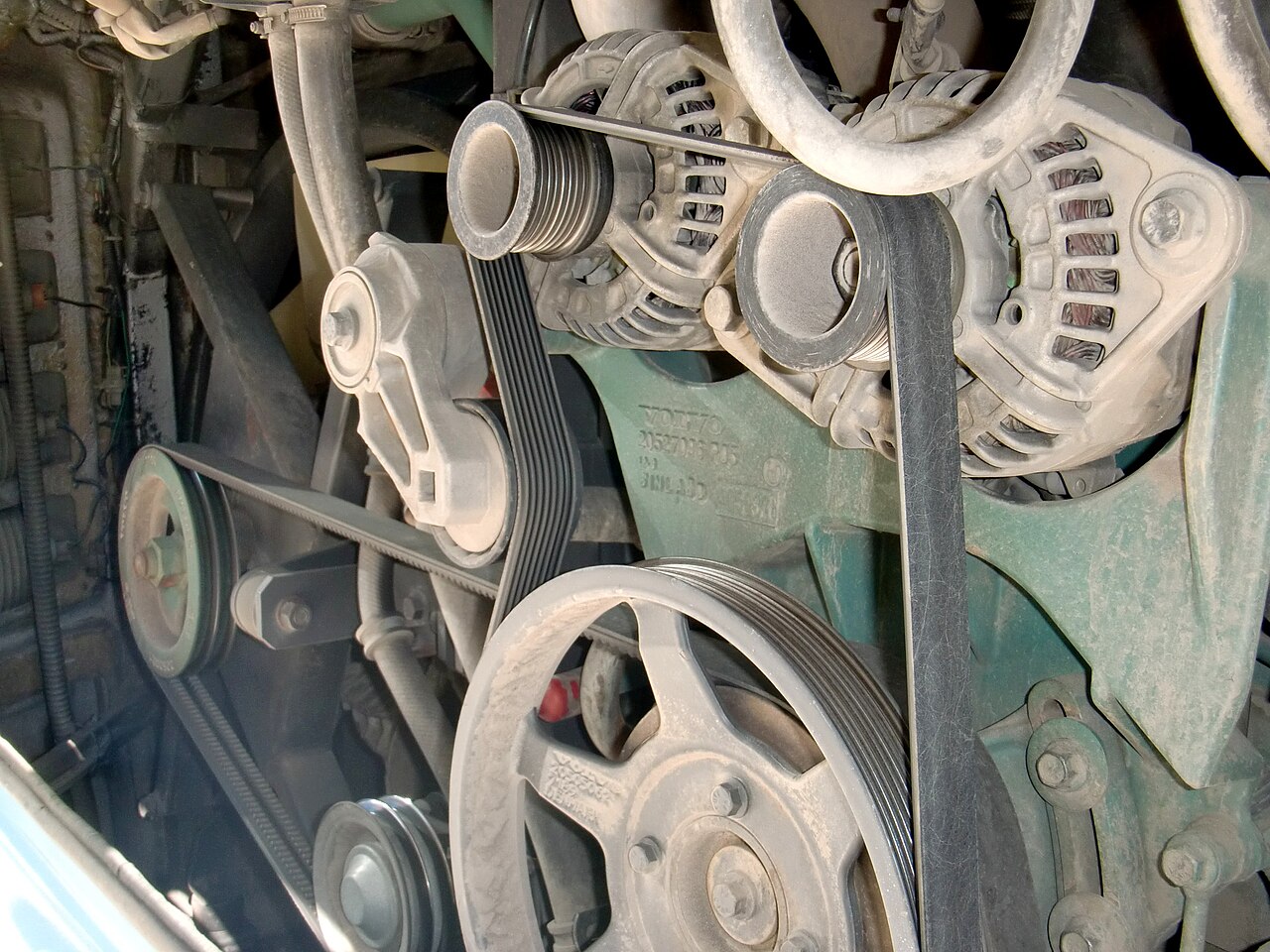
The belt that comes off the compressor drive is glazed, cracked and missing half of its printing. The fitter can still read a B and part of a number, so a B section belt is ordered and fitted, and within weeks it is squealing and riding low in the groove. The original was an SPB wedge belt, and the difference between the two is not a detail. Wedge belts of the SPZ, SPA, SPB and SPC sections and classic V-belts of the Z, A, B and C sections look similar on the shelf, share pulley groove families and are often stored side by side, yet they have different proportions, different length conventions and very different power ratings. Learning to read the V-belt profile correctly, from the printing or from the belt itself, is the cheapest way to avoid the wrong reorder, an overloaded drive and a second stop on the same machine a few weeks later.
Two families with different proportions
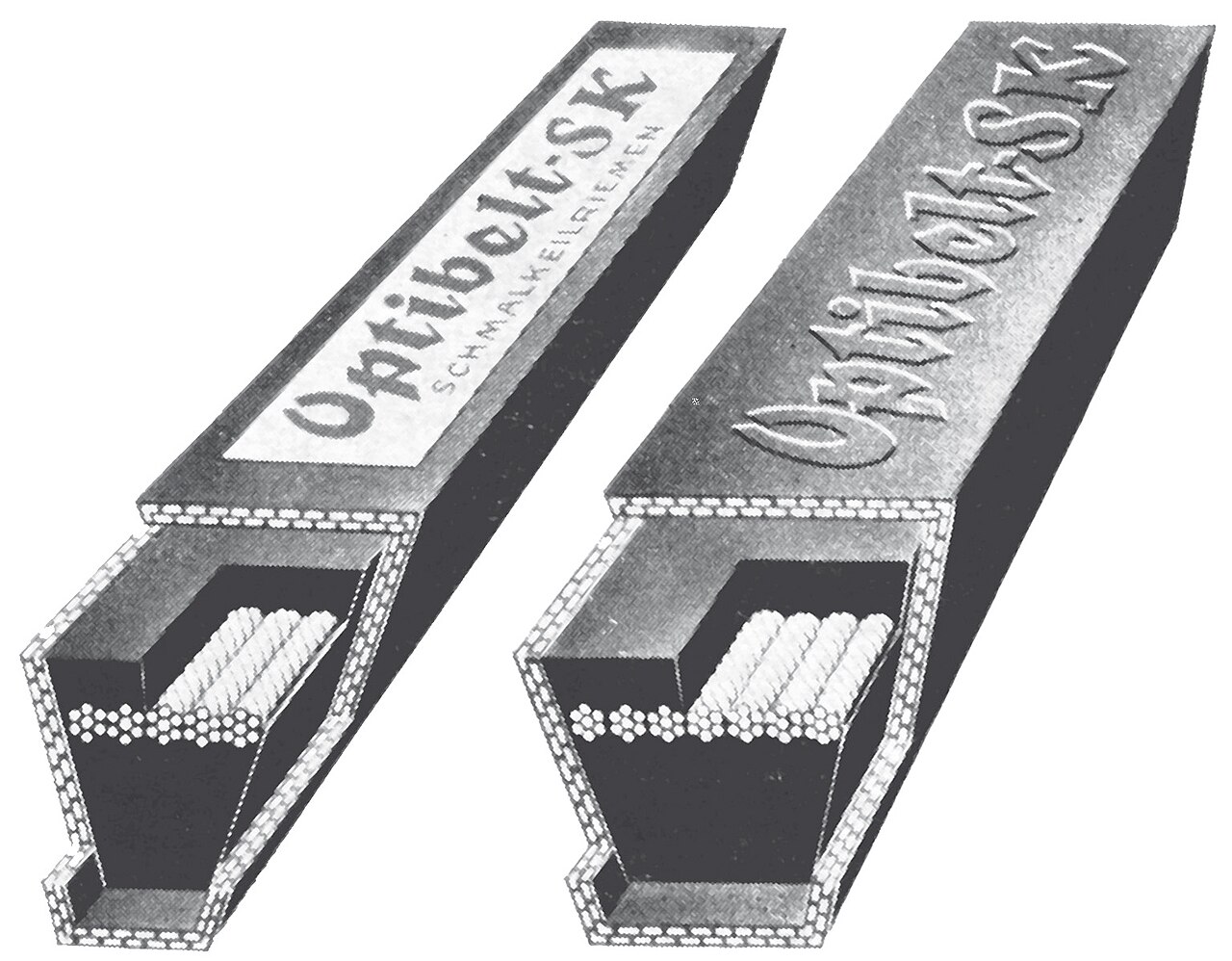
Classic V-belts, standardised in ISO 4184 and the older DIN 2215, are relatively wide and shallow: a Z section has a top width of about 10 millimetres and a height of about 6, an A section about 13 by 8, a B section about 17 by 11 and a C section about 22 by 14. Narrow or wedge belts, covered by DIN 7753 and the same ISO standard, are taller in relation to their width: SPZ is about 9.7 by 8, SPA about 12.7 by 10, SPB about 16.3 by 13 and SPC about 22 by 18. That deeper section puts more of the tension cord into the effective load-carrying zone and supports it better on the pulley flanks, so a wedge belt transmits considerably more power than a classic belt of similar width. In practice a drive designed for wedge belts often needs fewer belts or narrower pulleys for the same power, which is why most modern industrial drives use them.
Reading the printing on a used belt
When the printing is still legible, it normally gives the section and the length together, for example SPB 2000 or A 1200, plus the brand and sometimes a production code. The section letters are the first thing to check: SP followed by a letter always means a wedge belt, while a single letter means a classic section. The second is the length and its reference, because the two families use different conventions, discussed below. Our complete Optibelt selection guide lists the main markings used on industrial belts. When the printing is gone, measure the top width and height with a belt gauge or calipers on an unworn section of the belt, and compare the height-to-width ratio: about 0.6 to 0.65 points to a classic profile, about 0.8 or more to a wedge belt. A worn belt will have lost some width, so the ratio is more reliable than any single dimension.
Length conventions that cause most wrong orders
Wedge belts are designated by their datum length, also called pitch length, which is the length measured at the belt’s neutral line, so an SPZ 1250 has a datum length of 1250 millimetres. Classic belts are traditionally designated by their inside length, and the datum length is longer by a fixed amount depending on the section: about 22 millimetres for Z, 30 for A, 40 for B and 58 for C, according to common manufacturer tables. That means an A 1200 classic belt has a datum length of around 1230 millimetres and is not the same as a 1200 millimetre datum belt. Some manufacturers also quote outside lengths for certain ranges. When replacing a belt, therefore, always confirm which length the code refers to and convert if you are moving between families. Ordering by a number alone, without checking the reference, is the most common reason a new belt cannot be tensioned correctly or bottoms out on the tensioner travel.
Shared grooves, different behaviour
Pulleys to DIN 2211 for wedge belts are designed with groove geometry that also accepts the matching classic belt: SPZ grooves take Z belts, SPA take A, SPB take B and SPC take C, because the datum widths of 8.5, 11, 14 and 19 millimetres are the same. That compatibility is useful in an emergency, but it hides important differences. A classic belt in a wedge groove sits at a different height, carries much less power and needs a different tension, so a drive designed for SPB belts will often be overloaded with B belts. Mixing the two families on the same multi-groove pulley is never acceptable, because the belts run at different effective diameters and share load unevenly. Pulleys such as the SPZ140-04 taper bush pulley are marked by wedge section for this reason, and our range of taper bush V-belt pulleys follows the same designation.
Wrapped, raw-edge and cogged constructions
Within each section there are several constructions, and they matter as much as the profile. Wrapped belts have a fabric cover on all sides, which gives good resistance to slip and dirt and makes them tolerant of small pulleys up to a point. Raw-edge belts have exposed flanks, offering better grip, higher power and lower running temperature. Cogged belts add notches on the inside, which allows them to bend around smaller pulleys with less internal heating; they are often the right choice when space is short. The decision between classic wrapped belts and higher-capacity raw-edge or cogged designs is discussed in our article on rating an Optibelt drive with classic or cogged belts. For a like-for-like replacement, match section, length and construction; for an upgrade, recalculate the drive rather than simply swapping belts, because a higher-capacity belt changes tension and bearing loads.
Matched sets and tension after replacement
On multi-groove drives, belts must be replaced as a complete set, and every belt in that set should come from the same manufacturer and production tolerance class, often described as a matched set. A new belt next to stretched old belts carries most of the load and fails early, while the old belts slip and glaze. After fitting, the drive needs proper initial tension and a re-tension after the first hours of running, as set out in our guide to V-belt tension by deflection and frequency. Wedge belts generally need higher installation tension than classic belts of similar size, so using the old tension values after a change of family is a frequent mistake. Pulley groove wear should be checked at the same time, because worn flanks let a new belt ride low and reduce its life as surely as wrong tension does.
Building a reorder routine
The simplest way to stop wrong reorders is to record belt data where it is needed, on the machine and in the spare parts system, rather than relying on printing that will be gone in a year. A good record lists the section, the datum length with its reference, the construction, the number of belts and the brand, for example four SPB 2000 Lw raw-edge belts from Optibelt. The same record should mention the pulley designations and the installation tension. When the stores receive a used belt without data, a quick check of profile ratio and length with a measuring tape or a belt length gauge avoids the most common mistakes. Stocking only the sections that are really used and labelling them clearly in the classic V-belt and wedge belt bins also prevents the wrong family from ending up in a drive simply because it was the closest belt on the shelf.
Wedge belts and classic V-belts will continue to share shelves, pulleys and even part of their names, so confusion is inevitable unless someone takes it out of the system. Read the section letters first, check how the length is defined, never mix families on one drive and record the data on the machine. With those habits in place, the compressor drive in the opening example would have received its SPB belt the first time, run at the right tension and kept running quietly until the next planned change, instead of becoming a recurring line in the breakdown log. A ten-minute review of the belt drives on critical machines, with the data written down once, is usually enough to make every future reorder a simple lookup rather than a guess at the counter.
Can’t read the code on a worn belt? Send us the measurements, a photo and the pulley data, and our team will identify the section, length and the right Optibelt replacement. Book a free consultation.
Image credits: “Belt drive systen 01” by Miya.m (CC BY-SA 3.0); “Optibelt Keilriemen” by Optibelt GmbH (CC BY-SA 3.0), via Wikimedia Commons.