
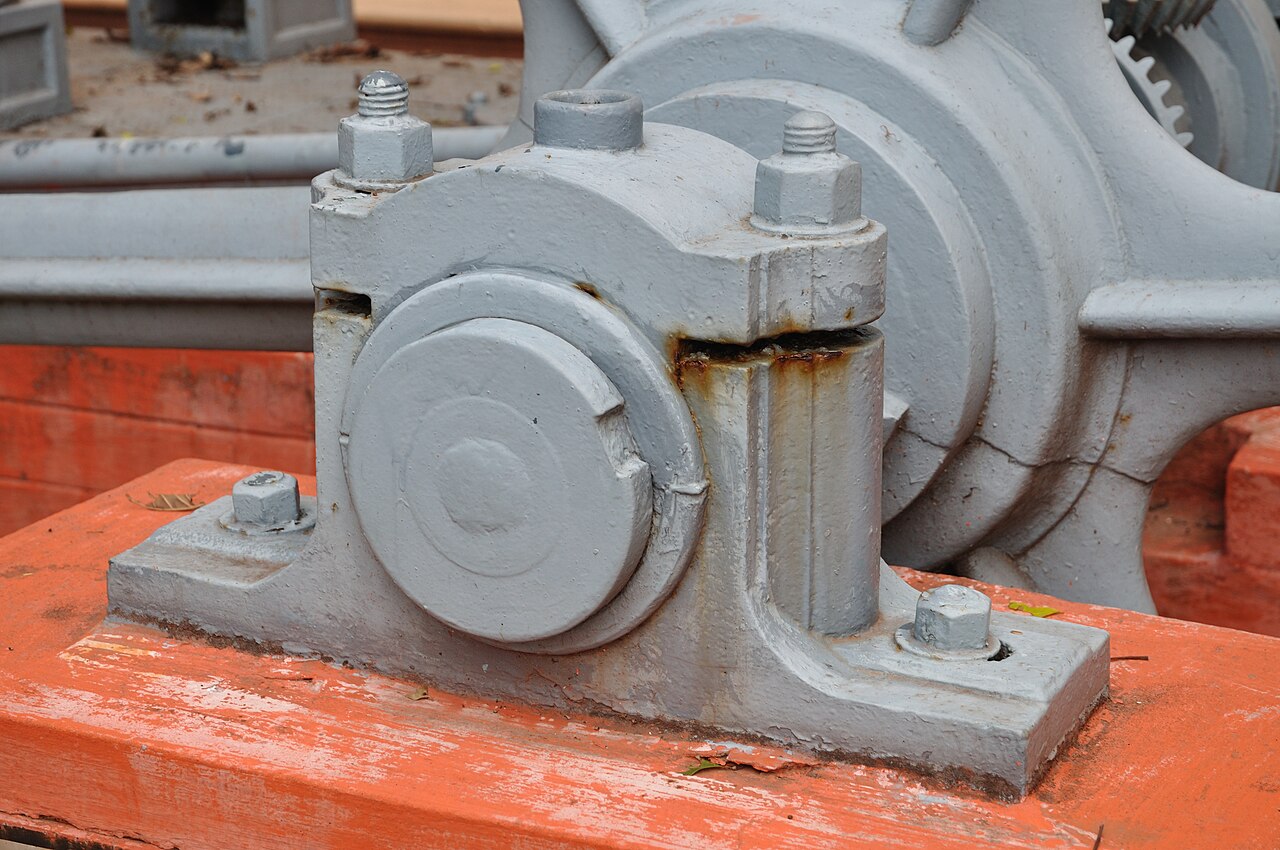
A fan shaft at a sawmill runs on two spherical roller bearings in cast iron housings, and every summer the drive-end bearing fails first. The bearings are the right size, the grease is correct, and yet the pattern repeats. When the housings are finally opened, the reason is plain: both of them were assembled with locating rings, so the steel shaft has nowhere to grow when it warms up and the bearings end up fighting each other through an axial load nobody calculated. Split plummer block housings are among the most forgiving components in a drive train, but only when three decisions are made deliberately: the housing size that matches the bearing and sleeve, the seal that matches the environment, and the locating or non-locating arrangement that matches the shaft. Each of those decisions is easy to get right on paper and easy to get wrong in the stores, where housings are often picked by bore size alone.
Why a split housing suits spherical roller bearings
A split plummer block has a cast base and a separate cap, joined at the shaft centre line and held together by cap bolts. That construction allows the complete shaft assembly, with bearings already mounted on their sleeves or seats, to be lowered into the bases and closed with the caps, which is far easier than threading a long shaft through two solid housings. It also makes inspection practical: the cap can be lifted to check the bearing, the grease condition and the seals without disturbing the shaft. Spherical roller bearings fit naturally into this design because they tolerate the small misalignment that comes from mounting two housings on separate pads, and because the usual tapered-bore versions mount on adapter sleeves, as discussed in our article on adapter sleeves with lock nuts. For lighter duties, our guide to pillow block and flange units with insert bearings covers the simpler alternative.
Sizing the housing to bearing, sleeve and shaft
Housing designations are built around the bearing outside diameter and the shaft, not just the shaft. A common example is a FAG 22218-K-M-C3 or an SKF 22218 EK/C3, with a 90 millimetre tapered bore and a 160 millimetre outside diameter, mounted on an adapter sleeve onto an 80 millimetre shaft: the housing must accept the 160 millimetre outer ring, the 40 millimetre width plus the sleeve and lock nut, and a seal sized for 80 millimetres. The same housing body frequently serves several bearing series with the same outside diameter, so the seal size and the locating rings are what make the assembly specific. In practice, order the housing by the bearing designation and the shaft diameter together, and check the drawing for the space needed by the lock nut on the side where the sleeve thread sits. Selecting from the range of bearing housings by shaft size alone is the most common source of mismatched assemblies.
Locating and non-locating: the decision that prevents failures
On a shaft supported by two housings, only one bearing should fix the shaft axially. That locating position has the bearing outer ring clamped between two locating rings, so it carries axial loads in both directions. The second position is non-locating: the outer ring is free to slide in the housing bore, which is machined slightly wider than the bearing, so the shaft can expand with temperature without loading the bearings axially. A steel shaft grows by roughly 0.011 millimetres per metre for every degree of temperature rise, so a two-metre shaft warming by 40 degrees grows by almost a millimetre, which is more than enough to overload both bearings if neither can move. The locating side is usually the drive end, where coupling or belt forces are highest, and the arrangement must be specified at order or assembly, with locating rings fitted only where needed. Mislabelled rings left in both housings are a classic cause of repeated failures at one end of the shaft.
Choosing seals for the environment
Seals are where housings differ most, and where the environment should decide. Double-lip rubber seals suit general industrial use with moderate dust and speeds, provided the lips are lubricated and the shaft surface is reasonably smooth. Felt seals are still common on older equipment and slow shafts but harden with time and heat. Labyrinth seals are non-contact, so they suit higher speeds and add no friction, but they rely on grease purging to keep dust out. For quarries, cement plants, mining conveyors and other dirty environments, multi-stage designs combining labyrinths with grease-filled chambers, sometimes with an additional V-ring, give much longer life, as our analysis of spherical roller bearings under shock loads in crushers and mills showed in practice. A housing without the right seal is only a cast iron box: whatever comes through the seal will finish the bearing long before fatigue does, no matter how carefully it was sized.
Mounting the base and closing the cap
The housing base needs a flat, rigid support, because a base bolted down on an uneven pad distorts the bearing seat and creates an oval outer ring that runs hot. Support surfaces should be machined or shimmed with full-size shims rather than small packers, and the two housings on a shaft should be aligned before the cap bolts are tightened. Caps and bases are machined together and are not interchangeable between housings, so they should be kept in pairs during maintenance and marked if several housings are opened at the same time. Cap bolts should be tightened to the manufacturer’s values in a crosswise sequence, with the bearing already positioned, because overtightening a cap onto a misplaced outer ring distorts both. Dowel pins or end stops are worth fitting where axial loads or vibration could make a base creep on its support, which is common on fans and vibrating screens.
Lubrication and relubrication in split housings
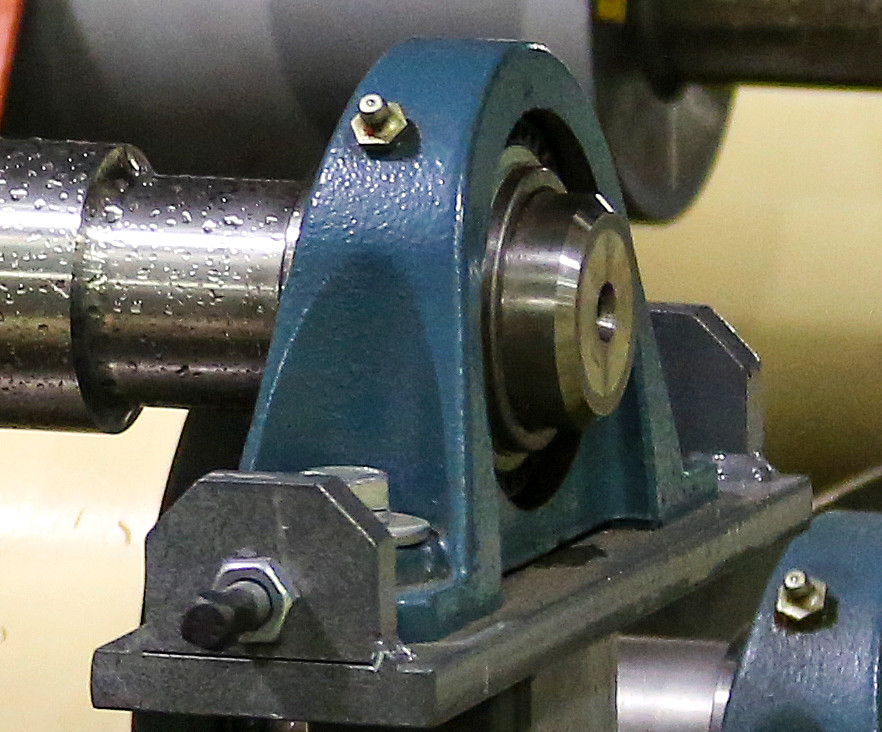
Spherical roller bearings in plummer blocks are mostly grease lubricated. The usual approach is to fill the bearing completely and the free space in the housing base only partially, often to about one third or one half depending on speed, leaving room for excess grease to escape without churning. Bearings with a lubrication groove and holes in the outer ring, the W33 feature on many designs, allow grease to be fed through a nipple in the cap directly into the centre of the bearing, so fresh grease reaches the rollers before it pushes old grease towards the seals. Relubrication intervals depend on speed, temperature and contamination rather than on a calendar, and our article on relubrication intervals for the real duty cycle shows how to set them. Too much grease in a fast housing causes heat; too little in a dirty one lets abrasive particles in.
Inspection and replacement in the field
One advantage of a split design is that it can be inspected without removing the shaft, so it is worth building a short routine around it. Lift the cap at planned stops, check the grease colour and consistency, look for discoloration or metallic particles, and verify that the non-locating bearing can still move axially in its seat. Check the seal contact and replace worn seals before they let contamination in. When the bearing must be replaced, keep the old one with its sleeve and note the radial internal clearance measured before and after mounting, because it confirms that the drive-up on the sleeve was correct. Replacement housings should match both the bearing and the arrangement, and spare caps and seals should be stocked for critical positions. Matching spherical roller bearings from SKF or FAG can be kept with the housings as a kit.
A split plummer block is simple equipment, but simple equipment is easy to assemble wrongly. Before ordering, write down the bearing designation, the shaft diameter, the seal type and which side of the shaft must locate. At assembly, fit locating rings only in the locating housing, align both bases on flat supports, tighten caps in sequence and grease to a measured fill. With those steps followed, these housings routinely outlast several bearings, and the summer failures on the drive end stop being a seasonal ritual and become a problem that has been engineered away for good. It also helps to tag each housing on the machine as locating or non-locating, with the bearing and seal designations written on the tag or in the maintenance system, because the person who opens that housing in three years will rarely have the original assembly drawing at hand.
Need a complete plummer block assembly? Send us the bearing, shaft diameter and operating conditions, and our team will specify housing, seals, sleeve and locating arrangement as a single kit. Book a free consultation.
Image credits: “Plummer Block Bearing – Kolkata 2012-01-11 8004” by Biswarup Ganguly (CC BY 3.0); “Carbon Fiber Technology Facility (9403927454), bearing” by Oak Ridge National Laboratory (CC BY 2.0), via Wikimedia Commons.