
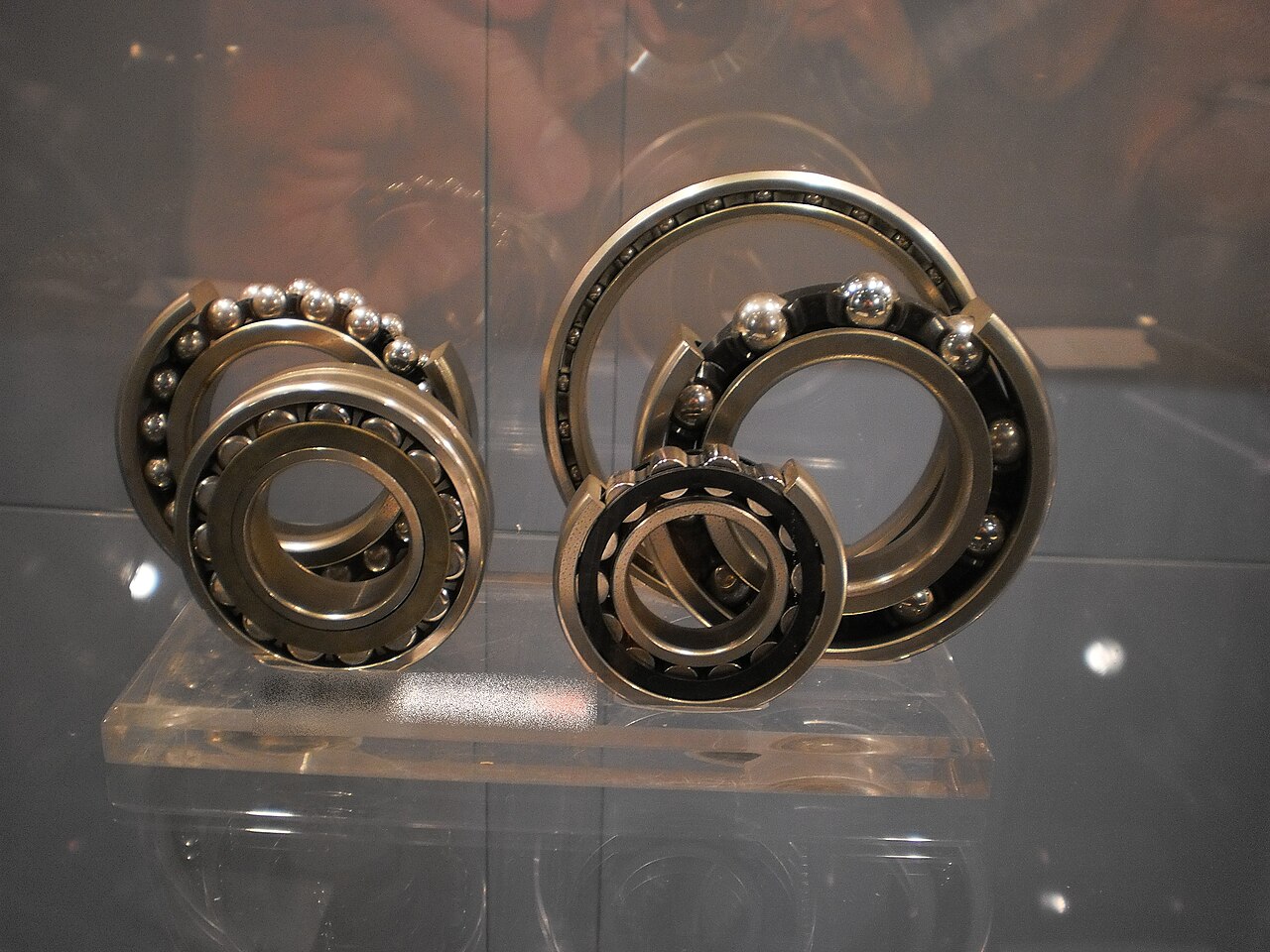
A conveyor head pulley keeps eating its 6206 bearings every few months, and the fitter has already tried the usual fixes: better grease, a C3 clearance, a new seal. The shaft and housing are fine. The real problem is that the bearing is simply too small for the radial load, and there is no room to go up a bore size or switch to a heavier series without remachining the housing. This is exactly the situation in which double row deep groove ball bearings of the 4200 and 4300 series earn their place. They share the bore and outside diameter of the familiar 6200 and 6300 bearings but are wider, with two rows of balls in one pair of rings, and that extra row adds a substantial amount of radial capacity inside almost the same envelope. Used in the right place they solve chronic failures; used in the wrong place they create new ones, so the decision deserves more than a glance at the catalogue table.
How the 4200 and 4300 series are built
A double row deep groove ball bearing is, in essence, two deep groove rows combined into one inner ring and one outer ring, with a cage that guides both rows. The 4200 series shares its bore and outside diameter with the 6200 series and the 4300 series with the 6300, but both are wider: a 4206 measures 30 by 62 by 20 millimetres, where a 6206 is only 16 millimetres wide. Typical examples on the shelf are the SKF 4206 ATN9 with a glass-fibre reinforced polyamide cage and the FAG 4207 TVH, again with a polyamide cage. The polymer cage keeps weight and friction low but limits operating temperature, which matters in warm gearboxes or near heat sources where a brass or steel cage would be the safer specification. Both rows share one internal clearance, which is the main practical difference compared with mounting two separate bearings.
Where the extra row pays off
The extra row raises the basic dynamic load rating considerably compared with the single row bearing of the same bore and outside diameter, and because rating life follows the third power of the ratio between load rating and equivalent load, the effect on life is much larger than the increase in capacity. If the rating rises by roughly half, the calculated life at the same load rises by a factor of about three and a half, as the basic formula in our explanation of ISO 281 L10h rating life shows. That is why double row bearings work well in pulleys, idler rollers, small gearbox intermediate shafts, agricultural implements and wheel applications where the radial load is high, speeds are moderate, and the housing cannot be enlarged. They also carry axial loads in both directions, although they are not intended to replace angular contact designs when thrust dominates.
One wider bearing versus two single rows
The alternative many workshops reach for is to put two single row bearings side by side in a longer bore. On paper that seems to double the capacity; in practice it rarely does. Two separate bearings share the load only if their internal clearances, fits and shoulder positions are matched closely, and in an ordinary housing one bearing almost always takes more than its share, especially when the shaft deflects. The double row bearing removes that uncertainty because both rows sit in the same pair of rings with the same clearance, so load sharing is built in at the factory. It also needs a single seat, a single circlip groove or spacer, and less axial length than two bearings plus a spacer. The two-bearing arrangement still has a role when sealed units are needed in both positions, or when a wide spread is required to resist tilting moments, but for pure radial capacity in a compact space the single double row bearing is the cleaner engineering answer.
Misalignment: the main limitation
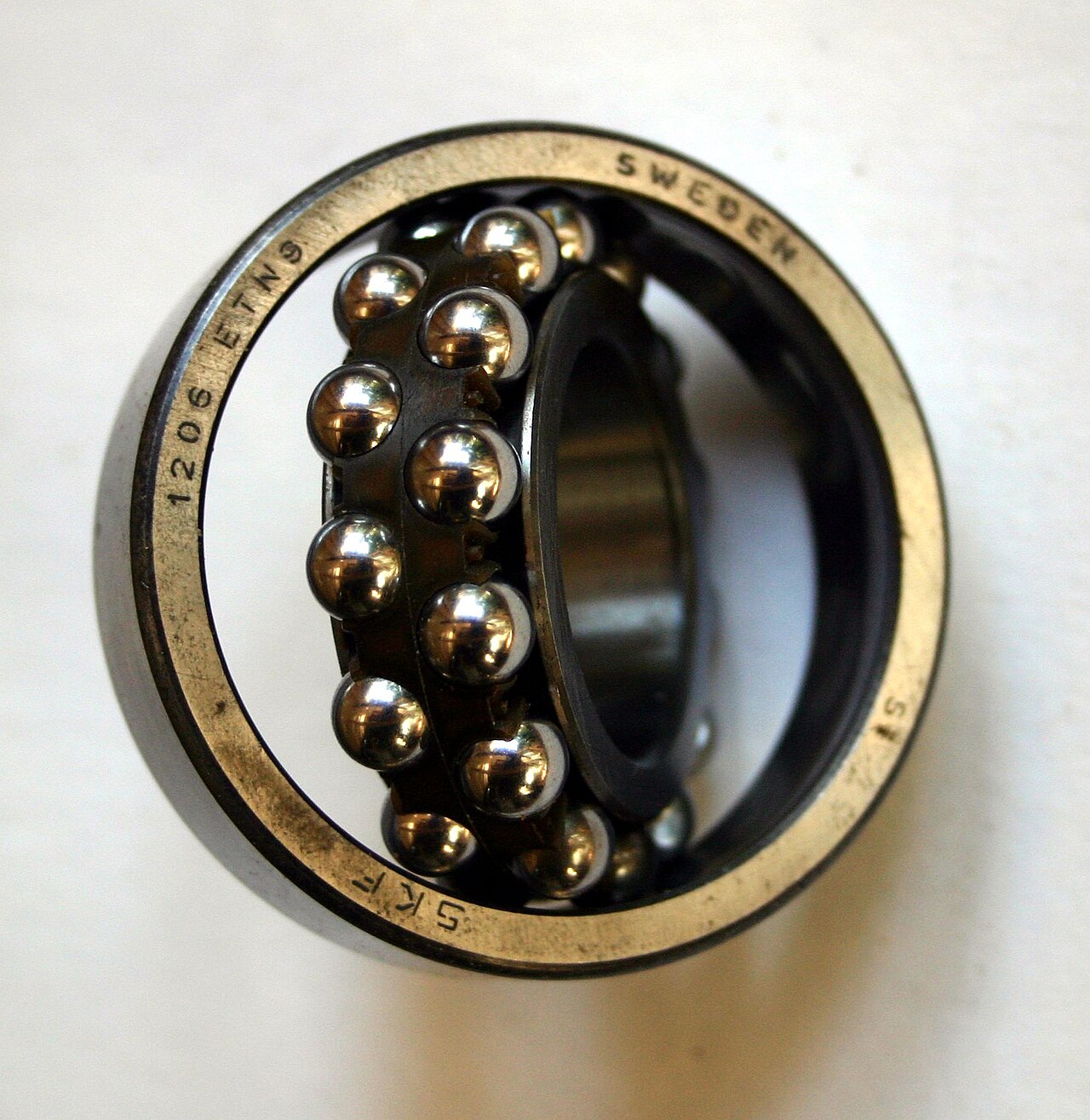
The weakness of a double row deep groove bearing is its intolerance of misalignment. Two rows of balls in rigid grooves resist tilting of the inner ring relative to the outer ring, so any angular error between shaft and housing turns into uneven load between the rows, edge stress on the raceways and heat. A single row deep groove bearing tolerates a few minutes of arc; a double row design tolerates noticeably less. That makes it a poor choice for long, flexible shafts, separate housings bolted to frames that can twist, or any assembly where the bores are not machined in one set-up. If misalignment is unavoidable, the SKF self-aligning ball bearings of the 1200 and 2200 series, with their spherical outer raceway, are the better double row choice, accepting lower load capacity in exchange for freedom of alignment. Checking shaft deflection and housing alignment before switching is therefore essential, not optional.
Fits, clearance and lubrication
Because the double row bearing is wider and carries higher loads, the usual mounting rules matter even more. The rotating ring needs an interference fit appropriate to the load, as set out in our guide to shaft and housing fits for rotating ring load, and the stationary ring a fit that allows thermal movement where needed. Internal clearance should be selected with the fit and the operating temperature in mind: a heavy interference fit on a warm shaft can consume a normal clearance and preload the two rows against each other, so C3 is often the safer choice, following the reasoning in our article on C3, C4 and CN clearance classes. Grease quantity also needs attention, since the wider bearing contains more free volume, and overfilling it in a closed housing raises churning temperatures quickly at higher speeds.
Speed, sealing and availability
Two other factors decide whether the 4200 or 4300 bearing is a realistic replacement. The first is speed: with more balls and a wider cage, double row bearings have lower limiting speeds than the matching single row bearings, so they suit pulleys and gear shafts rather than high-speed motors or spindles. The second is sealing: many common sizes are supplied open, so the housing must provide the seal, unlike the 6200-2RS bearings that many maintenance teams rely on. Availability is generally good in the bore range from 10 to around 70 millimetres, and the range of double row ball bearings in our catalogue includes both FAG and SKF designs. When interchanging, compare the full designation and not just the base number, because cage material and clearance suffixes differ between manufacturers even when the dimensions are identical.
A quick decision path
When a single row deep groove ball bearing keeps failing from fatigue in a housing that cannot be enlarged, the double row option is worth evaluating in a few steps. First confirm that the failure really is load-related, with spalling in the load zone, rather than contamination, lubrication or misalignment, which a double row bearing would make worse. Then check that the housing bore can accept the extra width, or that a shoulder or spacer can be moved. Next verify alignment: shaft and housing bores machined in one set-up, short stiff shafts and no visible tilt. Finally check the operating speed against the limiting speed of the double row bearing and make sure the housing provides adequate sealing. If all four points are satisfied, the change is usually a straightforward upgrade, and calculated life gains of three times or more are realistic with no other modification.
Double row deep groove ball bearings are not a universal upgrade, but in their niche they are one of the most cost-effective changes a maintenance team can make. They turn a chronically overloaded position into a reliable one without new housings, new shafts or a larger envelope, provided the alignment is good and the speed is moderate. Before switching, document the old bearing, the failure pattern and the available width, and treat misalignment as the deciding test rather than an afterthought. It is also worth recording the change on the machine file and in the spare parts list, so that the next fitter does not reinstall a single row 6200 or 6300 bearing out of habit and bring the old failure pattern straight back. Finally, keep at least one double row bearing in stock for every converted position, because these sizes are less common on local distributor shelves than their single row equivalents and a breakdown is the wrong time to discover a lead time.
Is a 4200 or 4300 bearing right for your position? Send us the current bearing, the load and speed data and a photo of the housing, and our team will check whether a double row replacement makes sense. Book a free consultation.
Image credits: “Kugellager ML” by Martin1009 (CC BY-SA 3.0); “Wingquist bearing00” by Androstachys (CC BY-SA 3.0), via Wikimedia Commons.