
The vertical mixer gearbox had been rebuilt twice in a year, and each time the lower bearing came out with smeared bands across the raceways and a cage polished in its pockets, the signature of thrust ball bearings that spent much of their life running with too little load on them. The machine idled empty for long periods between batches, and the springs that should have kept the washers loaded had been left out at the first repair. Axial bearings behave differently from radial ones in ways that change the selection the moment axial load becomes the main force. The differences concern washer orientation, minimum load, attainable speed and the more basic question of whether a dedicated thrust bearing is the right type at all.
What a 90 degree contact angle buys and what it costs
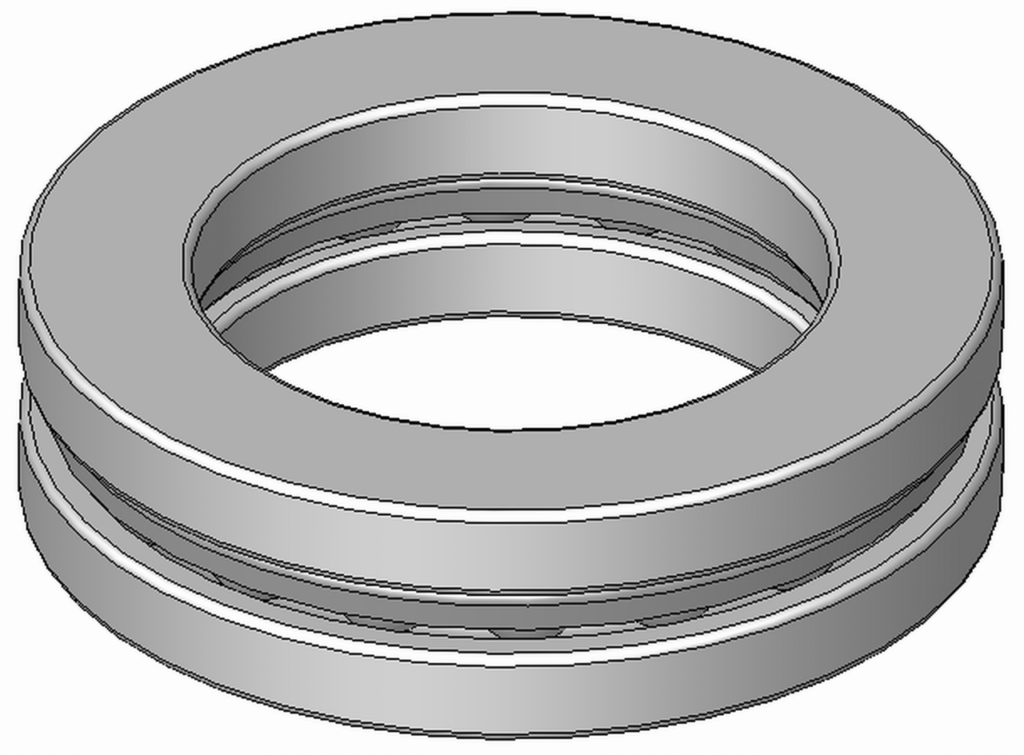
A thrust ball bearing runs its balls between two washers with grooved raceways at a contact angle of 90 degrees, so every ball shares the axial load and none of the bearing is spent on radial guidance. That geometry gives high axial capacity in a short axial length and makes the bearing stiff in the axial direction, which suits screw jacks, rotary tables, kingpins, crane hooks and vertical shafts at modest speed. The same geometry is the source of every limitation. A thrust ball bearing carries no radial load at all, so the shaft needs a separate radial bearing, and the washers must sit square to the shaft axis because the bearing cannot accommodate misalignment beyond the tiny amount elastic deformation allows. At speed, centrifugal force pushes the balls outward against the raceway shoulders and gyroscopic moments make them spin about the wrong axis. Together these points explain why a deep groove or angular contact bearing often beats a thrust ball bearing when axial load is moderate and speed is high.
Single and double direction thrust ball series
Single direction bearings are built in the 511, 512, 513 and 514 series, which grow in outside diameter, height and capacity for a given bore. The SKF 51105 is a light 511 series bearing at 25 × 42 × 11 mm, the SKF 51208 a 512 series bearing at 40 × 68 × 19 mm, and the SKF 51110 a light series bearing for a 50 mm shaft at 50 × 70 × 14 mm. The 511 series is the compact choice for low loads and tight space, the 512 series the general workshop default, and the 513 and 514 series appear where axial loads are heavy and radial space is available. Double direction bearings in the 522, 523 and 524 series have a single shaft washer between two ball and cage sets and two housing washers, locating the shaft in both directions, as on feed screws and reversing drives. The complete range sits in our thrust ball bearings category.
Shaft washer and housing washer are not interchangeable
The two washers of a single direction bearing look almost identical, and they are not interchangeable. The shaft washer has the smaller bore, ground to sit on the shaft with a tight fit, and rotates with it. The housing washer has a slightly larger bore so it clears the shaft, and often a small radial clearance at its outside diameter so it can settle against the housing face. Fitted the wrong way round, the shaft washer’s ground bore is left floating and the housing washer rubs on the rotating shaft, generating heat and steel debris within hours. On the bench, measure both bores with a calliper before assembly. Where the housing seat cannot be machined square enough, the 532 and 533 series with a sphered housing washer and matching seat washer allow initial alignment at assembly, although they do not accommodate dynamic misalignment in service. Those seat washers are listed under washers for thrust ball bearings and should be ordered as a matched size with the bearing.
Minimum axial load and why unloaded thrust bearings skid
Every rolling bearing needs a minimum load to make the rolling elements roll instead of slide, and thrust bearings need it more than most. In a thrust ball bearing, centrifugal force and gyroscopic moments on the balls grow with the square of speed; if the axial load is too small to hold the balls firmly in raceway contact, they slide on the washers while the cage drags them round, and the result is smearing, the transfer of material in streaks across the raceway. The SKF approach estimates the minimum axial load as Fa,min = A·(n/1000)² in kilonewtons, where A is a minimum load factor listed for each bearing and n the speed in revolutions per minute, so doubling speed quadruples the load required. Vertical shafts often satisfy it with their own weight; idle running and reversing loads frequently do not. The usual remedy is preload from disc or coil springs acting on the housing washer, which keeps the bearing loaded when the working thrust disappears, exactly what the mixer in the opening was missing.
Speed limits compared with radial bearings
Speed limits for thrust bearings sit well below those of radial bearings of the same bore, for kinematic as much as thermal reasons. In a radial bearing, centrifugal force presses the balls into the outer raceway, which is where they are meant to run. In a thrust ball bearing it presses them radially outward across a raceway designed for axial contact, shifting the contact toward the edge of the groove and increasing spin and sliding. For practical purposes, if a shaft runs fast with moderate axial load, a deep groove ball bearing or a pair of angular contact bearings will usually run cooler and last longer than a thrust ball bearing. Our article on angular contact bearings covers when a contact angle of 25 or 40 degrees gives enough axial capacity without the thrust bearing’s speed penalty.
Cylindrical roller and needle roller thrust bearings
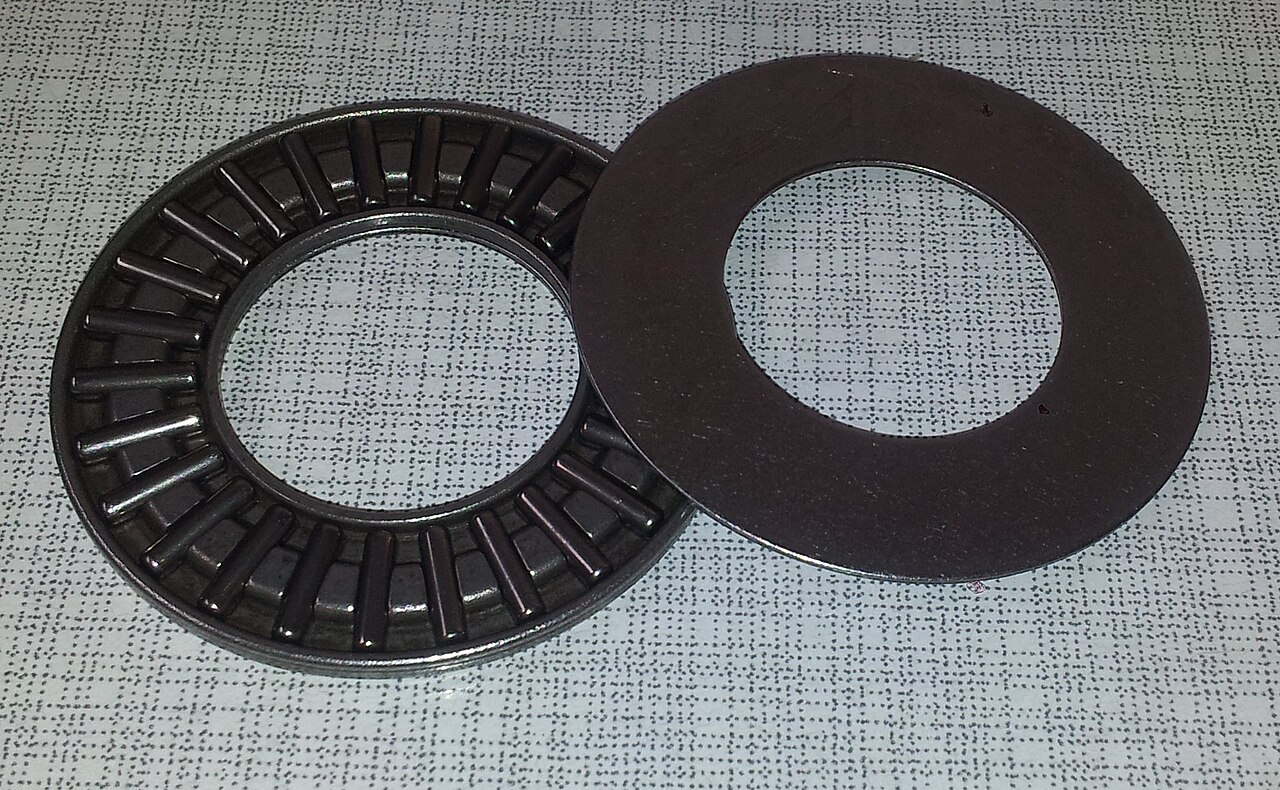
Where axial load is heavy and speed low, cylindrical roller thrust bearings in the 811 and 812 series replace balls with short rollers, raising capacity and stiffness within the same space. They are supplied as a cage and roller assembly with separate shaft and housing washers, designated K, WS and GS respectively, replaceable individually. Their limitation is built in: the outer end of each roller travels further per revolution than the inner end, so a cylindrical roller rolling cleanly at one point must slide elsewhere along its length. That sliding sets a lower speed limit and generates heat, which is why larger sizes use two or more short rollers per pocket. Needle roller thrust bearings such as the INA AXK cage assemblies push the same principle to an axial height of only a few millimetres. They run on thin AS washers, thicker LS washers, or directly on a machine part that must then be hardened and ground to bearing-level hardness and flatness; the options are in our needle roller thrust bearings category.
Spherical and taper roller thrust bearings for combined load
Spherical roller thrust bearings in the 292, 293 and 294 series are the answer when heavy axial load comes together with radial load and misalignment. Their asymmetrical rollers run at an angle to the axis against a sphered raceway in the housing washer, so the bearing is self-aligning and carries radial load provided it does not exceed about 55 percent of the simultaneous axial load. They appear in extruder gearboxes and vertical pumps, usually oil lubricated, and their minimum axial load rises with radial load as well as speed. Taper roller thrust bearings, a product type for which TIMKEN is a reference maker, handle very heavy axial load at low speed in screw-down mechanisms of rolling mills and heavy swivels, with line contact and true rolling because the roller cone apexes meet on the bearing axis. Neither type should be chosen for pure axial load at higher speed when a thrust ball or cylindrical roller design will do the job, since both carry more friction and cost.
Selection logic when load is purely axial or combined
The decision follows the load. If the load is purely axial, speed low and axial space limited, a thrust ball bearing in the 511 or 512 series is the first choice, with springs to guarantee minimum load and a separate radial bearing for guidance. If axial load is heavy and speed still low, a cylindrical roller thrust bearing raises capacity, and where axial height is the constraint a needle thrust cage on washers fits where nothing else will. Once a radial component appears, ask two questions. Is it small and the speed high? Then angular contact ball bearings, or a deep groove bearing taking the thrust, are usually better. Are both loads heavy, with possible shaft deflection? Then a spherical roller thrust bearing, or a pair of taper roller bearings, belongs there. Flanged cylindrical roller bearings carry some axial load too, within flange-contact limits, as our article on NU, NJ and NUP designs explains. A thrust bearing should be chosen because the axial load demands it, not because the load happens to point along the shaft.
The mixer was put right with a smaller 511 series bearing in place of the original heavier one, a set of disc springs under the housing washer and a check at assembly that the shaft washer sat on the shaft and the housing washer against the housing. Rated capacity fell, yet the bearing now stays inside its load window through idle periods too. That is the general lesson of axial bearings: oversizing a thrust bearing does not add margin when the duty includes light-load running, because a larger bearing needs more load to roll properly. Work through load direction and magnitude first, then speed and minimum load, then misalignment, and only then choose the series. Check housing face squareness before blaming the bearing, and record the real operating speed, since a thrust bearing selected for nameplate speed is a direct route to smeared raceways.
Not sure whether your axial load calls for a thrust bearing or an angular contact pair? Our team supports thrust bearing selection, from minimum load and speed checks to washer and preload arrangements. Book a free consultation.
Image credits: “Thrust needle roller bearing 2” by Jahobr (CC0); “Thrust-ball-bearing din711” by Silberwolf (CC BY 2.5), via Wikimedia Commons.