
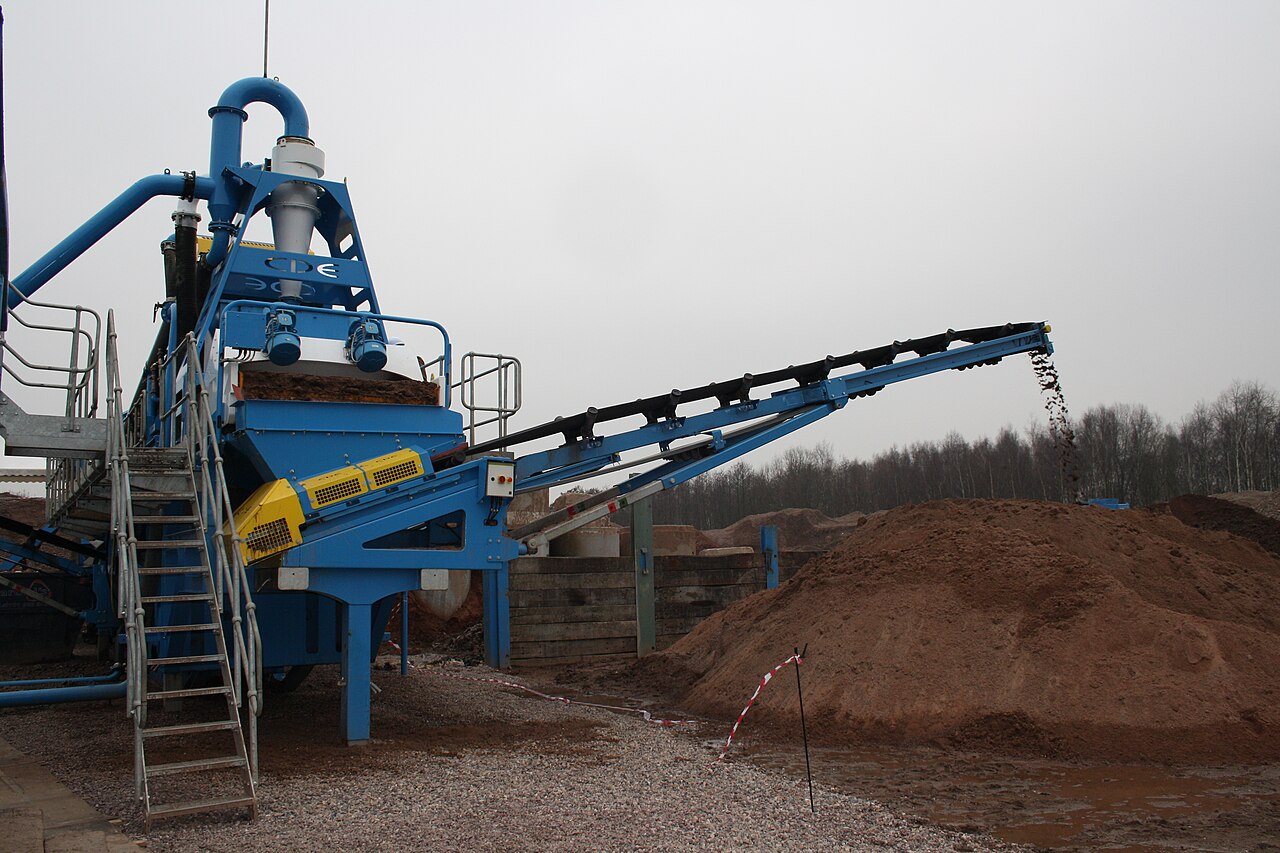
On a gravel washing plant, the bearings of a screen drive are supposed to last several years, yet the plant replaces them every few months. Each housing has a good nitrile radial shaft seal, correctly installed, but the combination of fine silt and high-pressure water sprayed during cleaning works its way past the lip and into the bearing. The solution that finally works costs a few euros per position: a rubber V-ring stretched onto the shaft in front of each housing, running against the housing face and throwing water and dirt away before they ever reach the radial seal. V-ring seals are among the simplest sealing elements in mechanical engineering, yet they are often misunderstood as a cheap alternative to a proper oil seal rather than as a different tool for a different job. This article explains how a V-ring works, how it compares with a radial shaft seal, where it should be used on its own or as a pre-seal, and how to size and fit it correctly.
How a V-ring seals: an axial lip that rotates with the shaft
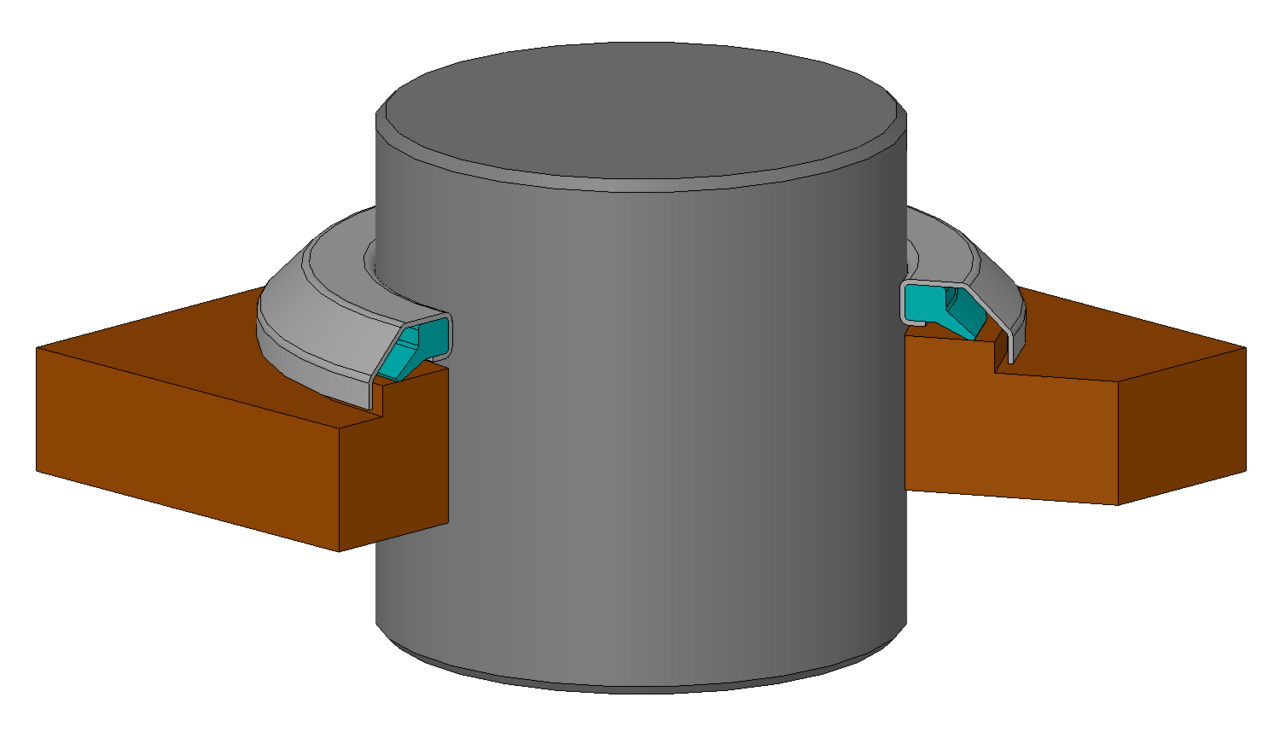
A V-ring is an all-rubber ring with a solid body and a thin, conical lip that projects at an angle from one side. It is stretched onto the shaft, where the body grips firmly and rotates with it, while the lip presses lightly against a flat counterface perpendicular to the shaft, typically the face of a bearing housing, a cover or a bearing shield. The sealing contact is therefore axial, not radial, and the lip runs on a surface that does not need to be ground and hardened like a shaft under a radial seal. Because the whole ring rotates, it also acts as a flinger: water, dust and particles that land on it are thrown outwards by centrifugal force before they can reach the contact zone. As speed rises, the same centrifugal force reduces the lip contact pressure, and above a certain speed the lip lifts off completely, at which point the V-ring continues to work as a non-contact flinger and gap seal with almost no friction or wear.
Where a V-ring beats a radial shaft seal
A radial shaft seal is designed to retain lubricant, particularly oil, and its spring-loaded lip running on a precisely finished shaft is excellent at that job. It is less comfortable with contamination from the outside, because abrasive particles that reach the lip contact grind a groove into the shaft, and water under pressure can force its way under a lip designed to hold oil in, not keep water out. A V-ring addresses exactly those weaknesses. It tolerates considerable shaft runout, misalignment and axial movement, it needs no special shaft finish, and its flinging action keeps the bulk of the contamination away. For grease-lubricated bearings in dusty or wet environments, such as conveyors, agricultural machinery, washing plants and food processing lines with frequent washdown, a V-ring is often the most effective barrier available. Our article on bearings for mining conveyors and crushers shows how this approach is used in some of the dirtiest applications.
Where a radial shaft seal is still essential
The V-ring has clear limits. It cannot retain oil under a submerged level, because its light axial contact and its tendency to lift off at speed leave a path for the liquid to escape, and it offers no resistance to internal pressure. It is also not designed to seal a static gap: if the shaft does not rotate, the flinging action disappears and the lip alone provides only modest protection against standing water. Gearboxes, oil-bath housings and any arrangement where oil sits against the shaft therefore still need a radial lip seal, chosen according to the guidance in our article on DIN 3760 seal types A, B and C. In those cases, the V-ring is not a replacement but a complement, mounted on the air side in front of the radial seal, where it absorbs the contamination and allows the radial seal to concentrate on retaining the lubricant. This combined arrangement is one of the most reliable sealing solutions in heavy industry.
Profiles and sizes: VA, VS, VL and large-diameter rings
Manufacturers offer V-rings in several profiles for different spaces and speeds. The standard VA profile, with a relatively narrow body, is the most common and covers the majority of general machinery. The VS profile has a wider, tapered body that grips the shaft more firmly and is suitable where higher speeds or a less stable fit are expected. The VL profile is very low and narrow, intended for confined spaces such as integrated bearing arrangements. For very large shafts, rings designed for clamping with a band or a ring are used, since a stretch fit alone is not secure at those diameters. Sizes are selected by the shaft diameter range, since each V-ring is designed to be stretched by a defined amount and covers a small range of shafts rather than a single dimension. The SKF V-ring seals on our shelves extend from small sizes up to very large designations such as the SKF 1200 VA R, and the material suffix again follows the nitrile and fluoro rubber logic used for radial seals.
Installing a V-ring at the right axial position
The single most important installation parameter is the axial position of the V-ring relative to the counterface, because it determines the lip deflection and therefore the contact pressure. Each size has a specified installed width, measured from the back of the body to the counterface, with a tolerance that is generous compared with radial seals but still real, often around one millimetre on small sizes. A ring pushed too close flattens its lip, causing heat, wear and drag, while one placed too far away barely touches the face and seals poorly. A simple spacer or a shoulder on the shaft makes the position repeatable. The counterface itself should be flat, square to the shaft, free from scratches and reasonably smooth, and on painted housing faces the paint should be removed in the contact area. The ring should be stretched evenly over the shaft, never rolled, and a light film of grease on the lip during installation prevents dry running in the first minutes after start-up.
Speed, material and maintenance in service
V-rings in nitrile rubber cover the usual industrial temperature range and resist mineral oils and greases, while fluoro rubber versions extend the range for hot environments and aggressive media, following the same principles described in our guide to choosing NBR, HNBR or FKM. Without additional retention, standard profiles maintain lip contact up to peripheral speeds of a few metres per second, with clamped or supported designs going further, and above those speeds they work increasingly as flingers. That is not a failure: at high speed the contactless mode reduces heat and wear, but the arrangement should then include a secondary seal for when the machine is stopped or running slowly. In service, V-rings need little attention beyond a visual check for cracks, hardening and correct position, and a little grease on the lip during routine lubrication. Rings that have moved along the shaft usually point to an incorrect size choice, a shaft with too low a diameter for the selected ring, or oil softening the rubber.
A V-ring is not a cheaper oil seal; it is a different sealing principle that excels where contamination arrives from the outside and the shaft keeps turning. Used alone, it protects grease-lubricated bearings in dusty and wet surroundings at minimal cost and friction. Used in front of a radial shaft seal, it turns a vulnerable lip into a well-protected one and multiplies the life of both seal and bearing. Selection depends on shaft diameter, profile, material and speed, and installation depends above all on the axial position against a clean, square counterface. For machines where radial seals keep failing because of dirt or washdown, testing a V-ring in front of the existing NBR rotary shaft seal is one of the quickest improvements available, and the SKF V-ring range offers profiles to fit almost any housing. Recording the installed width and the counterface condition on the maintenance sheet makes the next replacement faster and keeps the sealing performance consistent across shifts.
Fighting dust or washdown water at a bearing position? Our team helps choose between V-rings, radial shaft seals and combined arrangements, and matches sizes and materials from stock. Book a free consultation.
Image credits: “M2500 sand washing plant and stockpile conveyor (5529259509)” by Peter Craven (CC BY 2.0); “Gamma-seal type-9rb mounted vertical-shaft 120” by Silberwolf (CC BY-SA 2.5), via Wikimedia Commons.