
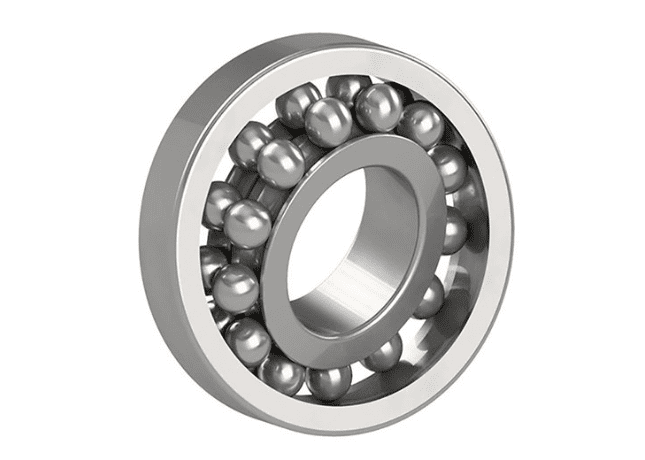
Now, let’s take a small step forward in discussing the main topics related to the world of bearings, asking ourselves what is meant by bearing play, and why it is important to become familiar with this concept, which is frequently encountered in both technical and non-technical readings.
Internal Play in Ball Bearings
To provide a precise definition of the above, let’s start by remembering that internal play of a bearing means the displacement of one ring relative to another in a radial or axial direction (respectively referred to as radial internal play or axial internal play).
Initial or Operational Play?
Having clarified the premise, it becomes important to understand how internal play in bearings functions by distinguishing between two different forms of “play”: initial internal play and operational internal play. As you might guess, the first refers to the play in the bearing before mounting, while the second form relates to bearings in operation that have already reached a stable temperature.
Operational Internal Play Values
Typically, the initial internal play in bearings is greater than the operational internal play: the reasons can be many, but they are primarily due to interference fits on the shaft or housing, along with the effect of thermal expansion of the bearing rings on one side, and the components of the fit on the other.
Choosing Internal Play
At this point, it is also worth noting that the operational internal play in a bearing can be determined by various elements that, unless you have sufficient practical familiarity, you may not be fully aware of. For example, operational play in a bearing can be significantly influenced by the preload class, the actual fits of the bearing on the tapered seat, the consequences of certain form errors, or dimensional variations caused by operating temperature (which may be related to device start-up or seasonal factors).
Related Reading
- How to Inspect a Bearing After 24 Months of Service
- Strategies to Extend the Lifespan of Power Transmission Belts in 2026
- AB-TOOLS Hand Tools for the Maintenance Technician
- Spherical Roller Bearings: Heavy-Load Applications Explained
- Angular Contact Bearings: When and Why to Use Them in 2026
Need help with bearing selection?
Our Euro Bearing technical team helps engineers and maintenance managers choose the right bearing, seal or linear component for each application — from automotive transmissions to agricultural machinery and industrial robotics. Tell us your operating conditions (load, speed, temperature, environment) and we will recommend the optimal solution from our catalogue of premium European bearings.
Contact our technical office → or browse the full product range.
Radial Play, Axial Play, and Why They Are Not the Same
Bearing play is the small but measurable movement that exists between the inner ring, the outer ring, and the rolling elements when no load is applied. Radial play is the displacement perpendicular to the shaft axis: it determines how much side-to-side movement is possible between the rings. Axial play is the displacement along the shaft axis: it influences thrust capacity and the bearing’s response to thermal expansion. The two values are linked geometrically — for a deep-groove ball bearing, the axial-to-radial ratio is roughly the square root of the conformity factor — but they are specified independently in catalogues because applications care about one or the other in different proportions. A spindle bearing in a precision grinder cares almost exclusively about axial play; a conveyor pulley bearing on a long thermally expanding shaft cares almost exclusively about radial play.
ISO Clearance Classes: C1 through C5 in Practical Terms
ISO standardises radial internal clearance into five working classes plus normal. C1 and C2 are tighter than normal and are used where rotational accuracy and minimum vibration dominate — machine-tool spindles, precision instruments, dental drills. Normal clearance covers the bulk of general-purpose industrial fitments. C3 is slightly looser than normal and is the default for electric motors, gearboxes, and many automotive applications where heat from continuous operation will close the clearance during running. C4 and C5 are looser still and are reserved for high-temperature applications, heavily interference-fitted shafts, or installations where the bearing operates very hot — calenders, traction motors, certain pumps. Selecting one class up or down is rarely a small decision; it changes operating temperature, vibration, and expected life by measurable amounts.
Measuring Play Without a Coordinate-Measuring Machine
Most maintenance teams do not have access to a CMM but can still characterise play with simple instruments. A magnetic-base dial indicator clamped to a fixed reference, with its probe touching the inner-ring face, gives axial play to within ±2 µm if the bearing is unmounted and at room temperature. A feeler gauge between rolling element and raceway gives a coarse but usable radial estimate for larger bearings. Modern shops are increasingly using ultrasonic thickness gauges in non-destructive mode to estimate the lubricant film thickness, which is the dynamic counterpart to static play in a loaded running bearing. The crucial point is consistency: measure the same way every time, record the value, and watch for trends rather than absolute numbers.
When Excessive Play Becomes a Warning Sign
Internal play that grows over time is rarely accidental. The most common cause is raceway wear — the steady removal of micron-thick layers from the contact surfaces under repeated rolling load. The second most common cause is fretting in the housing or shaft fits, which loosens the seat rather than the bearing itself but produces identical symptoms on a dial indicator. The third is corrosion or pitting that has removed material from the rolling elements. None of these is reversible: a bearing whose measured play has drifted upward by more than 30 % of its as-supplied value should be scheduled for replacement at the next available window, and the housing fit should be inspected for fretting at the same time, because installing a new bearing into a worn housing will reproduce the failure within months.
Related Resources from Eurobearing
For technicians who want to go deeper into bearing play, our editorial team has produced dedicated guides on adjacent topics. Each of the following articles complements the framework above with concrete examples, photographs, and selection tables built around real distribution scenarios:
- What Is Bearing Clearance in Ball Bearings?
- What Types of Ball Bearings Exist?
- FAG Ball Bearings: Features and Advantages in 2026
- CRAFT Ball Bearings: A Cost-Effective Standard
- What Is Bearing Shrink Fitting?
How Play Changes Under Load and Temperature
Static play measured at the workbench is not the play the bearing operates with. Press the inner ring onto an interference-fit shaft and a fraction of the radial play is consumed by the ring expansion before the shaft even rotates. Spin the assembly up to operating speed and the inner ring expands further from centrifugal load and from temperature differential against the housing — the inner is hotter because it is closer to the heat-generating contact zone. The result is that a deep-groove bearing nominally selected with C3 clearance can be operating at near-zero clearance under load, which is exactly what the engineer wanted and exactly why the wrong class causes seemingly random heating or noise.
This is also why running-in matters on a tight-clearance assembly. The first hours of operation deliver the highest temperature rise as the lubricant film stabilises and the geometry settles. A controlled break-in cycle — half-load for the first two hours, then a stepped increase — gives the assembly time to reach thermal equilibrium without burning the lubricant or local-spotting the raceway.
When a customer reports that an otherwise correctly selected bearing has failed quickly, the first question we ask is whether the running-in protocol was followed. The honest answer is often that it was not — which immediately narrows the diagnosis.
Eurobearing maintains technical documentation, cross-references and supply for the full catalogue of major bearing brands — SKF, FAG, INA, NSK, NTN, NMB, Schaeffler and dozens of secondary suppliers. If you need a second opinion on a bearing play question your team is wrestling with, our engineering desk is reachable by email and replies typically within one business day.
Need help with bearing selection?
Eurobearing is a European bearing and power-transmission distributor based in Northern Italy serving OEMs, MRO buyers, and industrial resellers across more than 40 countries. Our technical desk can help you cross-reference legacy part numbers, identify the correct dynamic load rating, choose the right cage material or seal type, and align lubricant intervals to your duty cycle. If you are evaluating bearing play for a specific machine — whether it is a continuous-process line, a packaging station, an agricultural drivetrain, or a marine winch — we are happy to review specs and propose qualified options from brands like SKF, FAG, INA, NSK, NTN, NMB, and Schaeffler. Contact the Eurobearing technical team for a free consultation, share the application photograph and the failed reference, and we will return a recommendation within one business day.