
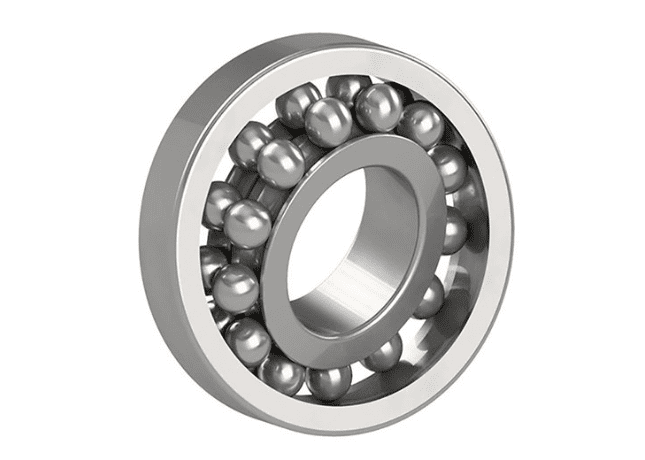
In a previous article, we discussed how ball bearings are components designed to reduce friction between mechanical parts. Their presence is crucial for ensuring safer and more consistent system movement. Proper functioning of these components ensures the efficiency and effectiveness of the vehicle or device they are installed in.
Now, let us take a step forward in exploring the main topics related to bearings by asking: What is bearing clearance, and why is it important to familiarize yourself with this concept, which frequently appears in technical or semi-technical discussions?
Internal Clearance in Ball Bearings
To provide a precise definition, let us begin by stating that the internal clearance of a bearing refers to the displacement of one ring relative to the other, either radially or axially (referred to as radial internal clearance or axial internal clearance, respectively).
Initial Clearance or Operating Clearance?
Having clarified this, it is also essential to understand the distinction between two different forms of clearance: the initial internal clearance and the operating internal clearance. As the terms suggest, the first refers to the clearance in the bearing before mounting, while the second relates to bearings already in operation and that have reached a stable temperature.
Operating Internal Clearance Values
Typically, the initial internal clearance in bearings is greater than the operating internal clearance. The reasons for this can be many, but they are mainly related to interference fits on the shaft or housing, as well as the thermal expansion of the bearing rings on one side and the coupling components on the other.
Choosing Internal Clearance
At this point, it is worth highlighting that operating internal clearance in a bearing can be influenced by various factors. Unless you have sufficient practical expertise, it may be challenging to fully grasp these nuances. For example, operating clearance can be significantly affected by preload class, the actual fit of the bearing in the tapered seat, the effects of shape errors, or dimensional variations caused by operating temperature (which may relate to device startup or seasonal factors).
To learn more, we recommend consulting your trusted technician and discussing all aspects related to the correct handling of internal clearance in ball bearings.
We also remind you that at Cuscinetti & Componenti, you will find a wide catalog of bearings from top brands, along with the usual courtesy of a staff ready to meet your information requests. Our reliable pre- and post-sales technical support ensures customer satisfaction.
Related Reading
- How to Inspect a Bearing After 24 Months of Service
- Strategies to Extend the Lifespan of Power Transmission Belts in 2026
- AB-TOOLS Hand Tools for the Maintenance Technician
- Spherical Roller Bearings: Heavy-Load Applications Explained
- Angular Contact Bearings: When and Why to Use Them in 2026
Need help with bearing selection?
Our Euro Bearing technical team helps engineers and maintenance managers choose the right bearing, seal or linear component for each application — from automotive transmissions to agricultural machinery and industrial robotics. Tell us your operating conditions (load, speed, temperature, environment) and we will recommend the optimal solution from our catalogue of premium European bearings.
Contact our technical office → or browse the full product range.
Radial Internal Clearance Versus Operating Clearance
The clearance stamped on the box is the radial internal clearance measured at the workbench: the bearing is unmounted, at room temperature, and free of any radial or axial load. The clearance the bearing actually operates with — operating clearance — is what determines noise, vibration, load distribution and life. Operating clearance is always smaller than the stamped value because two effects reduce it: the inner-ring expansion from the interference shaft fit, and the differential thermal expansion between inner and outer rings under load. Catalogue selection charts let you convert from one to the other, and the conversion is rarely trivial: an out-of-the-box C3 bearing on a tight shaft running hot can operate at near-zero clearance, which is sometimes exactly the design intent and sometimes a failure waiting to happen.
The Five ISO Classes and When Each Earns Its Place
ISO classifies radial internal clearance into Normal plus four additional classes (C2 below Normal, C3 above, C4 further above, C5 highest). Selection is not a free decision: it is dictated by the shaft fit, the housing fit, the temperature differential between inner and outer, and the desired operating clearance. Electric motors are the canonical C3 application because their typical interference fits and continuous hot operation close roughly half of the as-supplied clearance under steady-state load. Machine-tool spindles favour C2 because their tight fits and precision requirements demand minimal play. Heavy industrial drives with very tight shaft interference, sustained high temperatures, or large temperature differentials specify C4. C5 is the specialist class for extreme cases such as traction motors and certain pumps.
How Clearance Changes Through Life
Operating clearance is not a static value across the bearing’s service life. As the rolling elements and raceways wear, even microscopically, the clearance grows. As fretting in the housing and shaft fits develops, the apparent clearance grows in a different way — the bearing itself does not change, but its seat does. As the lubricant degrades and the operating temperature climbs, the differential expansion picture shifts. A condition-monitoring programme that tracks vibration spectra over months will detect these clearance drifts indirectly, because the characteristic frequencies and their amplitudes shift in recognisable patterns. This is one of the reasons longitudinal records are so much more useful than spot measurements.
Common Selection Mistakes
The most frequent mistake we see in technical desk requests is choosing C3 reflexively for any application that is hot, instead of calculating whether C3 is actually correct for the specific shaft fit and temperature differential. C3 is the right answer for many cases but not all; a tight interference fit with a 50 °C temperature differential needs C4. The second most frequent mistake is mixing clearance classes between paired angular-contact bearings, which destroys the preload curve and makes the bearing pair behave unpredictably. The third is selecting a tighter clearance class to reduce noise without realising that the tighter clearance increases heat and shortens life — the noise reduction is real but bought at the cost of bearing replacement intervals.
Verifying Clearance After Installation
A subset of high-precision applications verify clearance after installation rather than trusting catalogue assumptions. The method uses a dial indicator and a controlled axial preload to measure axial deflection, from which radial clearance is derived geometrically. The verification adds maybe ten minutes per bearing and gives the technician documented confidence that the installation matches design intent. For spindles, robot drives, and other applications where bearing performance directly drives product quality, the verification is standard practice. For general industrial fitments, the catalogue conversion is usually sufficient — provided the conversion was actually done rather than skipped.
Related Resources from Eurobearing
For technicians who want to go deeper into bearing clearance, our editorial team has produced dedicated guides on adjacent topics. Each of the following articles complements the framework above with concrete examples, photographs, and selection tables built around real distribution scenarios:
- What Is Play in Ball Bearings?
- What Types of Ball Bearings Exist?
- What Is Bearing Shrink Fitting?
- How to Address Bearing Overheating
The Practical Difference Between C3 and C4 in Daily Service
A question that comes up repeatedly at our technical desk is whether C3 or C4 is the right answer for a borderline case. The pragmatic distinction is this: C3 is the right answer when the operating temperature differential between inner and outer ring is moderate (roughly 5 to 20 °C) and the shaft interference fit is in the catalogue mid-range. C4 is the right answer when either the temperature differential exceeds 20 °C in steady state — high-power electric motors, paper-machine drying-section rolls, calenders — or the shaft interference is at the heavy end of the catalogue range. Choosing C4 when C3 would have done produces a noticeably noisier bearing with slightly shorter life; choosing C3 when C4 was correct produces an overheating bearing that can fail in months.
For non-borderline cases the answer is usually obvious from the catalogue selection tables, but the borderline cases deserve a moment of calculation rather than a reflex.
Eurobearing maintains stock of common bore sizes in C2, Normal, C3 and C4 from major manufacturers, which means specification changes after the first run-in observations rarely require a procurement delay.
Need help with bearing selection?
Eurobearing is a European bearing and power-transmission distributor based in Northern Italy serving OEMs, MRO buyers, and industrial resellers across more than 40 countries. Our technical desk can help you cross-reference legacy part numbers, identify the correct dynamic load rating, choose the right cage material or seal type, and align lubricant intervals to your duty cycle. If you are evaluating bearing clearance for a specific machine — whether it is a continuous-process line, a packaging station, an agricultural drivetrain, or a marine winch — we are happy to review specs and propose qualified options from brands like SKF, FAG, INA, NSK, NTN, NMB, and Schaeffler. Contact the Eurobearing technical team for a free consultation, share the application photograph and the failed reference, and we will return a recommendation within one business day.