
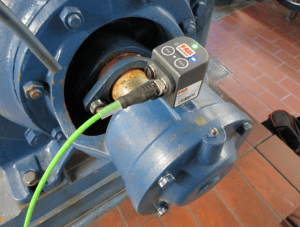
As is well known, and as we have often reminded you on these pages, to allow bearings to maintain their performance as close as possible to the original efficiency for an extended period, it is essential to resolve and identify anomalies that could cause significant damage and failures in the future. Scheduled periodic maintenance and inspections are necessary to achieve this goal.
But what does this involve? And what precautions should be taken?
Operational Phase Inspections
When it comes to preventive inspections, it is crucial to ensure proper monitoring of the bearing during its operational phase. Regular inspections should be carried out to detect noise levels during operation, monitor the temperature, or identify any vibrations. Even in cases of slight wear or flaking, irregular bearing noise can be promptly identified using a standard stethoscope.
As for temperature monitoring, while it is possible to detect obvious anomalies by simply touching the outer surface of the housing, for a more accurate check, it is advisable to measure the bearing’s temperature using a thermocouple inserted directly into the lubrication hole or a similar access point.
Inspecting “Difficult” Bearings
In some cases, bearings may be hard to access or not allow for “simple” checks like those described above. For example, this can apply to bearings mounted on moving parts, where it is not possible to measure noise or temperature during operation. Roller bearings in vehicles are a typical example, where periodic inspections can be carried out by applying fresh grease.
Examining the condition of fresh grease during bearing operation can also help assess the bearing’s operational state. This evaluation can be based on the level of contamination, the amount of metal shavings present in the grease, and any signs of leaks or grease deterioration.
As you might expect, if these checks reveal anomalies or signs of bearing failure, the bearing must be disassembled to conduct a more thorough inspection. This will help identify the root causes of the faults.
When Replacement is Needed
If the bearing needs to be replaced, we remind you that at Cuscinetti e Componenti, you will find the most extensive online catalog of bearings and other components from top brands for all types of machinery. With over 50,000 items, including industrial components, bearings, supports, oil seals, belts, linear guides, bushings, locknuts, washers, seals, idler pins, track rollers, support rollers, maintenance products, and much more, we have you covered.
Our customer support ensures the best pre- and post-sales assistance and is always ready to help you find personalized solutions.
Fast delivery throughout Italy, secure payments via credit card, PayPal, or bank transfer, and our “satisfied or refunded” guarantee are just some of the key benefits we are delighted to offer every day!
Related Reading
- How to Inspect a Bearing After 24 Months of Service
- Strategies to Extend the Lifespan of Power Transmission Belts in 2026
- AB-TOOLS Hand Tools for the Maintenance Technician
- Spherical Roller Bearings: Heavy-Load Applications Explained
- Angular Contact Bearings: When and Why to Use Them in 2026
Need help with bearing selection?
Our Euro Bearing technical team helps engineers and maintenance managers choose the right bearing, seal or linear component for each application — from automotive transmissions to agricultural machinery and industrial robotics. Tell us your operating conditions (load, speed, temperature, environment) and we will recommend the optimal solution from our catalogue of premium European bearings.
Contact our technical office → or browse the full product range.
Why Preventive Inspection Beats Reactive Replacement
Rolling bearings almost never fail without warning. Between the first micro-defect and the moment the machine stops there is a window — often weeks, sometimes months — during which the bearing broadcasts its condition through vibration, temperature, noise, lubricant chemistry and wear debris. A preventive inspection programme is simply the discipline of listening during that window. Plants that do it well typically report a sharp fall in unplanned downtime and a measurable extension of average bearing service life, because the underlying causes (misalignment, contamination, wrong lubricant) are corrected instead of being replaced along with the component.
The economics are straightforward. The bearing itself is usually the cheapest item in the failure equation. The expensive items are the unplanned stop, the collateral damage to shaft and housing, the emergency labour, and the scrapped production. An inspection routine converts an unplanned, expensive event into a planned, cheap one.
The Four Layers of a Bearing Inspection Programme
Layer 1 — Sensory inspection. The cheapest and still one of the most effective. An experienced operator walking the line can hear a rough bearing, feel an abnormal vibration through the housing, smell an overheated grease and see a leaking seal. Formalise it: a short checklist, a fixed route, a fixed frequency, and a place to record what was found.
Layer 2 — Temperature monitoring. Infrared spot checks or fixed sensors on the housing. What you are looking for is not an absolute threshold but a trend, and an asymmetry between the two bearings on the same shaft. A rising trend is one of the earliest and most reliable indicators available; our article on bearing overheating explains how to interpret it.
Layer 3 — Vibration analysis. The core of any serious programme. Overall velocity readings tell you that something has changed; spectral and envelope analysis tell you what. Bearing defect frequencies (BPFO, BPFI, BSF, FTF) identify which element is damaged, while a dominant 2X axial component points to misalignment and a dominant 1X radial to unbalance. Because bearing defects appear first in the high-frequency band, envelope (demodulated) analysis will see them long before the overall vibration level moves.
Layer 4 — Lubricant analysis. For oil-lubricated machines, a periodic sample tested for viscosity, water content, oxidation, additive depletion and particle count is the most information-dense diagnostic available. Wear-debris ferrography can even tell you which surface is degrading. For grease-lubricated bearings, a visual and tactile check of the purged grease — colour, consistency, presence of metal particles — is a workable proxy.
Building the Inspection Calendar
Frequency should follow criticality, not convenience. A practical structure that works in most industrial plants:
- Daily/shift: sensory check on critical machines; note anything abnormal.
- Weekly: temperature spot readings on the critical asset list.
- Monthly: overall vibration readings on all rotating assets above a defined power threshold.
- Quarterly: full spectral/envelope analysis on critical assets; oil sampling on circulating systems.
- Annually / at overhaul: dismount, clean and read the wear path on the raceways; verify housing bores, shaft seats, alignment and seal condition.
Relubrication intervals belong in the same calendar and must be derived from speed, load and temperature — not from habit. Our guides on grease lubrication and oil lubrication set out the calculation; over-greasing is as damaging as under-greasing.
Reading the Dismounted Bearing
The single most valuable inspection happens after removal. A dismounted bearing is a written record of its own service life. A wide, symmetrical wear path in the centre of the raceway means the bearing was correctly loaded and aligned. A diagonal or displaced path means misalignment. Dull, matt patches with embedded particles mean contamination. Discoloration to straw or blue means overheating. Fluting or washboard marks across the raceway mean electrical current passage. Brinell indentations mean impact during mounting. Each pattern names its own root cause, and correcting that cause is what prevents the replacement bearing from failing the same way. The companion article on identifying bearing damage is the field reference for this step.
From Preventive to Predictive
Preventive inspection is calendar-driven; predictive maintenance is condition-driven. The step between them is data. Once temperature and vibration are trended rather than merely measured, you can move from “inspect every quarter” to “intervene when the trend crosses the threshold” — which is both cheaper and safer. Wireless sensors and edge analytics have made this affordable even for mid-sized plants, and the payback is usually measured in months.
Key Takeaways
- Bearings warn before they fail; inspection is the discipline of listening.
- Layer sensory checks, temperature, vibration and lubricant analysis by asset criticality.
- Trend the data — deviation from baseline is more informative than any absolute threshold.
- Always read the dismounted bearing: it names its own root cause.
- Correct the cause, not just the component, or the new bearing will fail the same way.
Frequently Asked Questions
How often should bearings be inspected? Frequency follows criticality. Critical rotating assets deserve a sensory check every shift, temperature readings weekly and full vibration analysis quarterly. Non-critical auxiliaries can be handled on a monthly overall-vibration route.
Can I inspect a bearing without stopping the machine? Yes — and you should. Temperature, vibration, ultrasound and oil sampling are all on-line techniques. Only the wear-path inspection requires dismounting, and that belongs to the scheduled overhaul.
Which technique gives the earliest warning? High-frequency envelope vibration analysis typically detects a raceway defect first, followed by wear-debris analysis, then temperature, then audible noise. By the time a bearing is audibly noisy, its remaining life is short.
Is a preventive programme worth it for small machines? The programme should be scaled, not skipped. Even a simple route with an infrared gun and a written checklist pays for itself on the first avoided stop.
Need help with bearing selection? Our team supports you with cross-references and lead-times. Contact our specialists →