
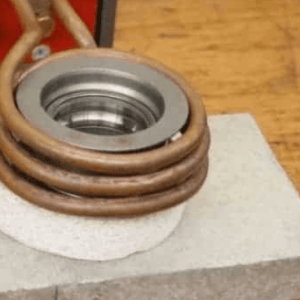
Bearing shrink fitting (commonly known as “interference fitting”) is a specialized technique widely used in industrial settings and mechanical workshops to facilitate the assembly or disassembly of mechanical components such as bearings and transmission elements.
But what does shrink fitting involve? And what are the benefits of this specific method?
How Does Shrink Fitting Work?
Shrink fitting aims to achieve the correct fit of bearings onto designated housings or shafts by using heat. The application of heat triggers thermal expansion, thereby overcoming the dimensional interference between two components. This process ultimately results in a stronger and more efficient mechanical fit.
When Is Shrink Fitting Used?
As previously mentioned, shrink fitting is typically employed to enhance the mechanical coupling between bearings and shafts or housings with specific internal or external diameters that require an interference fit.
When the two components are at the same ambient temperature, interference prevents proper mechanical assembly. However, when shrink fitting is used, the part undergoing the fitting process is preheated, allowing for significant expansion of the bore diameter. This facilitates easier insertion or removal of the component, which then returns to its original size upon cooling.
What Temperature Is Used for Shrink Fitting?
There is no fixed standard temperature for shrink fitting. However, most interference fitting operations are carried out at temperatures ranging from 90°C to 250°C.
What Are the Advantages of Shrink Fitting?
Shrink fitting, particularly when induction heating is used for preheating, is widely adopted by industries looking to increase production speed and improve process efficiency.
The main benefits of shrink fitting include:
✔️ Faster assembly and disassembly processes
✔️ Higher energy efficiency, reducing waste and unnecessary overheating
✔️ Better heat control, applying heat only where needed
✔️ More uniform heating and improved process consistency
✔️ Extended component lifespan due to optimal assembly techniques
✔️ Easy integration into production lines with compact and safe equipment
For more information, feel free to contact our technical support team!
Related Reading
- How to Inspect a Bearing After 24 Months of Service
- Strategies to Extend the Lifespan of Power Transmission Belts in 2026
- AB-TOOLS Hand Tools for the Maintenance Technician
- Spherical Roller Bearings: Heavy-Load Applications Explained
- Angular Contact Bearings: When and Why to Use Them in 2026
Need help with bearing selection?
Our Euro Bearing technical team helps engineers and maintenance managers choose the right bearing, seal or linear component for each application — from automotive transmissions to agricultural machinery and industrial robotics. Tell us your operating conditions (load, speed, temperature, environment) and we will recommend the optimal solution from our catalogue of premium European bearings.
Contact our technical office → or browse the full product range.
Why an Interference Fit Exists in the First Place
A rolling bearing ring that rotates relative to its load must be mounted with an interference fit. If it is not, the ring will creep on its seat — a slow, relentless circumferential migration that polishes the shaft, generates heat, produces fretting corrosion and eventually destroys both the bearing and the seat it sits on. The interference is what locks the ring to the shaft so that the two behave as one body. This is not an optional refinement: it is the difference between a bearing that reaches its calculated life and one that fails within months.
But interference creates a mounting problem. The bore of the inner ring is deliberately smaller than the shaft diameter — typically by a few tens of micrometres for a medium-sized bearing. You cannot simply push it on, and you must never hammer it on: the mounting force would pass through the rolling elements, brinelling the raceways and condemning the bearing before it has turned a single revolution. Shrink fitting is the elegant way out. Heat the ring, and thermal expansion opens the bore enough to slide it into place; let it cool, and it grips the shaft with exactly the designed interference.
The Arithmetic of Thermal Expansion
Bearing steel expands by roughly 11 to 12 micrometres per metre per kelvin. For a bearing with a 100 mm bore, that is about 1.1 to 1.2 µm of bore growth for every 10 °C of heating. If the drawing calls for a 40 µm interference and you want a further 40 µm of clearance to slide the ring on comfortably, you need roughly 80 µm of total expansion — which for a 100 mm bore means a temperature rise of about 70 °C above the shaft temperature.
Two rules follow directly. First, never exceed 120 °C for a standard bearing. Above that, the rings begin to lose dimensional stability and hardness unless they have been specifically heat-stabilised (S0, S1 and higher designations extend the limit). Sealed and shielded bearings have a lower limit still, because the seal material and the pre-packed grease will not survive: many are restricted to 80 °C or below, and some should not be heated at all. Second, heat uniformly. A ring heated on one side expands on one side, and it will go on crooked or seize halfway down the shaft.
The Right and Wrong Ways to Heat a Bearing
Induction heater — the professional standard. An induction heater raises the ring temperature quickly, uniformly and controllably, and modern units include a temperature probe with automatic cut-off. Crucially, they also demagnetise the bearing at the end of the cycle: a magnetised ring attracts steel particles and will contaminate its own lubricant for the rest of its life. This is the method to use whenever the budget allows.
Oil bath — acceptable with care. Immersion in clean oil at a controlled temperature is uniform and cheap, but it introduces two risks: the oil must be scrupulously clean, and the bearing must not rest on the bottom of the tank, where it will overheat locally. Support it on a grid.
Hot plate, oven, or heating ring — usable for small bearings, provided the temperature is genuinely controlled.
Open flame, blowtorch, or hammer — never. A flame produces uncontrolled local temperatures that destroy the heat treatment of the steel, and a hammer transmits the impact through the rolling elements. Both are guaranteed ways to install a bearing that is already damaged.
The Mounting Sequence, Step by Step
- Verify the seat before you heat anything. Measure the shaft diameter and the housing bore with a micrometre; check the tolerance class against the drawing. A worn shaft cannot be rescued by a hot bearing.
- Clean everything. The shaft, the shoulder, the ring, your hands and your gloves. Contamination introduced at mounting stays for the life of the bearing.
- Calculate the target temperature from the bore diameter and the specified interference — do not guess.
- Heat uniformly to that temperature, never above 120 °C for standard open bearings.
- Mount in one continuous movement, sliding the ring firmly against the shaft shoulder. You have only seconds before the ring starts to shrink; hesitation means a bearing seized halfway down the shaft.
- Hold it against the shoulder while it cools, so that it does not shrink away and leave an axial gap.
- Demagnetise if an induction heater was used without an automatic cycle.
- Lubricate and check rotation by hand before closing the housing.
Alternatives and Related Techniques
Where heating is impractical, hydraulic mounting — injecting pressurised oil between the ring and a tapered seat — is the standard method for large bearings, and it is also the safest way to dismount them. Cold fitting with liquid nitrogen or dry ice shrinks the shaft instead of expanding the ring, and is used where the ring cannot be heated; it demands careful handling and condensation control. For light interference on small bearings, a mechanical fitting tool that applies force to the correct ring — never through the rolling elements — remains perfectly acceptable.
The Mistakes That Cost the Most
Overheating above 120 °C softens the raceways and the bearing fails early with no obvious external cause. Uneven heating cocks the ring on the shaft and produces immediate misalignment. Excessive interference removes the internal clearance the bearing needs and leads directly to overheating in service — which is why C3 clearance is often specified for heavy interference fits. And mounting a contaminated bearing guarantees an abrasive wear pattern that will show up on the raceway at the first inspection. A structured preventive inspection routine will reveal all of these — but it is far cheaper to avoid them at mounting. Finish by lubricating correctly: see our guides to grease and oil lubrication.
Frequently Asked Questions
What temperature should I heat a bearing to? Enough to open the bore by the interference plus a comfortable clearance — usually 70 to 90 °C above the shaft temperature — and never above 120 °C for a standard open bearing. Sealed and shielded bearings have much lower limits, typically around 80 °C.
Can I heat a sealed bearing? Only with great care, and only within the seal and grease temperature limits stated by the manufacturer. Many sealed bearings should be mounted mechanically or hydraulically instead.
Why does the bearing need to be demagnetised? Induction heating leaves residual magnetism in the rings. A magnetised bearing attracts ferrous wear particles into its own lubricant, creating a self-contaminating loop that shortens life.
How long do I have to slide the ring on? Seconds, not minutes. Have the shaft prepared, the tooling ready and the path clear before the bearing comes out of the heater.
What if the bearing seizes halfway down the shaft? Do not hammer it. Cool the shaft or, more practically, remove and replace the bearing — a ring that has been forced is no longer trustworthy.
Need help with bearing selection? Our team supports you with cross-references and lead-times. Contact our specialists →