
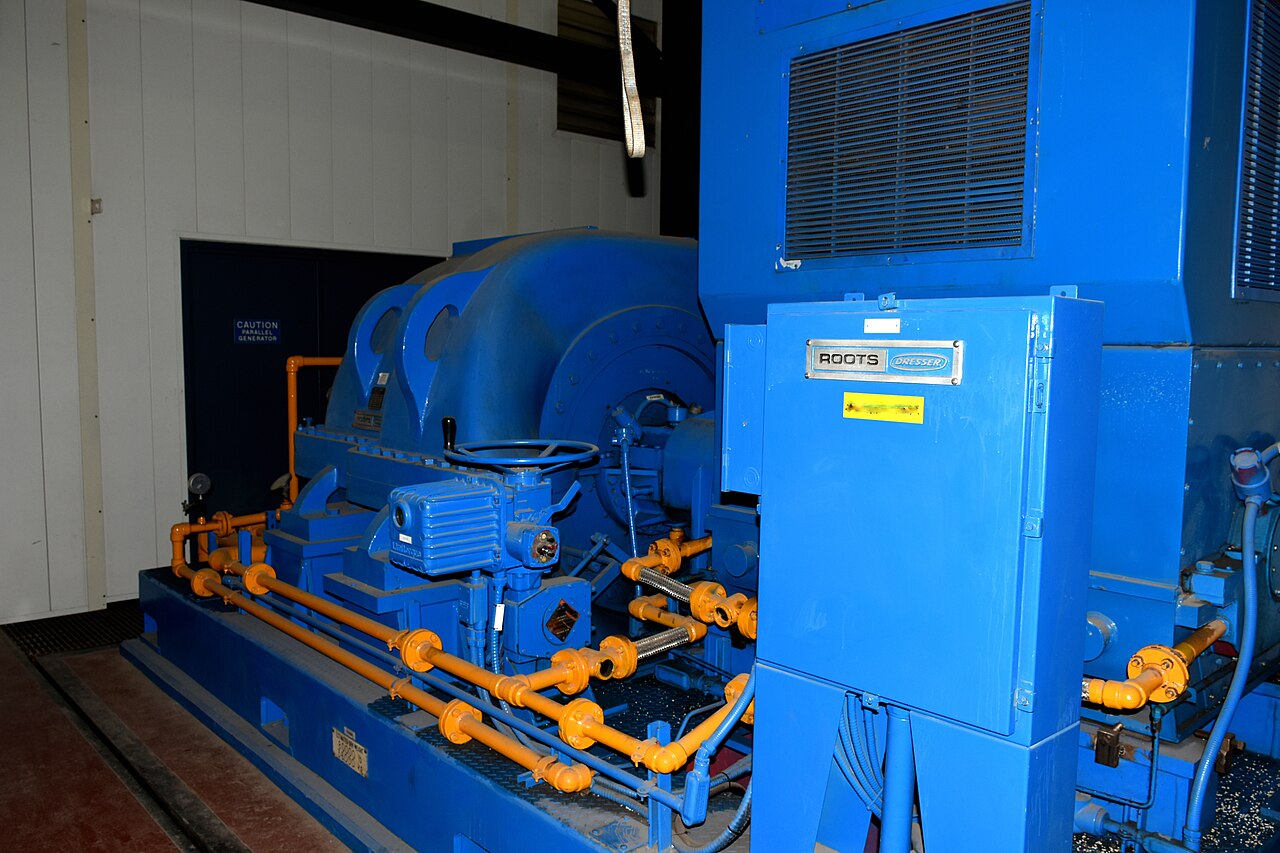
On the roof of a foundry, a centrifugal extraction fan has eaten its drive-end bearing for the third time in two years. Each time the fitter replaces the bearing, re-tensions the belts a little tighter to stop the squeal at start-up and closes the guard, and each time the temperature on the plummer block nearest the pulley climbs back above 80 °C within weeks. The impeller-end bearing, by contrast, looks almost new at every inspection. Belt-driven industrial fan bearings are rarely undersized by the original designer; they are usually overloaded by belt tension, mounted with the wrong side located, or fitted with a clearance that does not suit the hot gas running through the casing. This article explains how a typical two-bearing fan shaft is arranged, how to estimate the real load from an overhung pulley, which internal clearance to choose and which details make the difference between a fan that runs for years and one that becomes a monthly job.
The typical arrangement on a belt-driven fan shaft
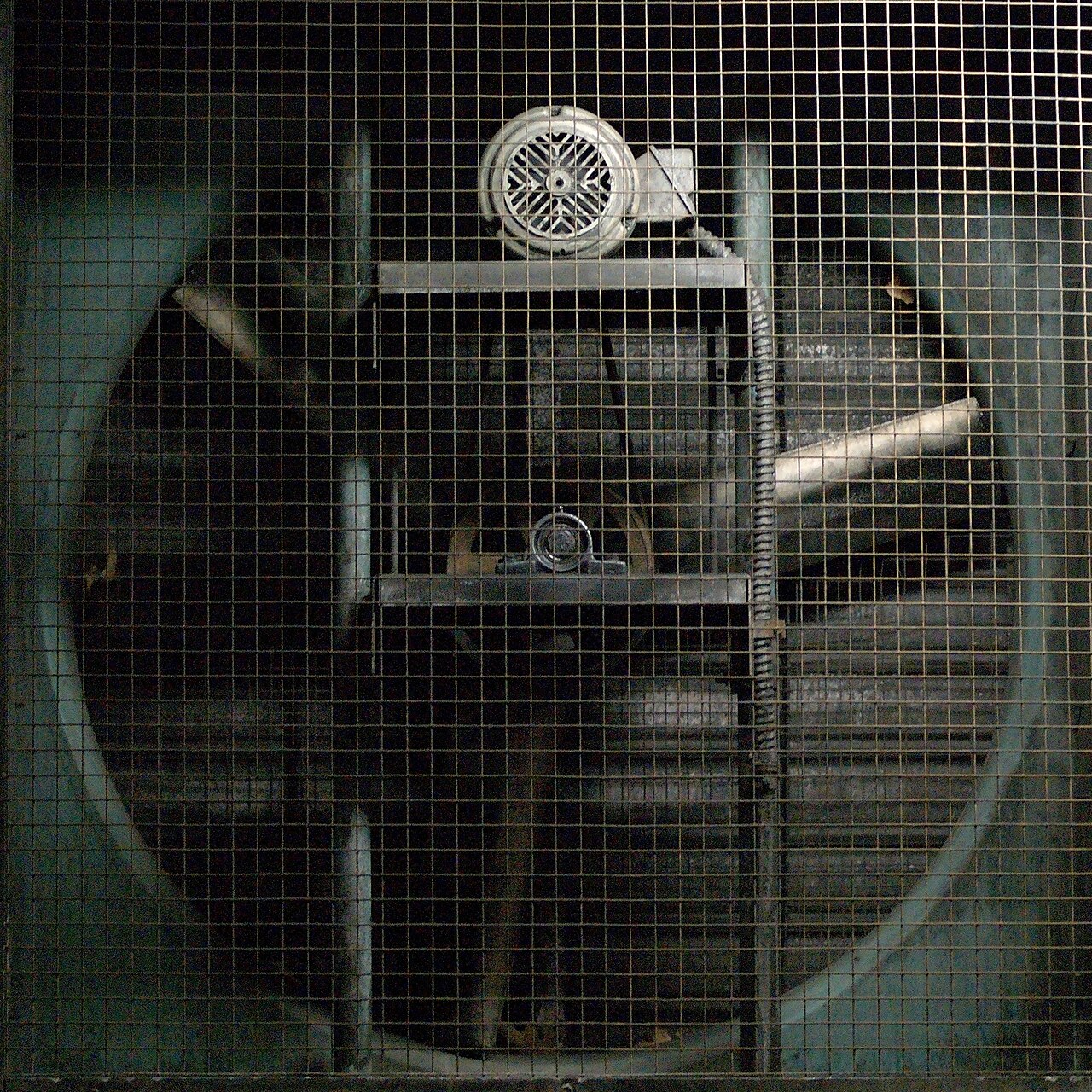
Most belt-driven centrifugal and axial fans use a single shaft supported by two housed bearings mounted on a pedestal or on the fan frame. The impeller sits at one end, either between the bearings or overhung outside them, and the driven pulley is overhung at the other end, outside the drive-end bearing. Small fans often use insert bearings in cast iron units, while medium and large fans use spherical roller bearings on adapter sleeves in split plummer blocks, because they tolerate the misalignment of a fabricated frame and carry the combined radial and axial loads. One of the two bearings must locate the shaft axially and the other must allow it to move, since the shaft grows with temperature and the frame can distort when the fan heats up. Our guide to split plummer block housings explains how locating rings turn a standard housing into either the fixed or the free position.
Which side should locate
On a belt-driven fan the usual recommendation is to locate the bearing nearest the pulley and let the impeller-end bearing float. The reasoning is practical: the drive end must keep the pulley in a fixed plane so that belt alignment does not change as the shaft heats up, and any axial movement at that end would shift the pulley relative to the motor pulley and wear the belt flanks. The impeller end, on the other hand, is the one closest to the hot gas stream, so most of the thermal growth starts there and can be absorbed by a floating housing. On fans handling very hot gas, or with a long shaft between bearings, the axial room in the floating housing must be checked against the expected expansion, including a margin for start-up transients. Fitting the locating rings on the wrong side, or on both sides, is one of the most frequent errors after a bearing change, and it produces exactly the symptoms seen on the foundry roof: heat, axial preload and short life at one position.
Estimating the overhung pulley load
The force that the belts exert on the fan shaft is far larger than the torque alone suggests, because a V-belt drive needs a static tension well above the effective pull to transmit power without slipping. A simple estimate starts with the torque at the fan shaft, T = 9550 × P / n, with P in kW and n in rpm. For a 30 kW fan running at 1,200 rpm, T is about 239 Nm. With a 315 mm pulley the effective pull is 2 × T / d, roughly 1,520 N, and multiplying by a typical V-belt factor of 2 to 2.5 gives a shaft load of around 3,800 N. Because the pulley is overhung by, say, 150 mm from a bearing span of 600 mm, the near bearing sees about 1.25 times that load, roughly 4,750 N, while the far bearing is lifted in the opposite direction by about 950 N. Add the impeller weight and the dynamic load from residual unbalance, and it is easy to see why the drive-end bearing usually runs hotter and fails first.
Why over-tensioned belts kill the drive-end bearing
Every extra newton of belt tension lands directly on the drive-end bearing, multiplied by the overhang factor, and bearing life falls roughly with the cube of the load for ball bearings and with the power of 10/3 for roller bearings. Doubling the belt tension to stop a squeal at start-up can therefore cut the calculated life of the near bearing by a factor of eight or more. The correct approach is to set the tension with a measured deflection force or a frequency meter, re-tension after the running-in period and inspect the belts rather than tightening them whenever they make noise. Our guide to V-belt tension by deflection and frequency gives the method, and choosing the right section and pulley also matters, as explained in our article on taper lock V-belt pulleys. Moving the pulley as close to the bearing as the shaft allows reduces the overhang, and that one adjustment often extends bearing life more than any change of brand.
Clearance, fits and temperature in hot gas fans
Fans that handle warm process air, dryer exhaust or flue gas heat the shaft from the impeller end, and the inner rings of both bearings run warmer than the housings. As with any bearing whose inner ring is hotter than its outer ring, the operating clearance shrinks, so C3 clearance is the normal choice for most industrial fans, and C4 is used where the gas temperature is high or the shaft carries significant heat into the bearing. Bearings on adapter sleeves must be driven up by the recommended amount, measured either with feeler gauges or by the axial drive-up method, because an over-tightened sleeve removes clearance and an under-tightened one lets the inner ring creep. A spherical roller bearing such as the FAG 22218-K-M on an adapter sleeve is a common choice for medium fans, and the matching adapter sleeves with lock nut should be replaced at the same time when the old sleeve shows fretting or a damaged thread.
Vibration, unbalance and the floating housing
Fans are vibration-sensitive machines, and the bearings are where that vibration is measured and where it does damage. Dust build-up on the impeller blades, erosion and corrosion change the balance over time, and the resulting dynamic load rotates with the shaft, which means it acts on the inner ring rather than on a fixed zone of the outer ring. A rising 1× running speed component on the vibration spectrum points to unbalance, while axial vibration at the drive end often indicates belt or pulley misalignment, which our article on proper belt drive alignment addresses. The floating housing deserves particular attention: if the outer ring cannot slide because the bore is corroded or the cap was clamped too tightly, thermal growth loads both bearings axially and produces heat even with perfect balance. A quick check is to measure the axial gap on both sides of the floating outer ring cold and hot, and to confirm that the shaft has really moved as expected.
Lubrication and seals for dusty fan installations
Most housed fan bearings are grease lubricated, and the relubrication interval is shortened by speed, temperature and vertical or dusty installations. The housings on extraction fans in foundries, sawmills and cement plants face fine dust that will find any gap, so the seal choice matters as much as the grease. Double-lip contact seals work well at moderate speeds, while labyrinth or taconite seals cope better with high speeds and heavy dust when they are regularly purged with fresh grease. Grease quantity should follow the bearing size and speed rather than a fixed number of gun strokes, because over-filling a fast-running fan bearing causes churning and temperatures above 90 °C within minutes. Where housings are replaced, standard split bearing housings in cast iron offer the most interchangeable solution, and the seal type should be specified explicitly when ordering, since the default supplied with a housing is not always the one the application needs.
A belt-driven fan rewards attention to a handful of details: locate the drive end and let the impeller end float, keep the pulley close to its bearing, set the belt tension by measurement rather than by ear, use the right clearance for the gas temperature, and keep the floating housing free to move. Those decisions cost nothing extra at a bearing change, yet they explain most of the difference between fans that run for years and fans that eat a bearing every season. When replacements are ordered, the designation of the bearing, the sleeve, the housing and its seals should all be checked together, along with the belts from suppliers such as Optibelt, so that the new assembly does not inherit the problem that destroyed the old one. A brief load estimate like the one above, written down on the maintenance record, also helps the next fitter understand why the drive end deserves the most care.
Replacing bearings on a belt-driven fan that keeps running hot or noisy? Our team helps check the overhung pulley load, the locating arrangement and the right housing and clearance before you order. Book a free consultation.
Image credits: “High Pressure Centrifugal Fan” by SAF (CC BY-SA 4.0); “Belt-driven ventilation fan and motor” by takomabibelot (CC BY 2.0), via Wikimedia Commons.