
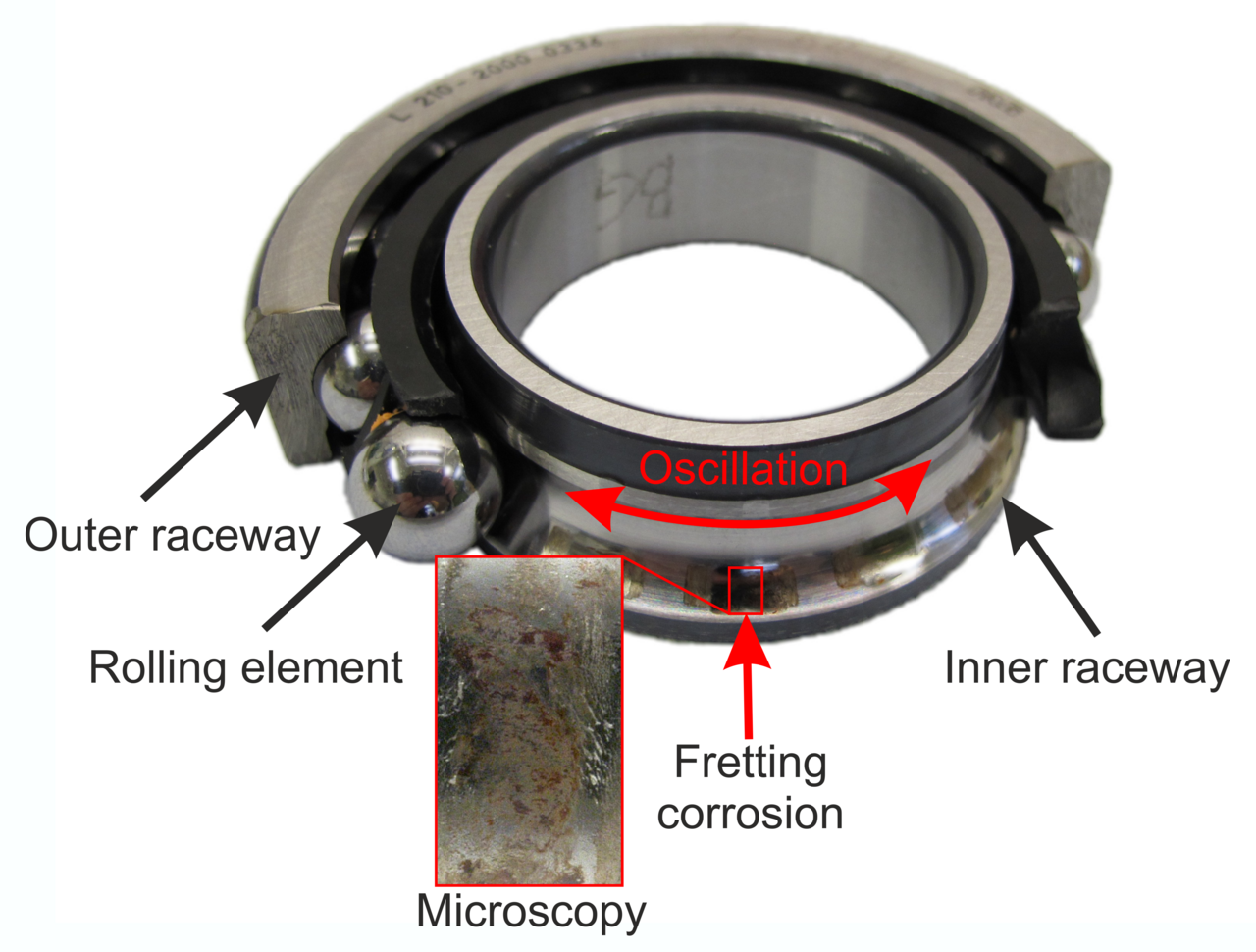
A brand-new standby pump is commissioned after eight months on its baseplate next to a compressor house, and within a few days the motor-side bearing develops a steady hum that rises in pitch with speed. When the bearing is removed, the raceway shows a neat row of shallow, polished depressions spaced exactly like the balls, some of them surrounded by a reddish-brown halo. Nobody overloaded the pump, it never ran dry, and the bearing was correctly fitted. This is false brinelling, the damage that vibration inflicts on a bearing that is not turning, and it often appears together with fretting corrosion on the fitting surfaces. Both modes are common on standby equipment, machines in storage and assemblies shipped by truck, rail or sea, and both are frequently misdiagnosed as manufacturing defects or overload. This article explains how to recognise them, how to tell them apart from true brinelling, and which simple measures prevent them on idle and transported machines.
What happens inside a bearing that vibrates but does not turn
When a bearing rotates, the rolling elements continuously drag a fresh film of lubricant into each contact and the load moves around the raceway. When the shaft is stationary but the machine is exposed to vibration, from neighbouring equipment, a truck bed or the deck of a ship, each rolling element rocks back and forth through a tiny arc in the same spot. That micro-movement squeezes the lubricant out of the contact and does not bring it back, so metal touches metal over a small patch. The repeated sliding removes microscopic particles, which oxidise immediately and act as an abrasive, and the patch deepens into a shallow wear mark. Because every rolling element does the same thing, the marks appear at a spacing equal to the rolling element pitch, which is the signature of the mode. Under the ISO 15243 classification this belongs to frictional corrosion, alongside fretting corrosion, rather than to plastic deformation, and that distinction drives the whole diagnosis.
False brinelling versus true brinelling
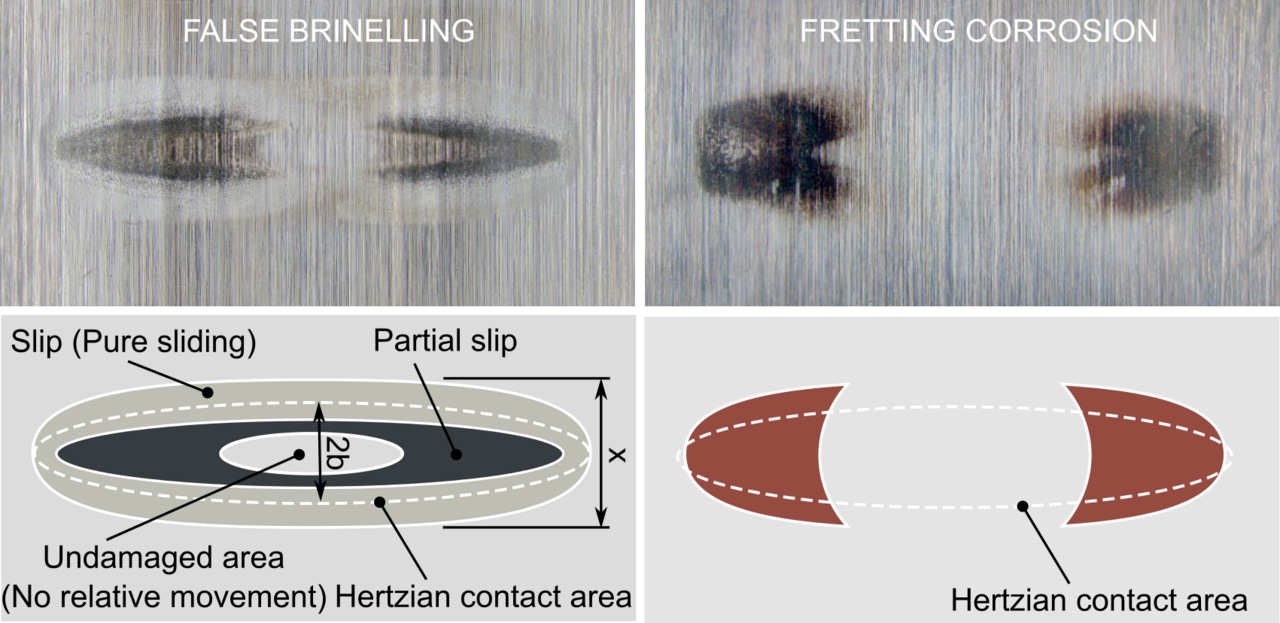
True brinelling is a plastic indentation: a static overload or an impact, such as a hammer blow during mounting or a dropped assembly, presses the rolling elements into the raceway hard enough to deform the steel permanently. The resulting dents are also spaced at the rolling element pitch, which is why the two modes are so often confused. The difference shows under a magnifier. In a true brinell mark the original grinding lines of the raceway are still visible at the bottom of the dent, because the material was pushed down rather than removed, and the edges are raised slightly. In a false brinelling mark the grinding lines have been worn away, the bottom is either bright and polished or stained by red-brown or black oxide, and the depression is often elongated in the direction of the oscillation. Our visual guide to bearing failure modes shows further examples, and a careful set of photographs, as described in our article on photographing a failed bearing for a warranty claim, settles most disputes with suppliers.
Fretting corrosion on bores and outside diameters
Fretting corrosion is the same mechanism acting on the fitting surfaces instead of the raceways. When the fit between inner ring and shaft or between outer ring and housing is too loose for the load, or when the shaft flexes under a heavy load, the surfaces move against each other by a few micrometres at every revolution or every vibration cycle. The result is a patchy layer of reddish-brown iron oxide on the bore or the outside diameter, sometimes accompanied by black areas where oxidation was limited. Fretting on a rotating ring is a warning that the ring may soon start to creep, wearing the shaft and generating heat, while fretting on a stationary outer ring often reflects a housing bore that is oversize, oval or worn. In both cases replacing the bearing alone does not solve the problem: the fit must be measured and corrected. Our article on shaft and housing fits for rotating ring load explains which tolerance classes prevent this movement in the first place.
Where these damages turn up in practice
The classic textbook example is cars shipped by rail, where wheel bearings developed false brinelling marks long before the vehicles reached their owners, but industrial cases are far more common today. Standby pumps and fans installed next to running equipment absorb vibration through the baseplate for months. Machines exported by sea spend weeks on a vibrating deck, often with heavy rotors resting on their bearings. Wind turbines idling in low wind, conveyor drives stopped for maintenance next to running crushers, and spare motors stored on a shelf above a press line all show the same pattern. Even spare bearings can be affected when they are stored near vibrating machinery, which is one of the reasons our guide to bearing storage, humidity and stacking recommends a quiet, dry location. Ball bearings are more sensitive than roller bearings because the point contact concentrates the micro-sliding, and greases with stiff consistency and poor oil bleed offer the least protection when the shaft never turns.
Telling them apart from fluting and electrical damage
A second family of evenly spaced marks causes further confusion: electrical erosion from shaft currents in inverter-driven motors. Fluting appears as a washboard of fine, grey, closely spaced lines across the whole raceway, perpendicular to the rolling direction, and the spacing is related to the speed and the current frequency rather than to the rolling element pitch. False brinelling marks, by contrast, are discrete, sit at fixed positions corresponding to where the rolling elements were resting, and are not present around the rest of the raceway. Frosting from electrical current gives a dull matt band, not individual depressions. Checking the spacing, the colour and the presence of grinding marks in the bottom of the marks distinguishes the three causes in a few minutes, and getting the diagnosis right matters because the remedies are completely different: insulated bearings or grounding for electrical damage, vibration isolation and rotation routines for false brinelling. Our article on fluting and shaft currents in inverter-driven motors covers the electrical side in detail.
Preventing damage on idle and transported equipment
Prevention starts with removing either the vibration or the stationary contact. For transport, the most effective measures are transport locks that relieve the bearing of the rotor weight, clamping the shaft axially and radially, and anti-vibration mounts under the crate. For standby machines, a simple routine of rotating the shaft by hand or bumping the motor every week or two moves the rolling elements to a new position and redistributes lubricant before the marks can form. Greases with good oil release and anti-wear additives offer better protection than very stiff products, and some sites use special preservation oils on stored assemblies. Where the problem persists, switching from deep groove ball bearings to roller bearings or to designs with larger contact areas can reduce sensitivity, though that requires an engineering review. Most importantly, commissioning procedures should include a noise and vibration check on any machine that has been stored or shipped, so that marked bearings are replaced before they fail in service.
False brinelling and fretting corrosion are both caused by small movements in places where the bearing expects either full rotation or no movement at all. They leave distinctive evidence: marks at rolling element pitch with worn-away grinding lines, and red-brown oxide on the fitting surfaces. Recognising that evidence prevents wasted warranty claims, wrong conclusions about overload and, above all, repeated failures after the next long idle period or shipment. A short checklist for storage, transport and standby rotation, together with correct fits and a suitable grease, removes most of the risk at very little cost. When a replacement is needed, matching the original designation, including clearance and lubricant fill, matters as much as the brand, whether the original came from SKF, FAG or another manufacturer. Including a photograph of each removed bearing in the maintenance record, together with the storage and transport history of the machine, makes the cause obvious the next time the same marks appear and helps purchasing and logistics teams understand why the precautions matter.
Found evenly spaced marks on a bearing from a machine that barely ran? Send us photos of the raceways and fits: our team helps identify the damage mode and the right replacement before the next start-up. Book a free consultation.
Image credits: “Example of fretting schwack-crop” by Fabian Schwack, Felix Prigge (CC BY-SA 4.0); “Fretting And FalseBrinelling Schwack Byckov” by Felix Prigge, Fabian Schwack, Artjom Byckov (CC BY-SA 4.0), via Wikimedia Commons.