
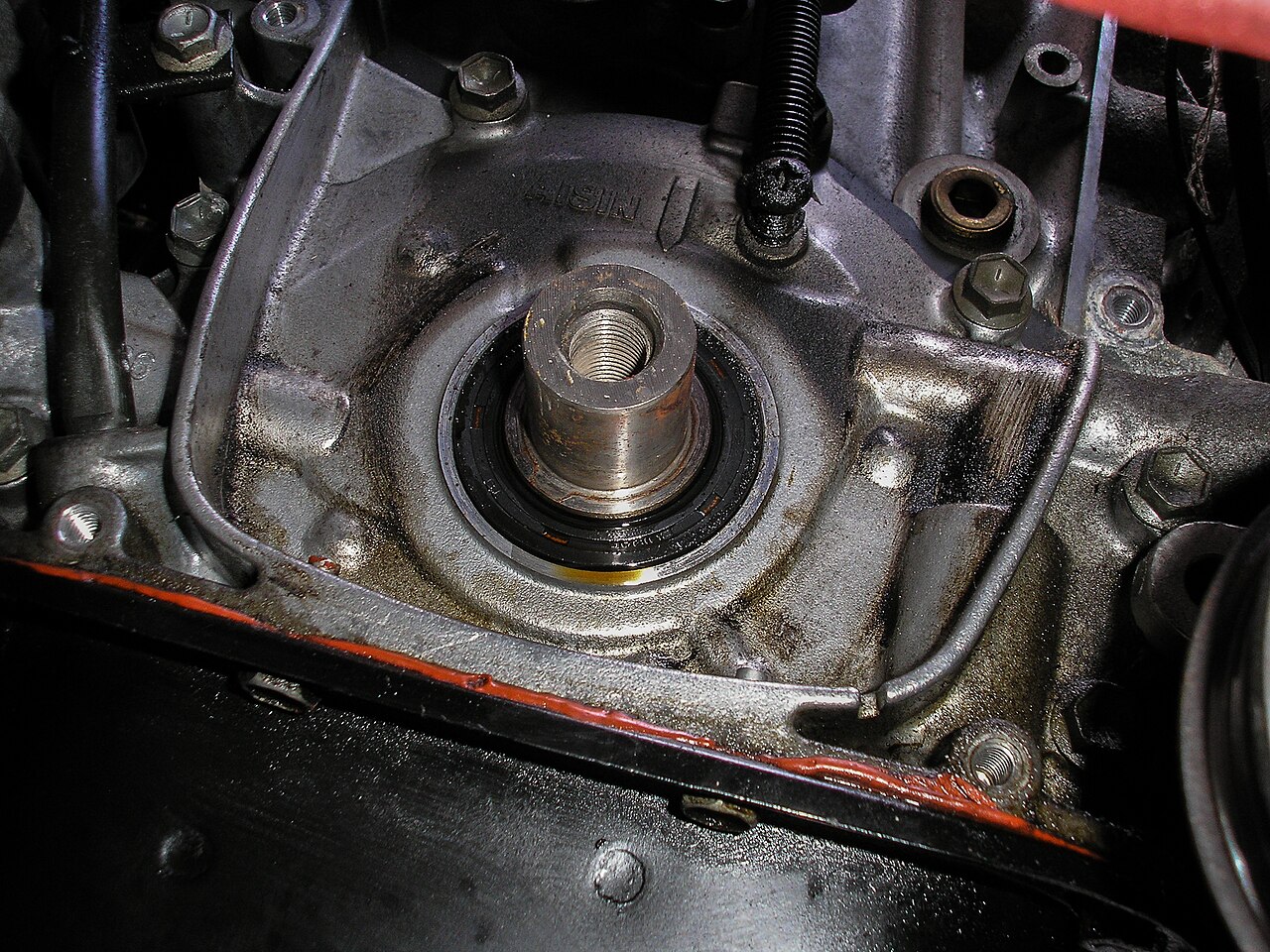
A parts counter receives a photo from a customer: a worn seal pulled from a gearbox, the rubber outer diameter scuffed, and the printed text on the face only partly legible, showing SKF HMS5 shaft seal designation fragments and a size of 45×62×8. The customer needs a replacement today, the exact SKF part is not in the van stock, and a CORTECO seal of the same size is sitting on the shelf. Whether that swap is a safe like-for-like exchange or a source of repeat leaks depends on understanding what the SKF letters actually describe. HMS5, HMSA10 and CRW1 are among the most common SKF radial shaft seal designs found in European industrial gearboxes, pumps and motors, and each corresponds to a recognisable construction under DIN 3760 and ISO 6194. This article decodes the three designations, maps them to the CORTECO profiles stocked by most distributors, and lists the details that must be checked before an equivalent goes into a machine.
How SKF builds a radial seal designation
An SKF radial shaft seal designation normally reads in a fixed order: shaft diameter, bore diameter and width in millimetres, then the design code, then a material suffix. In a seal such as the SKF 30×52×8 CRW1 R, the first three numbers are d × D × b, CRW1 identifies the design and the final letter indicates the lip material, with R standing for nitrile rubber and V for fluoro rubber in the common industrial ranges. Additional letters may appear for compound variants, special springs or packaging, and these should be copied in full when ordering, because they sometimes change the material or temperature range. The design code is the important part for cross-referencing. It tells you whether the outside diameter is rubber covered or metal, whether there is a secondary dust lip, and which lip geometry is used. Once those three facts are known, finding a matching profile from another manufacturer becomes a structured exercise rather than guesswork based on a single catalogue picture.
HMS5 and HMSA10: rubber outside diameter seals
HMS5 is SKF’s general-purpose seal with a fully rubber-covered outside diameter, a single spring-loaded sealing lip and a metal insert moulded inside the rubber. The rubber OD gives good static sealing in the housing bore, tolerates higher bore roughness and thermal expansion of light alloy housings, and makes installation easier, which is why HMS5 is the default choice in many gearboxes and pumps. HMSA10 uses the same construction but adds an auxiliary dust lip on the air side, which keeps fine contamination away from the main lip in dusty or splash-prone environments. The SKF range on our shelves includes sizes such as the 110×130×13 HMS5 RG and the 105×130×12 HMSA10 RG, and the full selection is listed under SKF shaft oil seals. In DIN 3760 terms, HMS5 corresponds to type A and HMSA10 to type AS, which is the bridge to every other manufacturer’s catalogue.
CRW1: the metal-cased design with a wave lip
CRW1 belongs to SKF’s metal-cased family: the outside diameter is ground steel rather than rubber, and the seal relies on a precise interference fit in a well-machined housing bore. Metal-cased seals are stiffer, sit more squarely in the bore and are often preferred in steel or cast iron housings with good bore quality, in larger sizes, and where the seal must resist being pushed out by pressure pulses. The distinctive feature of CRW1 is the SKF Wave lip, whose contact line follows a sinusoidal path around the shaft instead of a straight circle. The wave pattern generates a hydrodynamic pumping effect that returns oil to the sealed side regardless of rotation direction, while spreading wear over a wider band of the shaft. CRWA1 adds a dust lip to the same design. Under DIN 3760, CRW1 maps to type B and CRWA1 to type BS. Our article on DIN 3760 types A, B and C explains these families in more detail.
Mapping the SKF designs to CORTECO profiles
CORTECO uses its own short profile codes, and once the DIN types are known the mapping is direct. A rubber-covered single-lip seal, type A, corresponds to the CORTECO BA profile, so an HMS5 is typically replaced by a BA seal of the same dimensions and lip material. The version with a dust lip, type AS, corresponds to BASL, which is the usual match for HMSA10. The metal-cased single-lip type B corresponds to CORTECO B1, and the metal-cased version with a dust lip, type BS, to B1SL, so CRW1 and CRWA1 find their counterparts there. The CORTECO shaft oil seals range covers thousands of sizes in these profiles, which is why a distributor can almost always find an equivalent for a common SKF size. Our guide to CORTECO oil seal codes decoded at the parts counter shows how the CORTECO article numbers and profile codes are structured on the label.
What an equivalent does not automatically copy
Matching dimensions and DIN type is necessary but not always sufficient. The lip material must be equivalent: a nitrile seal cannot replace a fluoro rubber seal in a gearbox running at 110 °C with synthetic oil, and the choice between NBR, HNBR and FKM is covered in our article on choosing the lip elastomer by temperature and oil. Lip geometry is the second difference. The SKF Wave lip on CRW1 is bidirectional, while a standard straight lip without hydrodynamic aids depends on a correct shaft finish and a modest speed to seal reliably, so on a fast, reversing shaft the replacement profile should be checked for an equivalent hydrodynamic feature. Pressure capability also varies: standard radial seals tolerate only a fraction of a bar, and a gearbox with a blocked breather will push out any seal regardless of brand. Finally, the outside diameter type should not change casually, since a metal OD in a light alloy housing can leak when the housing expands at temperature.
Practical checks at the parts counter
A short routine prevents most seal mismatches. First, read every character of the original designation, including the material suffix, and if the print is illegible, measure shaft, bore and width with callipers, remembering that the shaft diameter is the most reliable reference because the seal OD may be deformed. Second, identify the OD type and count the lips by looking at the cross-section, which tells you whether the DIN type is A, AS, B or BS. Third, ask about temperature, oil type, speed and any pressure in the housing, because these decide the elastomer and sometimes the profile. Fourth, check the shaft surface where the old lip ran: a groove deeper than a few hundredths of a millimetre will defeat any new seal, and a different installation depth or a speedi-sleeve type repair may be needed. Recording the original and the replacement designation together in the customer file means the next order for the same machine takes minutes rather than a new investigation.
HMS5, HMSA10 and CRW1 are not mysterious codes: they describe a rubber-covered single-lip seal, the same seal with a dust lip and a metal-cased seal with a wave lip, which correspond to DIN 3760 types A, AS and B and to CORTECO profiles BA, BASL and B1. With those correspondences in hand, a distributor can offer a sound equivalent from either SKF or CORTECO in most cases, as long as the lip material, the operating conditions and the shaft condition are checked as carefully as the dimensions. Where the original carries special features, such as the bidirectional Wave lip on a fast reversing shaft, a fluoro rubber compound for high temperatures or a pressure-resistant profile, staying with the same design family is the safer choice. Either way, the decision takes a few minutes of checking and saves the cost of a repeat leak. It also pays to keep a small cross-reference sheet at the counter listing the most frequently requested SKF sizes with their CORTECO equivalents and lip materials, so that routine cases are handled in seconds and unusual ones receive the attention they deserve. Updating that sheet after every unusual request keeps it accurate.
Need a CORTECO equivalent for an SKF seal, or the other way round? Send us the full designation or the d × D × b dimensions and the lip material: our team checks the type, material and availability for you. Book a free consultation.
Image credits: “Wellendichtring Suzuki G10A” by Thilo Parg (CC BY-SA 3.0), via Wikimedia Commons.