
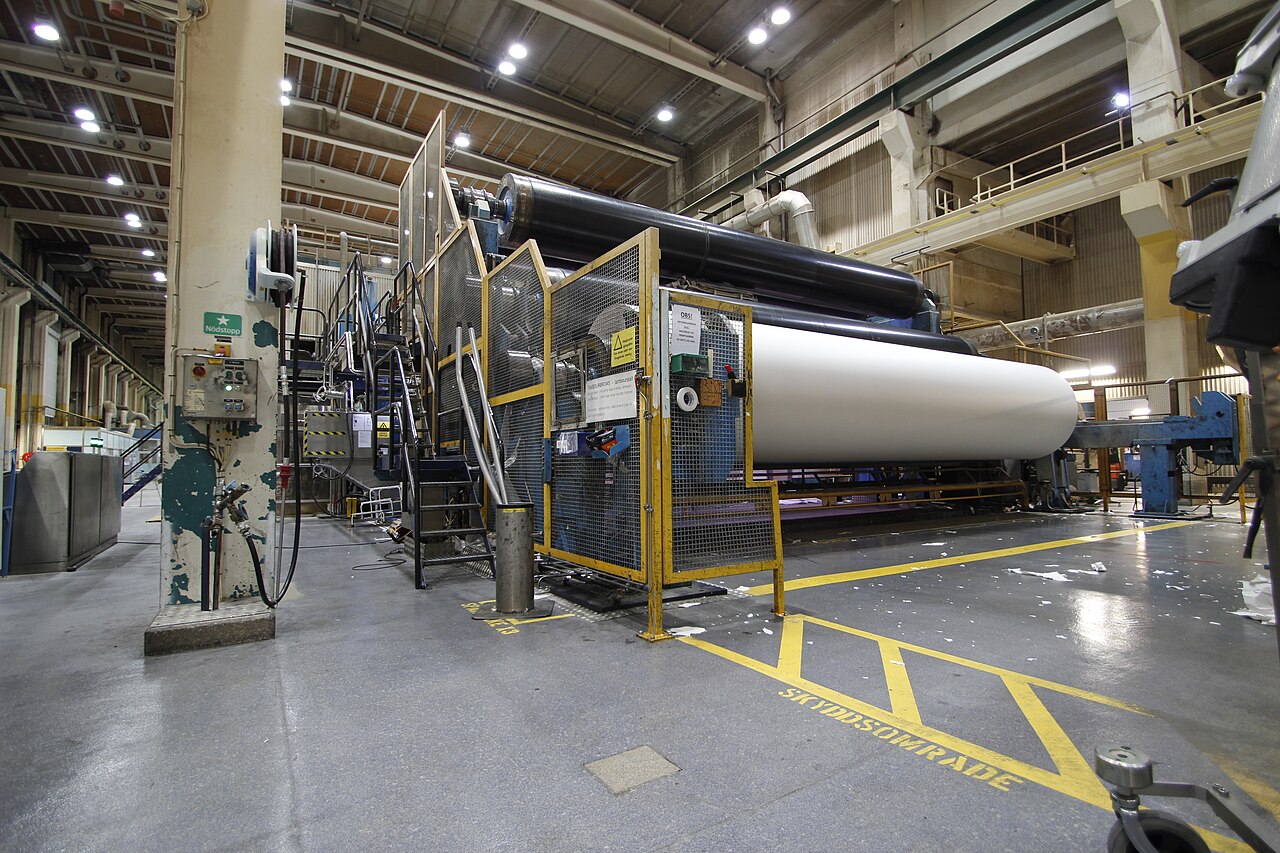
Walk along the dryer section of a paper machine during a shutdown and the heat is still radiating from the cylinders hours after the steam has been closed. Dozens of cast iron drums, each one fed with steam through a rotary joint in its journal, line up in rows with felts weaving between them, and every drum turns on two large bearings that live their entire life soaked in heat from the inside out. Paper machine dryer section bearings fail for reasons that rarely appear in a standard catalogue calculation: clearance that closes up as the journal warms, oil that oxidises in the return line, and cylinders that grow several millimetres longer between a cold start and full production. This guide looks at how heat travels into the bearing, why C4 internal clearance is the usual choice, how the locating and floating sides are arranged, and what a circulating oil system must achieve to keep the rollers apart from the raceways.
Where the heat comes from and where it goes
The steam inside a dryer cylinder typically sits well above 150 °C at full production, and it enters through a hollow journal that passes directly through the bore of the bearing. Heat therefore flows into the inner ring first, then through the rollers to the outer ring and finally into the housing, which is cooled by surrounding air and, more importantly, by the oil that circulates through it. The result is a persistent temperature gradient across the bearing: the inner ring can run 20 to 40 degrees hotter than the outer ring, and the bearing as a whole often operates between 100 and 130 °C. Many sites fit insulating sleeves or bores in the journal to limit the heat flow, which helps, but does not remove the gradient. Bearing steel itself tolerates these temperatures when it is dimensionally stabilised for them, so the real engineering problems are the change in internal clearance and the life of the lubricant, rather than the hardness of the rings.
Why C4 clearance is the starting point
Because the inner ring expands more than the outer ring, the radial internal clearance measured on the bench shrinks once the cylinder reaches temperature, and an interference fit on the journal removes another share before the machine even starts. A bearing ordered with normal clearance, or even C3, can end up with zero or negative operating clearance, which concentrates the load on fewer rollers, raises friction, pushes the temperature further up and accelerates the spiral towards failure. This is why dryer cylinders are traditionally equipped with spherical roller bearings in clearance class C4, such as the SKF 22220 E/C4 size used on smaller cylinders and much larger series on wide machines. C3 still has a place on cooler cylinders, felt rolls and guide rolls, but any change from C4 to C3 on a steam-heated position should be backed by a calculation. Our guide to choosing C3, C4 or CN internal clearance walks through that reasoning step by step.
Heat stabilisation and the fit on the journal
Clearance class is only half of the specification. Bearing rings that operate continuously above about 150 °C must be heat stabilised, otherwise the steel slowly changes dimension as retained austenite transforms, and the fit on the journal loosens or tightens over months. Manufacturers indicate the stabilisation level with suffixes or general catalogue statements, and a common convention is S1 for operation up to 200 °C, which covers most dryer applications. The fit itself is usually achieved on a tapered journal or with a withdrawal sleeve, because those methods allow the reduction in clearance during mounting to be measured with feeler gauges and controlled precisely, and they make removal much easier during a rebuild. The rotating inner ring needs an interference fit to avoid creep, but every extra hundredth of interference eats into the clearance that the heat will also consume, so the drive-up value must be taken from the bearing manufacturer, not improvised. Our article on shaft and housing fits for rotating ring load explains the underlying rule.
Locating and floating sides on a cylinder that grows
A dryer cylinder several metres wide can grow by around a centimetre in length between a cold start and full steam temperature, and the bearing arrangement must absorb that growth without loading the rollers axially. The usual solution is to locate one end, typically the drive side where the gear or coupling needs a fixed position, and let the other end float. On the floating side the outer ring can slide in a housing with a loose fit, which works but depends on the bore staying clean and round, or the bearing can be one that accepts axial displacement internally, such as a toroidal roller bearing, which keeps the outer ring clamped and avoids fretting in the housing. Whatever the choice, the floating side needs enough axial room in the housing for the full expansion plus a margin, and that room must be checked after any housing replacement. The same locating and non-locating logic is covered for general machinery in our article on split plummer block housings.
What the circulating oil system has to achieve
Grease simply cannot survive the temperatures of a dryer section for long, so most cylinders are lubricated by a central circulating oil system that pumps filtered oil through each housing and returns it to a tank. The oil does three jobs at once: it forms the lubricating film, it carries heat away from the bearing, and it flushes out wear particles and moisture. Viscosity is usually chosen around ISO VG 150 to 220 so that the oil still provides an adequate film at an operating temperature that may reach 100 °C or more, and the flow rate is set per housing so that the outlet temperature stays within a defined band. Oils for this duty are formulated with high oxidation stability and good water separation, because steam leaks and humid air will always find their way in. Filtration to a fine level, regular water content checks and a sight glass on every return line are the cheapest insurance a mill can buy. For general principles, see our notes on high-temperature lubrication practice.
Reading the warning signs before a cylinder stops
Dryer bearings rarely fail without warning, but the warnings are easy to dismiss because the whole section runs hot. A gradual rise in oil return temperature on one position compared with its neighbours is often the first indicator of reduced clearance or an oil flow problem, and a blocked orifice can starve a housing for weeks before vibration shows anything. Darkening oil, a burnt smell at the return line or a rising acid number in oil analysis point to oxidation that will soon leave varnish on the raceways. Vibration routes collected with the machine at full speed reveal outer race defects and, on the floating side, the stick-slip pattern of a housing that no longer allows free axial movement. During shutdowns it is worth measuring the radial clearance of any bearing that has been running hot, because a value close to the lower limit of the class is a sign that the fit, the stabilisation or the lubrication needs attention before the next production campaign.
Bearings in a paper machine dryer section are a good example of a component whose specification is dictated by its environment rather than by load alone. C4 clearance, heat-stabilised rings, a controlled fit on the journal, a floating side that really floats and a circulating oil system that keeps temperature and contamination in check work together, and weakening any one of them shortens the life of the others. When replacements are ordered, the designation should be compared suffix by suffix with the original, including clearance and stabilisation, and any substitution between brands such as SKF and FAG should be checked against the operating temperature, not only the dimensions. Mills that keep a simple record of oil outlet temperature, clearance measurements and failure causes for each cylinder quickly learn which positions need an upgrade and which simply need better oil management. Where budgets allow, pairing that record with periodic oil analysis and a thermographic survey of the housings during production gives an early, inexpensive view of which cylinders are drifting away from normal behaviour.
Planning a dryer section rebuild or chasing short bearing life on steam-heated cylinders? Our team helps compare clearance classes, heat stabilisation and housing arrangements before you commit to a full set of replacements. Book a free consultation.
Image credits: “PM-52 Dryer section” by Work With Sounds (CC BY-SA 4.0), via Wikimedia Commons.