
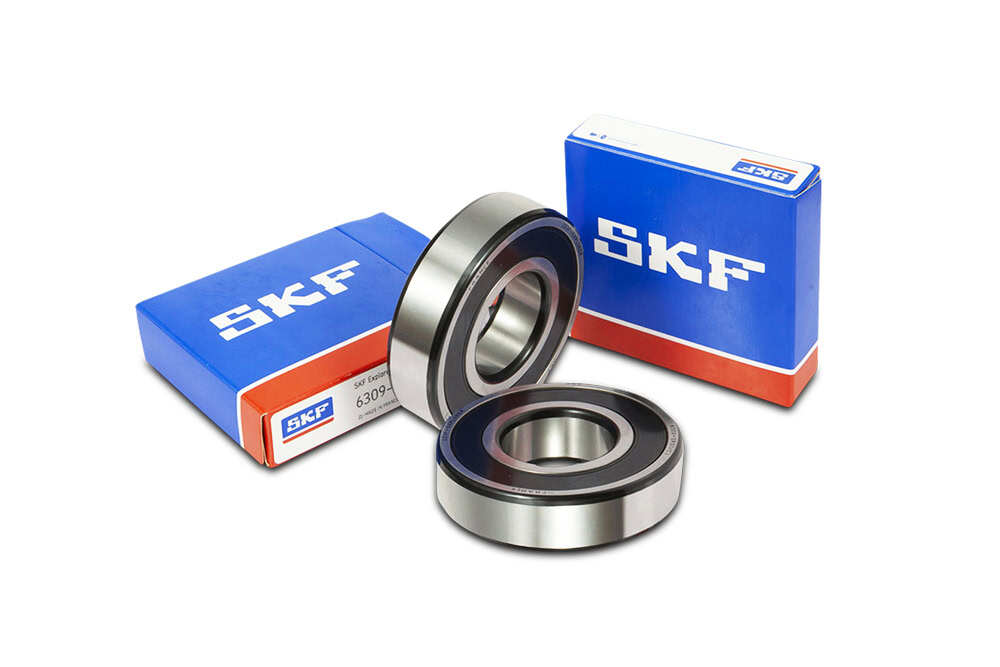
In the power transmission and rotating components sector, protection against contaminants is essential to ensure the operational longevity and efficiency of rolling bearings. SKF, a leading company in motion solutions design, has developed various sealing types to protect its bearings from external elements that could compromise their functionality.
Two of the most common solutions are 2RS1 and 2RSH seals, both designed to provide protection on both sides of the bearing (hence the “2” designation). However, these seals have significant differences in design, performance, and ideal applications, which we will explore in this article.
1. The Importance of Seals in SKF Bearings
Ball bearings operate in often critical environmental conditions where dust, moisture, chemicals, and other contaminants can accelerate wear and reduce operational life. To protect bearings and ensure their proper functioning, SKF uses nitrile rubber (NBR) seals reinforced with a steel ring, which improves mechanical resistance and component protection.
Adopting an efficient seal provides:
- Extended bearing life, thanks to protection against dirt and moisture.
- Reduced maintenance needs, lowering costs and machine downtime.
- Improved energy efficiency, preventing excessive friction caused by internal contamination.
The 2RS1 and 2RSH seals are two of the most widely used options for excellent protection in industrial applications, but they have key differences that influence their selection.
2. Features of 2RS1 Seals
The 2RS1 designation identifies a nitrile rubber (NBR) seal reinforced with an internal metal plate. This design provides an effective barrier against external contaminants, making it suitable for environments with high exposure to dust, moisture, and industrial residues.
Main Features of 2RS1:
- Material: Nitrile rubber (NBR) with a metal insert for greater mechanical resistance.
- Structure: The sealing lip is in contact with the inner ring of the bearing for effective protection.
- Protection: Excellent resistance to dust, moisture, and fine particles.
- Friction: Higher compared to non-contact seals, leading to a slight increase in operating temperature at high speeds.
- Typical Applications: Industrial sectors with contaminated environments or risk of liquid infiltration, such as electric motors, agricultural machinery, and mechanical transmissions.
3. Features of 2RSH Seals
The 2RSH designation represents an optimized version of SKF’s sealing technology. This seal is designed to reduce friction while maintaining a high level of contamination protection.
Main Features of 2RSH:
- Material: Advanced formulation nitrile rubber (NBR) for enhanced resistance.
- Structure: Sealing lip with an optimized profile to reduce friction and improve energy efficiency.
- Protection: Improved compared to 2RS1, with greater ability to prevent impurity ingress.
- Friction: Reduced compared to the 2RS1 version, allowing for more efficient operation at high speeds.
- Typical Applications: Systems where reducing friction is essential to improve energy efficiency, such as high-speed machinery and precision application bearings.
4. Performance Comparison
| Feature | 2RS1 | 2RSH |
|---|---|---|
| Material | NBR rubber with metal insert | Advanced NBR rubber |
| Contaminant Resistance | High | Very High |
| Friction | Medium-High | Medium-Low |
| Durability at High Speeds | Lower | Higher |
| Energy Efficiency | Medium | High |
| Recommended Applications | High exposure to contaminants | High-speed applications with low friction requirements |
As shown in the table, the 2RS1 seal is better suited for contaminated environments, while the 2RSH provides superior performance at high speeds and lower friction.
5. Final Considerations
The choice between 2RS1 and 2RSH depends on the operating conditions of the bearing and the application priorities:
- If the primary objective is maximum protection against dust and moisture, the 2RS1 is the ideal choice.
- If a solution with lower friction and greater energy efficiency is needed, the 2RSH is the best option.
Both solutions provide effective protection, but with advancements in materials and design, the 2RSH stands out as the more advanced solution for modern industrial needs.
To achieve the best performance from your system, it is essential to carefully assess operating conditions and select the most suitable bearing for your needs.
Related Reading
- How to Inspect a Bearing After 24 Months of Service
- Strategies to Extend the Lifespan of Power Transmission Belts in 2026
- AB-TOOLS Hand Tools for the Maintenance Technician
- Spherical Roller Bearings: Heavy-Load Applications Explained
- Angular Contact Bearings: When and Why to Use Them in 2026
Need help with bearing selection?
Our Euro Bearing technical team helps engineers and maintenance managers choose the right bearing, seal or linear component for each application — from automotive transmissions to agricultural machinery and industrial robotics. Tell us your operating conditions (load, speed, temperature, environment) and we will recommend the optimal solution from our catalogue of premium European bearings.
Contact our technical office → or browse the full product range.
Why the Seal Suffix Matters More Than People Think
Two bearings can share the same bore, outer diameter, width and load rating, and behave completely differently in service — because the two letters at the end of the designation describe the component that decides how long the lubricant survives and how much dirt gets in. In a great many industrial failures, the bearing did not fail: the seal did, and the bearing simply followed. Understanding the difference between 2RS1 and 2RSH is therefore not pedantry; it is one of the more consequential specification decisions available to a maintenance engineer.
Reading the Designation
The logic of the suffix is simple once you know it. The leading digit tells you how many sides are sealed: RS means one side, 2RS means both. The trailing character identifies the seal design and, indirectly, the material and the contact geometry. So a 6205-2RS1 is a deep groove ball bearing sealed on both sides with the RS1 seal, and a 6205-2RSH is the same bearing with the RSH seal.
It is worth placing the sealed variants in context against the shielded ones. A Z / 2Z shield is a pressed steel disc that does not touch the inner ring: it runs with essentially zero added friction and no wear, but it only keeps out coarse particles and does nothing against moisture. A contact seal touches the inner ring and genuinely excludes dirt and water — at the cost of friction, heat and a lower permissible speed. Everything else is a variation on that trade-off.
RS1 and RSH Side by Side
RS1 is the long-established general-purpose contact seal: a nitrile rubber (NBR) lip bonded to a sheet-steel reinforcement, contacting a recess in the inner ring. It is robust, well proven across decades of industrial service, tolerant of a wide range of conditions, and available across an enormous portion of the deep groove ball bearing range. Its sealing performance is good and its friction moderate.
RSH is the more recent design, also NBR with a steel reinforcement, but with a refined lip geometry and contact pressure. The design intent is to reduce seal friction — and therefore heat generation and frictional torque — while maintaining, and in several respects improving, the exclusion of contaminants. In practice this means a bearing that runs slightly cooler and can be taken to a somewhat higher speed than the equivalent RS1, with lower frictional losses.
Neither seal changes the bearing’s load ratings, and both are compatible with the standard grease fills. The choice between them is a choice about friction, speed and the specific contamination challenge.
How to Choose in Practice
- Speed is the first filter. Any contact seal reduces the permissible speed relative to an open or shielded bearing. Where the application is fast, RSH generally offers more headroom than RS1 — and if the speed requirement is very high, the correct answer may be a shielded (2Z) bearing with an external seal doing the real work.
- Energy and heat. Where a large population of small motors or pumps runs continuously, the lower seal friction of RSH compounds into a measurable reduction in energy consumption and operating temperature. In a bearing that already runs warm, this matters: see our guide to bearing overheating.
- Contamination severity. For fine dust, splashing water or washdown environments, a contact seal is mandatory. For genuinely aggressive environments — high-pressure washdown, slurry, abrasive dust — no integral seal is sufficient on its own; you need an external sealing arrangement in the housing as well.
- Availability and cross-reference. RS1 remains the broader range across sizes and series; RSH is concentrated in the sizes where the friction benefit pays. If you are standardising a spares list, check availability in the exact sizes you consume before you commit.
- Temperature and chemistry. Both are NBR, with a practical continuous range of roughly −40 °C to +100 °C and poor resistance to some chemicals. Where the environment is hotter or chemically aggressive, a fluoroelastomer (FKM/Viton) seal — the VM designation family — is the correct choice. Our overview of sealing ring and oil seal materials sets out the elastomer selection logic in full.
Sealed-for-Life Does Not Mean Maintenance-Free Forever
A 2RS1 or 2RSH bearing is filled with grease at the factory and cannot be relubricated. Its service life is therefore bounded by the life of that grease fill — which, as explained in our guide to grease lubrication, roughly halves for every 15 °C above 70 °C. A sealed bearing running hot is consuming its only lubricant charge at several times the design rate, and no amount of external attention will replace it. This is precisely why the lower friction of the RSH seal has a compounding benefit: less friction means less heat, which means longer grease life, which means longer bearing life.
It also means that condition monitoring matters more, not less, on sealed bearings: there is no purged grease to inspect and no relubrication opportunity to catch the problem. Temperature and vibration trending, as described in our article on preventive inspections, is the only early warning you will get, and the failure signatures are those catalogued in identifying bearing damage.
Key Takeaways
- 2RS = contact seals on both sides; the trailing letter identifies the seal design.
- RS1 is the proven general-purpose contact seal with the broadest size range.
- RSH offers lower seal friction, less heat and higher speed capability with comparable contaminant exclusion.
- Both are NBR: for high temperature or chemical exposure, move to an FKM (Viton) seal.
- Sealed bearings live and die by their single grease fill — keep them cool and trend their condition.
Need help with bearing selection? Our team supports you with cross-references and lead-times. Contact our specialists →